Thursday, February 24, 2005

High-Blood Pressure

Stop me before I kill myself. Despite taking blood-pressure medication, I ate two incredibly-salty "Big Grab" bags of Fritos just ten minutes ago, and now I read this:
Despite advisories to take it easy on sodium, Americans are now consuming about 4,000 milligrams a day -- nearly double the recommended limit to keep blood pressure under control, the Center for Science in the Public Interest (CSPI) said.

So the CSPI renewed a lawsuit first filed in 1983 to ask federal courts to force the Food and Drug Administration to declare sodium a food additive instead of categorizing it as "generally recognized as safe." This would give the agency the authority to set limits for salt in foods.

"There is no way the FDA can look at the science and say with a straight face that salt is 'generally recognized as safe,"' CSPI executive director Michael Jacobson said in a statement.

"In fact, salt is generally recognized as unsafe, because it is a major cause of heart attacks and stroke. The federal government should require food manufacturers to gradually lower their sodium levels."
I was impressed, in 2002, when a French doctor who campaigned against adding salt to processed foods was accused of threatening national security (since food processing is an important French industry, anything that can remotely interfere with it can be construed as a crime against the state):

Scientist Pierre Meneton received a less-than pleased response from the French government when he filed a report on the delicate topic of salt. By attributing 75,000 heart attacks a year to excessive salt intake, and pointing out the French food industry’s opposition to limiting salt in their products, Meneton was added to the swelling ranks of names listed as a threat to national security.His membership to the club came complete with surveillance by secret service agents of him, his family, friends and colleagues, as well as phone taps and interception of cell calls. A leaked governmental memo ordering the surveillance was published in an issue of Le Point magazine.
Salt may be the perfect weapon of mass destruction. Everywhere where there's food, you can find the white crystals!

So what to do know, post-binge? Purge? Nah, the stuff is soluble: I wouldn't get but a fraction of it. I know! Lots and lots of diet cola! Purge electrolytes with fluids (and let's not mention the caffeine, phosphoric acid, and the mysterious phenylalanine)!
Albuquerque's Response to "The Gates"

Courtesy of Julia, from West Virginia, who apparently passed through our mutual hometown recently. Do I sense a food theme in public art?


(photo credit is apparently Jaelyn DeMaria Leary at the Albuquerque Journal, but I have no link: the cheeseballs who run the Journal have such a high opinion of their Web Site that it requires $60/year just to gain the privilege of looking at it.)
Christo: The Gates, Central Park, New York

"The Crackers," courtesy of Deborah, and a chain of E-Mail forwards, ultimately from a recent visitor to New York City. More on Christo's work.

F-Bomb Reverberations

After Cheney went nuclear last year, there was bound to be fallout: among Colorado legislators.
Bloggers and Rappers

Rappers and bloggers love the same things: strip clubs, Bentleys, and especially, all the eye-popping bling-bling! As bloggers and rappers both know, it's all about the Benjamins, baby!
An Embarrassment

If this actually is how Condi Rice spoke to the Europeans, it indicates her complete intellectual bankruptcy, her descent into pure, servile hackery, a feminine 'Dean Rusk' of the Bush administration:
Secretary of State Condoleezza Rice, seeking to impress French intellectuals in her meeting with them in Paris, referred to Iran as "totalitarian," as if the authoritarian Shiite theocratic regime neatly fits the model of the Soviet Union. With this rhetorical legerdemain, she extended to Persia the already overstretched analogy of the "war on terrorism" as the equivalent of the Cold War. But her juggling of labels left her interlocutors dismayed by her lack of intellectual adeptness. One of the French told me Rice was "deaf to all argument" and spoke in a "Soviet style," but that no one engaged her gaffe because "good manners are back."
You Won't Be 'Endorphin' For Long!

We had our final dress rehearsal for "Annie" tonight. Things worked well, although the pace suffered a bit in the Christmas mansion scene. As FDR, I need to work on my look a bit: I'm a dead-ringer not for FDR, but rather for one of his presidential predecessors, Woodrow Wilson. Maria banged her finger, Amanda banged her eyebrow, and Kaylynn's dress fragmented at an inconvenient time, but we soldiered on. At least Mike Jones succeeded tonight with his 'Daddy Warbucks' skull cap!

This show can serve to educate the young girls. Last night, youngest Orphan (about age 7) Leona Craig asked: "What's 'The Depression'?" I would have explained it to her, but we were too busy recreating a theatrical version of the Depression to afford to stop to explain it!

It's an outrage that, at the direction of the City of Davis, we had to remove every bit of our materials from the Varsity Theater, in order to make room for a sorority talent show tomorrow night. We'll have to move everything back in there on Friday. Very disruptive, and it would not have happened if the City had been more careful regarding scheduling.

Every arts group I've ever worked with has had a rocky relationship with its facilities provider: the facilities user and the facilities provider have inherently different, clashing interests. In the DMTC New Theater, there will be a better, unified approach!

Wednesday, February 23, 2005

"Annie" Tech Week (2)

The effort continues. Last night, I worked with a FDR cigarette holder for the first time. The gold cigarette holder had a nice flat tip to fit in-between the teeth, but the longer black one looked better. Unfortunately, the black cigarette holder had a round cross-section, so it didn't fit so well in-between the teeth. It's too long too: I turned my head in the Cabinet scene, and jammed the cigarette tip into Diane Hoel's blouse. I apologized, fumbled with the damned pointy thing, and in the darkness of the Varsity Theater, I could hear an amused Michael McElroy laughing!
Expelling Immigrants

This story reminds me of a summer afternoon, in 1988. I was sitting in an Indian restaurant in Phoenix, when a big fat man in a cheap suit entered the restaurant. Surprisingly, the first thing he did was to grab a bearded man who was serving water to the customers, yell at him, shove him into a corner, and only then flash a badge. Fatso was apparently making an arrest. The poor immigrant was clearly in deep trouble. The immigrant was hauled away, and we were left, waterless and angry, to carefully consider the merits and difficulties of U.S. immigration policy.
Jeff Gannon

Likely a Rove plant:
Additionally, Guckert attended the invitation-only White House press Christmas parties in 2003 and 2004, and last holiday season, in a personal posting on GOPUSA, Eberle thanked Karl Rove for his "assistance, guidance, and friendship."

Tuesday, February 22, 2005

A Dust-Covered Sea of Ice?

On Mars? Maybe! People have wondered whether there might be such a landscape there, especially in the north, where it's unusually flat, but this is the first I've heard about any such landscape near the equator:
"It's been predicted for a long time that you should find water close to the surface of Mars near the equator," Jan-Peter Muller, from University College London, UK, said.
Really? I disagree: I thought there was an irreversible process on Mars whereby equatorial water was being slowly cold-trapped at the poles, leaving the equator dessicated. To be generous, it sure looks like there are dusty ice-shelf cracks there in the image, but perhaps there are alternate explanations: maybe surface appearances deceive and the ice is long-gone, or maybe these are volcanic mesas largely buried in sand. But who knows, right? Let's check it out!


3D images of pack ice near the Martian equator have been taken by the High Resolution Stereo Camera on board the Mars Express probe. The detected ground features are reminiscent of fractured ice floes on Earth. (Image: Esa/DLR/Berlin/Neukum, downloaded from BBC.)
Strange Weather

As strange as the weather is here in California, with Los Angeles making an earnest effort to get the rainiest season ever, there is strange weather elsewhere as well. I'm struck at how robust the polar easterlies are forecast to be over northern Canada, such that lows heading east out of North America instead pivot around the high over eastern Canada, and plunge westwards across Baffin Island and northern Hudson Bay. The Icelandic high is heading south next week, and a series of California-like cutoff lows will be crossing the Mediterranean as well.

According to this morning's Sacramento Bee, a tornado touched down north or NE of Dunnigan, in Daron's neighborhood. I wonder if there was any damage out there?
Non, Cher

You should know better, Miss Hollywood-Wannabe from the 60's, than to comment on Britney and J. Lo!
Some Meteorologist I Am!

Computers are a blessing and a curse. I noticed the lights flicker this afternoon here at work, so I saved my spreadsheet, but I didn't bother to look out the window (what modern meteorologist looks out the window anyway?), and so I missed all the excitement! A tornado! In the Sacramento area! As the National Weather Service stated:
STRONG CONVECTION DEVELOPED OVER SAC AND NRN SAN JOAQUIN VLYS THIS AFTERNOON ALONG SURFACE OCCLUDED FRONT. VORT LOBE THAT WAS NEAR 33N/125W ROTATED INLAND AND DESTABILIZED LAPSE RATES. WITHIN THE CLUSTER OF STORMS AROUND THE CITY OF SAC...SEVERAL OF THE STORMS EXHIBITED ROTATION WITH SEVERAL FUNNEL CLOUD REPORTS...AND REPORTS OF TORNADO TOUCHDOWNS NEAR/VICINITY OF DOWNTOWN SAC. THIS CLUSTER OF STORMS MOVED OFF TO THE NW PER THE MID LEVEL FLOW AROUND THE UPPER LOW OFF THE COAST...WITH A COUPLE OF THE STORMS EXHIBITING ROTATION AT TIMES NW OF SAC TOWARDS DUNNIGAN.
At Last, Greenhouse Gas Sense!

Paradoxically, it's always easier to reduce greenhouse gas emissions, through conservation and efficiency improvements, than to go through the rigamarole of calculating greenhouse gas emissions and thereby try to get some ostentatious public recognition of one's supposed good intentions and good works. This is true even though the calculations for CO2 emissions, for example, are simpler than for typical criteria air pollutant emissions.

Only the utilities seem very interested in the California Climate Action Registry, created two years ago by the state legislature, but that's because they fear regulation and need that crucial public recognition of their efforts. The City of Sacramento doesn't have the luxury of plunging into the numbers, though, as Joel Levin, the Registry's vice president of business development explains:
Levin said power suppliers are especially interested in grappling with their emissions voluntarily, fearing that if they don't, government mandates will follow.

"For a city that's completely strapped, they see this (registry) as more of an environmental reputation thing," Levin said. "They don't have the fear of God they'll be regulated."
As I've stated before, for green house gas reductions, I fear regulation will never work. Instead, the slogan for dealing with greenhouse gas emission reductions should be the one Nike uses: "Just Do It!" And cities all over the state are coming to the same conclusion. Hooray for common sense!

Monday, February 21, 2005

"Annie" Tech Week

We're sailing into Tech Week for "Annie" at DMTC. Things are basically under control, but since we have a scheduling conflict at the Varsity Theater for Thursday night, we don't get the benefit of a final, dress rehearsal. So, we've got to get it as right as we can for Tuesday and Wednesday night.

Tonight, Mike Jones tried on his Daddy Warbucks skull cap, to simulate baldness. Worked pretty well, but it peeled a bit after awhile, and his dome began to remind me of a shar pei puppy. I'm sure he'll get that nailed (or at least glued) down. If not, maybe he'll reconsider that Mohawk look he joked about last night.

Blundering a bit with the FDR wheelchair. Got hung up in the Christmas Tree tonight. Last night, collided with Daddy Warbuck's desk. For some reason (like slipping on a banana peel), it's funny (how easily the mighty fall!)

I'm trying to remain in character, even in blackouts, and not jump out of the wheelchair and run off in the dark, because the audience can see somewhat, even in blackouts. It's hard because Jan Isaacson insists they need help stage right, but I am determined not to break the character of FDR.

According to the script, towards the end of the Cabinet scene in Act II, Annie is supposed to quickly kiss my (FDR's) cheek before making her exit. In rehearsal, upon hearing there was a kiss, I quipped, "What, on the lips?" There was a moment of awkward tension: people laughed too hard. Meanwhile, Annie (Kaylynn Rothleder) looked aghast, like she had just swallowed 55 snails. Kaylynn was sick all last week, so now, when it's time for the sentimental buss, it's me who's aghast. Since we are both approaching each other like a form of toxic waste, the moment is likely to remain awkward, but fortunately it's not crucial how the moment is handled - a quick hug works fine.

Kaylynn sure sings great for someone who still is coughing. I wish I could sing healthy as well as she sings sick. The girls are doing great - it's a very strong corps of orphan girls. Chloe especially is doing great.

My inclination to forget names is scaring me, especially in "New Deal for Christmas," when I recite a list of Cabinet member names to music. My weakness, which really became a problem about ten years ago, might bite me at any time. Last night, for example, I got the City Tech's name wrong (James Henderson - I called him by his father's name, Mark), an error for which there is no excuse, since all three of us did "Guys and Dolls" together at the Woodland Opera House in 2001.

Well, we'll see what tomorrow brings. After all, it's only a day away!
It's Still There!

This fear-flogging article about hurricane forecasts (recommended by Drudge, of course) made me laugh my head off! Apparently the stealth factor regarding where North Atlantic hurricanes go is the Bermuda High Pressure System:
And, perhaps most worrisome for Florida, the Bermuda High still lurks in the western Atlantic.
Well, but of course, that's where it belongs. The Bermuda High is but one of several, semi-permanent sub-tropical highs girdling the globe, a surface expression of Hadley Cell circulation within the Earth's atmosphere. Being surprised at the existence of the Bermuda High is like being surprised at the existence of the Atlantic Ocean. You wake up every morning in Miami, look east, and say: "DAMN! That water is STILL there!"

But reading further, it's not so much the existence of the Bermuda High:

The high is somewhat mysterious, a clockwise-swirling ridge of high pressure that wobbles back and forth across the Atlantic, strengthening and weakening, in response to weather patterns over Iceland and the Azores islands near Portugal. Sometimes it's in the western Atlantic near Bermuda — hence the name.
but rather its location in the western Atlantic, that is the issue:
Guess what? The Bermuda High is still in roughly the same place, according to the National Weather Service.

If the high lingers there through the summer and fall, Florida could be nature's punching bag for yet another hurricane season.

Experts say it's too far soon to tell whether that dire scenario will occur. But it's not too soon to prepare for it.

"If in fact the subtropical (Bermuda) High is going to be more frequently positioned farther south and west like it was in 2004, then one clearly has to be concerned," said James Elsner, a Florida State University hurricane researcher.

Jim Lushine, a meteorologist for the weather service's Miami office, offered one hint to watch for: If May is unusually dry, as it was last year, that could be evidence that the high is still lingering — and an omen of bad things to come.

"I'm not saying we'll have four hurricanes in one year," he said. Then again, "I wouldn't be shocked if we had six."

Others cautioned that the high's behavior was just one of many weird occurrences in 2004, a year so off-the-wall bizarre that a hurricane hit Brazil — in March. (The storm, unofficially named Catarina, was the first hurricane in at least four decades in the South Atlantic.) The Earth's climate is so complex that scientists don't understand everything that goes into creating a vicious hurricane season.
I was really surprised that Brazil doesn't see more hurricanes in March (late summer), and I was surprised that everyone, especially the Brazilians, were surprised (guess the Earth is stranger than we think). But the Bermuda High has gotta be somewhere, and the western North Atlantic is just as good a place as any. But then the article goes off the deep end again:
Forecasters confess they don't have an easy way to gauge the high's behavior.

"We don't know why it's there or how long it's going to be there," Lushine said after the weather service issued a bulletin Feb. 2 blaming the strong Bermuda High for four months of record-dry weather in Palm Beach County. "It's not anything we keep track of."

Lushine added that the high has remained strong and stayed, on average, in the same general area since March. The weather service doesn't have detailed records on its location before then, he said. The high can shift dramatically from day to day, in response to cold fronts and other disturbances.

The high also can stick around the same neighborhood for thousands of years — with vast consequences for the hurricanes spinning toward Florida.

During a 2,800-year stretch ending around 1000 A.D., the Bermuda High seemed to linger near Haiti, said Kam-biu Liu, a geography professor at Louisiana State University who studies prehistoric sediments for clues about past climate conditions. That era was also a "hyperactive" period in which catastrophic hurricanes struck Florida and the Gulf Coast three to five times more often than today, Liu said.

During the past millennium, he said, Florida has enjoyed a quiet period — although that quiet included Andrew in '92 and the 1928 storm that killed more than 3,000 people near Belle Glade.

Here's the scary part: The Bermuda High could easily move back toward Haiti, giving Floridians another thousand or so years of blue tarps.

"We don't know how much longer this quiet period will last," Liu said. "That's the biggest lesson: We haven't seen anything yet."
Why would the Bermuda High find itself around Haiti? No reason for it to be there, as far as I can tell. But wondering about the climate was not the reason why the article was written. The real reason?

Be afraid! Be very afraid! Even now, the Bermuda High is wobbling between the Azores and Bermuda, like it has done since just about the dawn of time. BE AFRAID!

Sunday, February 20, 2005

Egregious Inhofe

The Senator from Oklahoma is apparently unimpressed by the State and Territorial Air Pollution Program Administrators/Association of Local Air Pollution Program Administrators (STAPPA/ALAPCO):

The Republican head of the Senate's environment committee directed two national organizations to turn over their financial records after they criticized President Bush's plan for cutting air pollution.

Sen. James Inhofe, R-Okla., also requested membership lists and tax returns in a letter to the groups' representative who told a Senate subcommittee last month that Bush's Clear Skies Initiative was too lenient and undermined state efforts to regulate emissions.

The organizations said the action was meant to intimidate opponents. The request appeared to be "some sort of retaliation against some very legitimate criticism of (Bush's) Clear Skies proposal," said William Becker, executive director of (STAPPA/ALAPCO). The two groups represent the views of state and local regulators before the Environmental Protection Agency and Congress.

Andrew Wheeler, majority staff director for the Senate Environment and Public Works Committee, defended the request. He said the panel had an oversight responsibility and wanted to determine if the organizations got funding from environmentalists and other outside interests.

"It has nothing to do with Clear Skies," Wheeler said. "If we wanted to intimidate them, we would have done it before they testified, not after." Becker said neither association receives money from private interests. "We have a limited constituency - the 50 states and local agencies," he said. "These are the only ones for whom we can work."

Inhofe must have a very primitive idea of who the various interested parties are in air pollution work. STAPPA/ALAPCO is in an in-between place, neither with the utilities (the good guys), or with the environmentalists (the bad guys), similar to how, with medical care, doctors are in an in-between place, neither with the drug companies (the good guys) or with the patients (the bad guys). Imagine, air pollution program administrators have two - TWO! - similar-sounding programs, working together. Are they good guys, or are they bad guys? Who can tell? Must be an enviro/communist plot of some sort! Demand to see their records (notice nobody else gets asked!)

What an ass Inhofe must be!
AM/PM Graveyard Gossip

The question the regulars are apparently asking is:
"So, who's the perv with the dog?"

Friday, February 18, 2005

Peretz Misses the Challenge

Martin Peretz at TNR misses the challenge of our times: the rise of fascism in the United States. Instead, he is focused on long-documented failings of liberalism, failings TNR has done much to reveal, to its great credit, such as the inadequacies of the U.N., e.g. with respect to the Balkans and Rwanda:
(The liberal) complaint is not a matter of circumstance. It is a permanent affliction of the liberal mind. It is not a symptom; it is a condition. And it is a condition related to the desperate hopes liberals have vested in the United Nations. That is their lodestone. But the lodestone does not perform. It is not a magnet for the good. It performs the magic of the wicked. It is corrupt, it is pompous, it is shackled to tyrants and cynics. It does not recognize a genocide when the genocide is seen and understood by all. Liberalism now needs to be liberated from many of its own illusions and delusions. Let's hope we still have the strength.
There is no point to beating up liberals, however. The new challenge is beating up on triumphal conservatives. People like George Bush or Richard Perle or Rush Limbaugh have the power to do far more damage than Jesse Jackson, or Al Sharpton, or Michael Moore ever could, even on their worst days. Despite the Fox-News glitz, most conservative ideas are no better than even the mustiest liberal ideas. If Peretz can't see that, then he's hopelessly out-of-touch with our times, and he should consider leaving TNR to someone who can.

What a waste! TNR is becoming irrelevant. That is unfortunate. I've been a subscriber for a quarter-century. It's my favorite magazine. Or, it once was my favorite magazine. It's quickly becoming a favorite of tiresome cranks, however, a den of obsessive self-hatred. Get a grip! Point your weapons at the enemy!
Journalists

When raw economic interests drive questions, rather than a search for the truth, journalists are bound to become an endangered species.
Patches the Horse

Life of the modern horse.
Grab That Third Rail, George!

Grab it good and hard!
President Bush's push to transform Social Security is in trouble, despite intense salesmanship designed to build support in Congress and with the public. Democrats are united against the president on the issue. A new national poll shows the idea is losing ground with taxpayers. Many Republicans in Congress remain hesitant to promote letting workers under 55 privately invest a portion of their Social Security payroll taxes.

And Thursday, Bush's political challenge became more daunting as one of his key constituencies — economic conservatives — fumed at his new willingness to consider a tax increase to pay for the changes.
On Public Education

I went to get a haircut yesterday, and explained to the hairdresser that my hair had to be quite short, as I will be playing FDR in "Annie," which opens next weekend at DMTC in Davis. She had never heard of Franklin Delano Roosevelt! I gave a thumbnail history of the Depression, and World War II, which she seemed to have heard of, at least a little bit. To be fair, she seemed to be an immigrant, but still!!!

On the Relative Merits of Various Extreme Sports

Skydiving is probably the best: no matter one's age or physical condition, it shouldn't be that hard to contrive to fall out of an airplane.

The New Cycle of Rain

After the Pineapple Express went through last week - at least, went through Arizona, anyway...

An aside:
The term "Pineapple Express" is often used in California to signify a long band of moisture featuring heavy rain originating around Hawaii. I use the term more loosely, to signify any long band of moisture, featuring heavy rain, originating from roughly the same latitude as Hawaii.
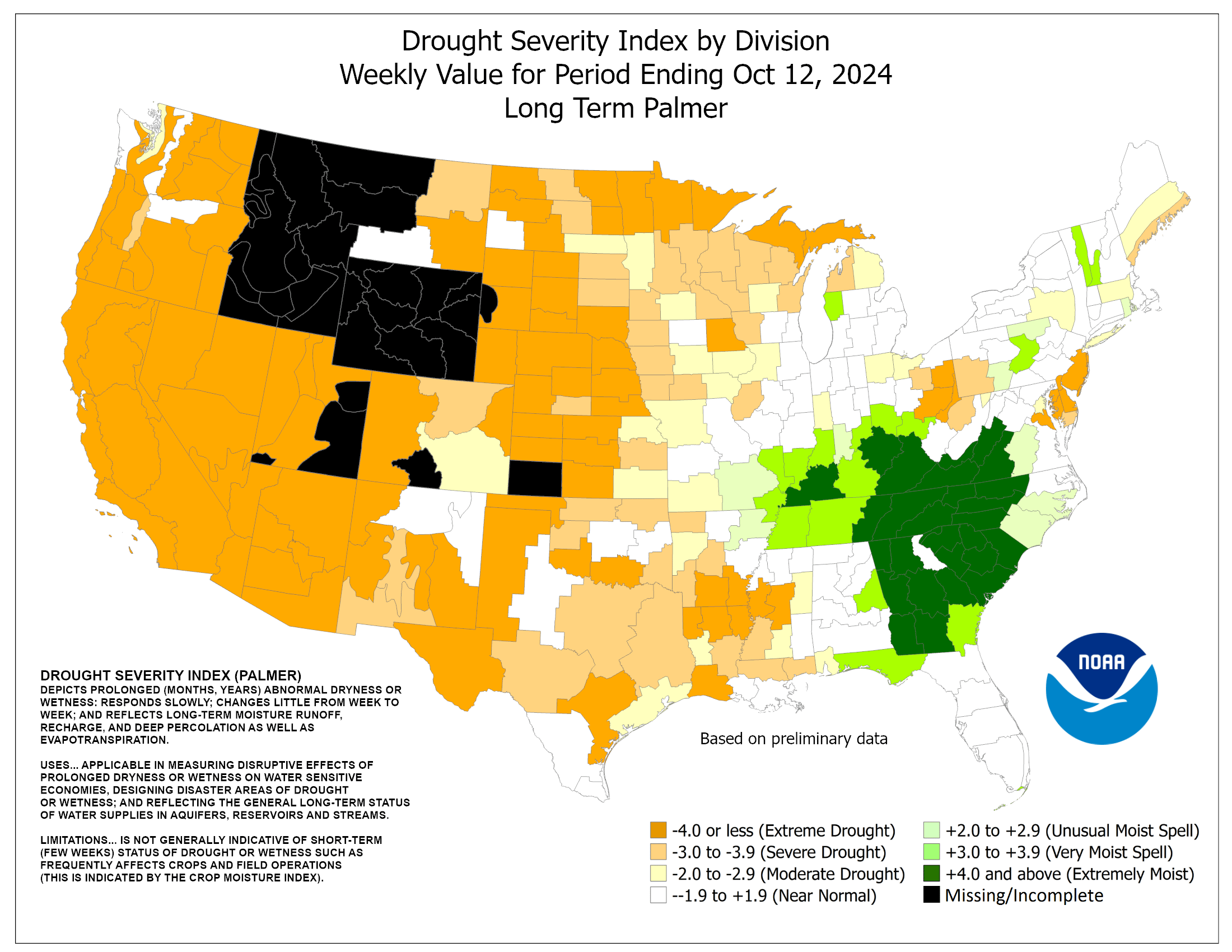
Anyway....after the Pineapple Express went through last week , a cutoff low established itself off the California coast, which is acting like a mechanical cog propelling a conveyor belt of moisture from the tropics. Over the next week, the cog (the low) will slowly move inland, offering new opportunities for rain for the entire SW. We are in a rain phase! Halleluljah! (Snowpacks south of 42 degrees latitude are above average: long-term Palmer drought severity index is in fairly good shape everywhere except Montana and Wyoming.)

Thursday, February 17, 2005

Run Silent, Run Smack Into Poorly-Charted Mountains

Mapmaking, chartmaking, and other geophysical surveying enterprises always seems to get the short end of the federal budget (the U.S. Geological Survey is a perennial target), but attention to detail can save a submarine full of problems down the road. Like on January 8th, when the nuclear-powered submarine San Francisco was travelling at high speed, 500 feet under the surface, heading towards shore leave in Brisbane, Australia, when it ran straight into a poorly-charted undersea mountain:
Military officials have said the mountain, which rises within 100 feet of the surface, was not on the navigation charts that the Navy uses. One sailor was killed and 60 were injured.... It's bow was severly damaged, and 23 sailors were hurt too badly to stand watch as the vessel limped back to Guam.

...The main chart on the submarine was prepared by another agency within the Defense Department in 1989. Officials at the charting office have said they never had the resources to use the huge volumes of satellite data to improve their charts.

...It is possible that the San Francisco could have detected the undersea mountain if it had used its active sonar system. But since early in the cold war, submarines have avoided using active sonar, which emits loud pings that can give away their location. Even on training missions, they practice operating silently and rely on passive sonar systems that can detect only ships and other objects making noise.
Chemistry Teacher

An electric detonator - that's the ticket! I wish I had had this guy for my chemistry teacher in high school: he knows his explosives! We could have used the help. The resourceful in our class (e.g., charismatic folks like J.H., who graduated early) made do with dangerous, impact-sensitive plastic explosives instead:
David Pieski, a teacher at Freedom (High School in Orlando, FL) for two years, used an overhead projector in class to give students detailed instructions in bomb-making, including advising them to use an electric detonator to stay clear from the blast, according to an arrest report.
Gannon's Access

Male prostitute Gannon had White House access without a background check and before being affiliated with even the phoniest press operation (Talon) at all! So, how does that happen without White House complicity?

Wednesday, February 16, 2005

Bush Looking Cornered

Despite his faux public-relations campaign, Bush is looking defensive, and he's beginning to stumble on Social Security:

President Bush says he has not ruled out raising taxes on those who earn more than $90,000 a year to help bolster Social Security's finances.

Under the current system, payroll taxes are paid only on the first $90,000 in wages. Bush has repeatedly said that he opposes raising taxes, but his advisers have been intentionally vague about whether he would also rule out subjecting a greater share of pay to the existing tax.

Asked directly, Bush said that he would not rule out raising that cap, though he does not want to see the payroll tax rate go up. The rate is now 12.4 percent of pay, split between workers and employers.

White House spokesman Trent Duffy said Bush will consider this option along with many others proposed. "Just because he said it was an option doesn't mean he embraced it," he added.

Bush has now hosted Social Security-focused forums in eight states since his Feb. 2 State of the Union address. The campaign-style event took him to the home turf of (New Hampshire) GOP Rep. Jeb Bradley, who said during his fist run for Congress in 2002 that "privatization is not the answer" to Social Security's problems.

Though Bush heaped praise on scores of local politicians, from the state's two Republican senators on down, he did not mention Bradley.

"You don't have to worry about your senators. They're people who understand we have got to address the problem," he said, conspicuously omitting Bradley.

But the White House has said the aim now is to sell Americans on the idea that there is an immediate problem, even though the system doesn't run out of money for decades, in hopes that they will put pressure on their representatives in Washington -- like Bradley -- to get behind the plan. Bush aides say the time for the legislative nitty-gritty of writing bills and negotiating with lawmakers will come after this intense public relations phase.

Bush wants to make certain that workers age 55 and over understand that their Social Security benefits will not change under his proposal for private accounts. Political advisers see that as crucial, especially to protect Republicans who fear that Democrats will use their tangling with the popular retirement benefit against them in the 2006 midterm elections.

The president portrayed his plan as both good for the Social Security system and as a crucial step in building ownership for more Americans. But he did not mention that investing in stocks and bonds means workers with private accounts risk seeing their assets shrink, nor did he talk about lower benefits or the enormous transition costs of the accounts, estimated in the trillions of dollars.

He did acknowledge that the private accounts "don't fix the system."

"Scoop" Jackson

Neocon archival shenanigans!
Ballet, the Kirov, and the Soviet Ballet Canon

How does the Western dance world reincorporate Soviet ballet, and vice versa? Jennifer Homans tackles the Soviet side of the tricky question, because of its urgency. So many of the best ballet dancers and choreographers alive worked under the Soviet system. St. Petersburg's Kirov Company, under director Makhar Vaziev, in particular, must decide how to proceed:
Should the company close the door on its Soviet past, re-open Peter the Great's "window on the West," and rush to "catch up" with Europe and America? Or is there something of value worth preserving from the ballet of Soviet times?

...In response to the upheavals of 1905, World War I, and the Russian Revolution, many of the dancers and choreographers trained under Petipa and his successors fled the country, taking their skills and knowledge to Europe and America. (They included Fokine, Nijinsky and his sister Bronislava, the impresario Diaghilev, and perhaps most importantly, Georgi Balanchivadze, or George Balanchine.) Those who remained in Russia were swept into heated debates about what constituted "socialist" forms of dance. Classical ballet was a natural target: at first Lenin saw it as a corrupt "landowners" art, but finally he conceded that it was the rightful heritage of the proletariat, and the former Maryinsky Theater became the self-appointed guardian of Petipa's legacy. Indeed, the company has often been seen as a haven that protected imperial classicism from the artistic degradations of Bolshevism.
It is not possible, or even desirable, to ignore the accomplishments of Soviet ballet, but the impulse to do so is strong:
In short, the Kirov is trying to give itself a new history--the history it might have had but for 1917. Vaziev and many of his ballet masters belong to the Yeltsin generation, and their disdain for the Soviet era is palpable, and understandable. They are too young to have seen original productions of Soviet works of the 1940s, 1950s, and 1960s, but they came of age when the Kirov was languishing and communism was crumbling.

...But this dismissal of Soviet aesthetics raises a serious problem. Ballet has no universally accepted standardized notation, and so the "text" of a dance exists in the minds and the bodies of those who perform it. ...The "classical tradition" is thus little more than a fragile chain of memories passed down from one generation to the next. Vaziev and his team are breaking the chain and removing many of the Soviet links, yet they depend on teachers and coaches whose careers were made in the 1950s, 1960s, and 1970s. And these Soviet veterans feel that it is the accomplishments of their era that are being lost and betrayed, with dire consequences for the future of Russian ballet.

...Many Kirov coaches complain that today's Russian dancers, by contrast, slavishly imitate the "mannerisms" of Western artists. And in their judgment the new "authentic" reconstructions of Petipa's classics that Vaziev has commissioned are "primitive," old-fashioned, and anachronistic. The problem, one senior coach confided, is that the new ballet masters hired by Vaziev are mere "children," "provincials who know nothing" and want to "explode" the Soviet heritage. This impulse, she argues, shows a depressing lack of historical reflection: "We have to keep those things which were achieved. It is like our great revolution of October 1917, in which we destroyed everything. We have to learn not to repeat this mistake."
Jennifer Homans observes:
There are many problems, but the company is striking out in bold directions, and it has a deep tradition to draw from. The danger lies in the desire to retreat into ersatz imperial grandeur, and the impulse to elevate cynicism about the Soviet past into an artistic creed. This would be unfortunate, for ballet is an idealistic art form, and one that depends--perhaps more than any other--on how its artists treat their history.
Evolution, not revolution, is the best approach. Reinterpret the Soviet dances, as the older Imperial dances have been reinterpreted in both East and West, but above all, keep dancing them. Work out a rapprochement with Western ballet. In a half-century or so, the two traditions will fuse into a workable new tradition. Remember, these "provincial" children aren't so bad either, and their instincts may be sound. Ballet is a living tradition: if you lose the children, you lose everything. Everything!
Don't Think....

Don't think of a gay conservative male prostitute sitting in the middle of the White House press room.

(Apologies to and inspiration from "Don't Think of an Elephant - Know Your Values and Frame the Debate," by George Lakoff; Foreword by Howard Dean; Introduction by Don Hazen).
The End is Near!

Nancy did some damage:
Nancy uprooted trees, damaged roofs and flooded coastal areas...
Nevertheless, Nancy is doomed! By Thursday night, or Friday morning (CA time), Cyclone Olaf will overtake Cyclone Nancy.

As Nancy M. here at work recognizes:
I've been busy, but I'm weakening...
Rio Tinto, No?

No wonder they call it Rio Tinto: it's so red! Best terrestrial analog to Martian chemistry!
Good for Woodland!

Looks like Woodland will join Sacramento Municipal Utility District (SMUD):
The Woodland City Council voted late Tuesday to become the first of four Yolo County areas to officially request joining the Sacramento Municipal Utility District.

The council voted 4-0 to accept the findings of a recent study that said residents in Woodland, Davis, West Sacramento and parts of unincorporated Yolo County probably would save money by joining the Sacramento electric utility. The council also approved formally asking SMUD to annex the areas in a resolution to be prepared by the cities and county.
Missed The Big Protest

But I support the Pearcys 100%!
Chanting, shouting and shaking tambourines, about 300 people divided themselves evenly Tuesday night across a tree-lined street in Land Park to volley their views on war and free speech.
More Tales of Sacramento At Night

You learn a lot loitering around an AM/PM convenience market in the early morning hours. The little flavored cigarillos called "Swishers" are very popular: everyone has to have at least just one. Who knew? Not tobacco-free me!

People get nighttime cravings. My favorite was the sleepy teenager who wakened his mother so they could drive down to the AM/PM for an early-morning snack. Given a selection of possible snacks, though, Sleepyhead couldn't decide, and ultimately earned a tongue-lashing from his inconvenienced and exasperated mother.

There are an awful lot of people lost in Sacramento. People trying to find the road to San Francisco or Roseville. People trying to find discontinuous streets, like 30th Street. People who don't know the difference between Interstate 80 and Highway 50, and thus hunt for the Norwood Exit miles away from its actual location.

My favorite lost soul was the fellow who had his address scrawled on a piece of paper. He had just moved to that location - in fact, had been there only once - and now he couldn't find his way back home. Poor guy. Looking at the map this morning, it appears he lives on a very minor discontinuous street far from the AM/PM, so it's no wonder he was having problems. Hope he made it home before sunrise!

Tuesday, February 15, 2005

Brigham Young Redux

Perhaps Margaret Spellings meant Mormons are "our" people, in which case everybody else is someone else's people.
Ms. Spellings said that Senator Orrin G. Hatch had invited her to Utah and she expressed eagerness to visit there. "These are Republicans," she said. "These are our people."
Upon first arriving in the Salt Lake Valley, Brigham Young proclaimed "This is the place." It seems only a short step to saying "These are our people." Next is "This is our quest," or "These are the times of our lives." The kind of portentous silliness that Masters of the Universe like to spew at the rabble, and that seems right at home in the Land of Zion.
Bush Administration vs. Tortured American Pilots

The asininity continues....
Oww!

South African sloop training for the America's Cup collides head on with a whale.
When Hurricanes Collide

Interesting situation in the Western Pacific, Southern Hemisphere. After wrecking American Samoa Cyclone Olaf is catching up to Cook-Islands-wrecking Cyclone Nancy. After swallowing Nancy, engorged Olaf will then get caught up in the Southern Hemisphere Pacific Westerlies, and make for stormy conditions mid-Pacific.

This is a far-grander replay of events in 1993, when Hurricane Hilary caught up to and devoured Tropical Storm Irwin off the Mexican coast.
Dark Physics Humor

From the Daily Rotten:
Feb 15 1988
Surely you're dead, Mr. Feynman.
Cockroach Caucus

On a blogger-crunching march, in Tulsa!

Monday, February 14, 2005

Stupid Media

Ripley, via Paperwight, regarding Jeff Gannon (aka J.D. Guckert) - the DC Press Corps sure look like the stupid complacent chumps the Bush Administration knows they are:
But despite the ultimate responsibility lying elsewhere, by not reporting on Gannon themselves, by not protesting loudly about his admittance to the club, the national media’s best and brightest were tacitly participating in a smack-down of their own credibility.
Single Women, Democrats, and Jabba the Hut

Loathsome gasbag Jabba the Hut (aka Rush Limbaugh) today picked this report in 'The Nation', that single women sided with the Democratic Party in the 2004 election, to mean that Democrats now oppose the marriage of single women, so as to retain electoral advantage. Limbaugh then proceeded to caricature single women as desperate and miserable. What an ass! If there's any bias in the Democratic Party, it's towards marriage - remember, Democratic Massachusetts has the lowest divorce rate of any state in the country.

There is only one major political party that wants to keep single women desperate and miserable and it ain't the Democrats!

Limbaugh also stated that Howard Dean's candidacy for chairman of the Democratic National Committee (DNC) was opposed by a majority of elected officials in the Democratic Party. There is an element of truth there - certainly some major, elected officials feared Dean - but the 447 Democratic operatives that compose the DNC thought differently:
A heretofore obscure entity, the Association of State Democratic Chairs (ASDC), a subgroup of the 447, moved aggressively to take the place of the bumbling Hill leadership and Democratic governors who found themselves unable to influence the process.
There is no reason why these people are any less able than elected officials to determine what is best for the party as a whole. Someone has to do some party-building, and Dean looks like a builder!
Why the Southern Agrarians Were Right About The War of Northern Aggression

The loss of community, the depersonalization, the anomie, the mountains of damaged mail:

Dear Postal Customer:

...We realize your mail is important to you and you have every right to expect it to be delivered intact and in good condition.

...When a Post Office handles in excess of 7 million pieces of mail daily, it is imperative that mechanical methods be used to maintain production and ensure prompt delivery of the mails. It is also a fact that modern production methods do not permit attention to individual pieces of mail.
It's Valentine's Day, Dammit: Stop Joking Around!

Do a Yahoo! search on "Lieberman could be on an administration list to replace Defense Secretary Donald Rumsfeld," and what you get is this:
Romance is in the air today across the land. But in Washington, the buzz continues about "The Kiss." No, not Gustav Klimt's famous painting. It's the big fat one an exuberant President Bush planted on Sen. Joseph I. Lieberman's right cheek as he waded through the Capitol crowd after the State of the Union a couple of weeks ago.
Schwarzenegger Kicks Sand in Face of 98-Pound Weakling State GOP

Interesting! Two years ago, Schwarzenegger couldn't win a fair Republican primary, and today he's completely locked out the intraparty competition! It's appropriate that Dora Kingsley resigned - that was the only honorable course!
Rube Goldberg

Overmatched by all the things that can go wrong, our supposedly almost "operational" missile defense system fails yet another test.

Sunday, February 13, 2005

Oh, Come Off It...

Howard Dean will be a fine DNC Chairman, but these cartoons seem to show the world is full of panicked "Fainting Violets."
Extremists on the March in Ohio

The proposed academic "Bill of Rights" in Ohio, a brainchild of David Horowitz, isn't about rights at all. It's about enforcing political conformity on professors. An academic setting is didactic in nature: the professors teach and the students learn. It is not a free speech forum, although the professor may lead students through a limited amount of open discussion:
The proposal ... would prohibit public and private college professors from presenting opinions as fact or penalizing students for expressing their views. Professors would not be allowed to introduce controversial material unrelated to the course.
Who decides what is "controversial material unrelated to the course?"

Some classes are necessarily political in nature: education and political opinion are deeply intertwined (example: classes in Middle East studies). Getting a balance there is difficult, and professors often fail. Employing "minders" in the student body or from the state legislature is the wrong way to go, however, since they have little or no committment to the body of learning, as teachers do. The faculty and the professors must have the freedom to get that balance right.
"It doesn't matter a professor's viewpoint," Horowitz said in an interview. "They can be a good professor, liberal or conservative, provided they pursue an educational mission and not a political agenda."
Who decides what a "political agenda" is? Does a political interest in "climate change" among climatologists, for example, constitute a "political agenda?" Where does the aggrandizement of the state legislature stop? Who said professors had to surrender their opinions to teach anyway? Why does America have to embrace fascism and tyranny in order to operate public or private colleges or universities? Is it a matter of "values," or is it really about enforcing political discipline? Remember, professors are generally not hired to teach "values," but rather bodies of knowledge and expertise. The idea is that students should become active adults who can decide for themselves, without minders, what public policies they wish to support:
[State Senator Larry] Mumper said he is concerned universities are not teaching the values held by taxpaying parents and students.

He questioned why lawmakers should approve funding for universities with "professors who would send some students out in the world to vote against the very public policy that their parents have elected us for."
It Never Rains in Southern Arizona (continued)

It's scary there when the waters rise - like wild beasts charging through peaceful river beds.
Right-Wing Thuggery

I was vastly annoyed to hear that the local protest in Land Park that featured a U.S. soldier hung in effigy (a story carried nationwide by Drudge) came to an end because trespassers stole the effigy. Supposed conservative respect for the law was shown to be a sham:
"I'm a huge military supporter, and I've got some good friends over in Iraq right now," said Mike Coates, 25, of Fair Oaks.

Coates heard about it on the radio and drove by Wednesday afternoon with a ladder in his pickup truck to take down the effigy. It was already gone.

The camouflage fatigues, noose and U.S. flag that was bundled as a head were partially ripped down by someone who fell off the facade of the house in doing so, according to neighbors. The rest was taken by someone on a motorcycle, they said.
Fascistic tendencies of the neighbors also came into focus as well:
Neighbor Marque Cohen, however, has made repeated calls to police and city officials to get the Pearcys' protests removed.

"I'm outraged," he said. "The First Amendment is fine, but I think it's definitely being abused. The forefathers wouldn't have agreed to this type of thing. This is more like malice."
Respectful disapproval was nevertheless also heard from another neighbor:
"I don't necessarily agree with everything (Pearcy) puts up there, but it's his right," she said.
I say, a person's house is their castle, and they have the widest possible latitude on deciding whether or what political protest they want to display on their own property, without interference from disapproving ruffians or neighbors. That is what being an American citizen is all about! Freedom of expression! And where better to express yourself than from your own property?

When Bush supporters in my neighborhood of Curtis Park wrote into the local paper, "The Sierra Viewpoint" four months ago and asked their pro-Kerry neighbors (such as myself) not to rip up their Bush lawn signs, we complied. It was the right thing to do. So where's the fair play?
Heartwarming Story

The brain-damaged woman who began speaking again after 20 years.

Saturday, February 12, 2005

Overheard Today at Home Depot

As a group of ladies entered the behemoth store:
Now, remember everyone: focus!
From a talkative 3 or 4-year-old girl, who was speaking to her father about a bag of fertilizer he was contemplating buying:
Are there mice in that bag? I'm not afraid of mice. I'm only afraid of evil mice!
I wonder if she had seen "The Nutcracker?"
Coming To Terms With Free Trade

Walt, John, and myself, good college friends with different outlooks, continue our discussion regarding free trade:

Walt

My understanding of John's position is:

  • problem: declining U.S. manufacturing ability since 1970;
  • cause or aggravating factor: the trade deficit;
  • remediation plan: protection of U.S. industry with a 3-tier tariff schedule.

I see things very differently. I don’t believe that the U.S. has lost manufacturing ability, or jobs, since 1970. I’m not an economist, but I do have a 2005 World Almanac. I looked up the following statistics for the U.S. GNP since 1960:

[GNP (E12 current dollars); GNP (1967 dollars); per capita GNP (1967 dollars)]:

1960: (0.53, 0.60, $3400);
1970: (1.04, 0.90, $4400);
1980: (2.8, 1.1, $4900);
1990: (5.8, 1.5, $6000);
2000: (9.9, 1.9, $6800).

It looks like the wealth created in the U.S. since 1960 has more than tripled, from $0.6 trillion in 1960, to $1.9 trillion in 2000, adjusted for inflation (1967 dollars). Furthermore, although U.S. population increased during that time, the per capita GNP still doubled, in inflation-adjusted dollars. I interpret this to mean that we have added a great deal of manufacturing ability since 1960, and that there is twice as much wealth per person in 2000, compared to 1960, as well.

Is this increase in wealth merely a fictional “paper” increase, or perhaps held by only a few fatcats? No, it is not. Some comparisons between the 1987 and 2005 World Almanacs:

Automobiles: (1987 - 130 million; 2005 - 220 million);
Televisions per capita: (1987 - 0.14; 2005 - 0.84);
Phones: (1987 - 134 million; 2005 - 182 million);
Internet lines: (1987 - less than 1 million; 2005 - 159 million).

What about unemployment? Has the U.S. been losing jobs, as a percent of the labor force? No:

1960: 5.5%;
1970: 4.9%;
1980: 7.1%;
1990: 5.6%;
2000: 4.0%.

I do not see any worsening trend. However, the data are somewhat misleading; they might suggest a nearly constant number of jobs available when comparing 1960 (5.5%) to 1990 (5.6%). However, that is not the case. These numbers represent unemployment not as a percentage of the total population, but rather as a percentage of the workforce. In 1960, most women were out of the workforce; but in 1990, most women were in it. So there is significant job growth between 1960 and 1990, which cannot be seen from the unemployment table alone. Finally, a look at life expectancy: (1960 - 70 years; 2000 - 77 years).

To sum up, when looking at statistics from the World Almanac, I can’t find any evidence for declining manufacturing ability, standard of living, or job loss. On the contrary, all categories seem to be getting consistently better. Furthermore, my personal anecdotal observations are consistent with the statistical data.

Of course some individual towns, and employment in some individual industries, have declined over this period. Some of those declines, for example mining, are partly or mostly due to competition from overseas. Others are due to increased productivity. An example there is agriculture. At one time, more than half of Americans were on the farm; now it is less than 3%. Are we in a starvation crisis? Not at all – production efficiency has gotten so good that 3% of the people can supply all our food needs. The important thing from a national perspective is not the employment level or financial health of any one industry, but the economy as a whole. I see nothing to be alarmed about, as far as ability to produce wealth is concerned. So your basic premise, that we are losing manufacturing ability, is not correct, as far as I can tell from statistics and my own experience.

But are trade deficits a bad thing anyway? I don’t believe so. One thing to remember, which you know, is that “deficit spending” and “trade deficit” are two different things, with nothing important in common. Deficit spending is borrowing, a trade deficit is buying. Borrowing money is not necessarily bad, but it obligates one to a financial responsibility which can last a long time. Buying is not bad at all, if one has the money to pay.

The national trade deficit is the sum of all the individual trade deficits of American citizens. My wife and I have been running a trade deficit with Bi-Lo supermarket ever since we got married. Currently it is close to $4000 per year, with a twelve year total of $50,000! There is no prospect of reducing this trade deficit in the foreseeable future. I’m beginning to suspect that no matter how long I live, I will die with a net trade deficit with Bi-Lo. Is this bad? No, because my economic well being does not depend on a balance of trade with Bi-Lo. Furthermore, I do not borrow from them. I earn, from an outside source, much more money than I ever spend at Bi-Lo. Finally, if my outside income declines in the future, I will be able to reduce spending at Bi-Lo, if I choose: much of what I buy is elective, and not strictly necessary. Yes, I know that Bi-Lo is an American company, but the principle is the same. If it was a foreign company, nothing about my personal situation would be different. By the way, I have a significant trade deficit with Honda, too, and likewise I don’t expect it to send me to the poorhouse.

I’m sure you see the analogy here. America’s economic well being does not depend on a balanced trade sheet, as long as we earn an independent income from an independent source, which is larger than the trade deficit (T.D.) Our GNP is a whole lot bigger than our trade deficit. According to my almanac, the 2003 T.D. was 4.8% of the GNP. That’s analogous to me spending $4.80 at Bi-Lo for every $100 I earn. Another way to look at it is: in 2003, we earned 20 times more than we sent overseas. Next year, we’ll earn again 20 times more wealth than we’ll send to other countries. We make money a whole lot faster than we send it abroad. And remember, the trade deficit is NOT an accumulating debt – it is not a debt at all. Adding it up to get a big cumulative number, and a corresponding sense of impending doom, does not make sense, as far as I can tell.

Also, I do not worry much about China or some other country buying all our power plants (or whatever) with their U.S. dollars, and then turning them all off at once. If we don’t want to sell, we won’t. If we’re tricked into selling, we’ll freeze their U.S. assets, take over the power plants, and turn them back on.

Maybe I’m missing something important here. If I am, I’ll feel like a fool, but I’ll thank you for setting me straight. If you do, please explain it with my Bi-Lo trade deficit analogy, so I’ll understand it better. Also, note that the U.S. ran a nearly continuous trade deficit from 1790-1875. Why don’t the history books talk about that being a big disaster?

Your proposed 3-tier tariff structure interested me, because here you shifted part of your objective from preserving U.S. industrial capacity and jobs to putting pressure on other countries to change their social priorities.

If the objective of a tariff is to reduce imports, and thereby preserve(noncompetitive) American jobs, and also reduce cash flow out of the US, then the most effective tariffs will be those imposed on the nations with whom we have the worst trade balances. Those nations are China, Japan, and Canada, in that order. However, you propose the highest tariffs on goods from China, Vietnam, and Bangladesh. Although China is certainly a major source of imports, Vietnam and Bangladesh are absolutely trivial contributors to the trade deficit, or to U.S. job loss. Neither one even made the Almanac’s trade balance table. On the other hand, you nominate Canada and Japan for no tariffs at all! This suggests that here, you see tariffs more as an instrument of foreign policy, and less as a shield for U.S. industries. Your motive may be only partly to reduce imports, but more centrally to exert pressure on nations whose labor & social practices are different from ours.

So how do I feel about this? I’ve got mixed feelings. In principle, it is OK to use coercion to change other nations’ behaviors. Diplomacy is an accepted practice throughout the world, and diplomats have only two tools in their bag: the carrot, and the stick. Imposing tariffs to pressure nations into improving their environmental, labor, or intellectual property behaviors is perfectly OK with me. However, I am very much against using tariffs in order to restrain trade, or to keep uncompetitive or inefficient industries alive. That is planned obsolescence. If we rely on a tariff, which are a species of boycott, in order to keep our businesses going, one day we’ll wake up to find that nobody in the world wants to buy our products, because better and cheaper products will be made in every nation but ours. I also believe that imposing tariffs for these reasons is unethical. It is all right to shun people who won’t work, or who think society owes them a living, but it is wrong to do that to people who work hard and create something useful. Also: do we want the poor nations of the world to pull themselves out of poverty, or not? How will they ever succeed if the “upper class” conspires to refuse to buy their stuff?

Of course I’m perfectly aware that some of the reasons for the competitive edge overseas are fewer environmental regulations, fewer worker safety regulations, and lower wages. So it’s a grey area, kind of like everything else. Thus my mixed feelings.

I face layoffs myself. My company had 23,000 employees in 1992. Today there are 13,000, and the company plans to lay off 2,000 more over the next 18 months. I know all about layoffs.

Marc

Even though America is wealthier than it was 35 years ago, it doesn't mean manufacturing is healthier. Presumably, we could ship all of our manufacturing overseas, and all the specialized jobs that go with it, totally devastating manufacturing, if, in turn, investors overseas were happy investing their avalanche of dollars gained from exports in U.S. government securities and U.S. consumer debt. As long as the value of the dollar remained stable, the system would work.

In the Winter 2005 Wilson Quarterly, Robert Aliber has written a thought-provoking tract called: "The Dollar's Day of Reckoning." Aliber looks at the macroeconomics of America's rapidly-growing trade deficit, and he sees imminent troubles. The U.S. trade deficit is growing too large to be sustainable: our indebtedness to overseas investors is growing by 16% per year, whereas the GDP is growing only by 6% per year. Basically, we are borrowing more and more from overseas investors in order to make our interest payments to them - an unsustainable situation, in a household as well as in a nation. Some of the debt is government debt - the U.S. budget deficit, and some of the debt is consumer debt (e.g., home loans). A lot of the government debt we are racking up isn't a terribly efficient use of the money (security, army, etc.). I bet a lot of the consumer debt isn't that useful either. In any event, the value of the dollar is at risk.

Aliber sees a lot of similarities between the U.S. situation, and other unfortunate countries' situation (e.g., Argentina, Russia, Japan, Thailand, etc.) since 1970. According to Aliber:

Today, the U.S. saving rate remains low because of the continued displacement of American saving by foreign saving. But America's reliance on foreign saving is excessive: The nation's international indebtedness is increasing at much too rapid a rate. The inevitable adjustment will require that American's household saving rate increase as reliance on foreign saving declines. ... [The United States] is engaging in Ponzi finance, and the game will soon be up.

Manufacturing has much to recommend it. As Aliber notes, tradable goods (e.g., cars) are generally worth more than nontradable goods (e.g., expert shelving) in an economy. I tend to think in more moral terms: manufacturing requires more skills, and hence has a better impact on the citizenry, than most other forms of economic activities.

John

Walt's point that the U.S. economy has grown dramatically since 1960 is, of course, completely accurate, but I feel that the basic picture has begun to change over the last 25 years. Starting in the 1980's the U.S. moved from being the biggest creditor nation to being the biggest debtor nation. This is a very fundamental change which is at the core of my concerns. While in many ways the standard of living is better now it is hard to cite specific material indications to prove that that is absolutely the case. Cars, for example. In nearly every part of the country today an individual who does not own a car cannot take advantages of job opportunities and is often forced into isolation and poverty. A car now is pretty much essential. As to television, if ever there was an "opiate of the masses" television is it. The shallow infotainment which passes for television news has kept the American people in a fantasy world controlled by political forces which control those "news" broadcasts. Newspapers are in dire straits across the country because people do not choose to read hard news. It's easier to turn on the television and be offered platitudes of pets rescued from frozen ponds and celebrity scandals. And a few lines of actual news are thrown in just to make people think they are being informed.

The American work force greatly expanded, particularly after about 1970 when women began working outside the home in large numbers. That contributed to improving the standard of living for American families. Yet how common are one wage earner families with several children as was the standard in 1960? In most cases that is financially impossible. I'm not saying that our standard of living has declined--only that things are not as clear cut as at first glance.

Manufacturing employment in the U.S., according to the best information I've been able to find, has fallen from 25% of the work force in 1960 to around 10% now. Now obviously a good deal of that is a result of factors such as new technology and increased efficiency, but the majority of it is a result of manufacturing moving outside the country. Whole sectors of the U.S. manufacturing economy are now absent. Small commercial aircraft (with the exception of corporate jets) are gone, having been replaced by planes form Brazil, the E.E.C. and Japan. Commercial ship building is gone. North Carolina's economy is reeling from the demise of wood furniture manufacturing. Hand tools and, more importantly, machine tools are nearly gone. I note the latter one because it illustrates that we are no longer producing products but are not even building the machinery to build them.

In your Bi-Lo analogy I see some basic differences with international trade. The Bi-Lo is a local business providing jobs and taxes for the local economy. To the extent that a local Hyundai dealership does the same the analogy works. But Bi-Lo gets most of its products--with the exception of coffee, some ethnic foods and some produce--from domestic suppliers which are providing jobs for American workers, thus keeping money circulating in the U.S. economy. In the case of international trade that money leaves the U.S. and goes to build foreign economies which, to a point, is not bad. But again, it is the amount of the trade deficit which I find ominous. As Marc noted, a trade deficit which grows at a rate far exceeding the growth rate of the GDP is not sustainable.

As to concerns about U.S. security, my main concern is Chinese power in the Far East. An unprecedented influx of cash into a totalitarian regime is not reassuring, particularly one which, with other foreign nations, holds 40+% of the US national debt. China could easily refuse to buy U.S. Treasury bonds (there are already indications this may happen soon) and cause inflation in the U.S. on the magnitude of that we experienced during the Mideast oil cutoff during the 1970's. That is a risk we should never take, especially when the result would be an ever greater increase in the already ghastly national debt caused by increased interest rates.

A bit more about my thoughts on tariffs. Canada has no significant trade barriers to the importation of U.S. products. Japan, on the other hand, has enforced strong barriers to U.S. imports, which is why I qualified my proposed tiered tariff system to address that situation. Nations which impose such barriers should have equal barriers to their products imposed by the U.S. As to Vietnam and Bangladesh, I cited them only as examples. There are many other third world nations like them. They can produce goods by paying workers pennies per hour but a tariff on such goods would serve as a strong incentive for their governments and private industry to improve the standard of living for their people. It would be the proverbial win-win situation whereby the U.S. would gain much needed revenue from tariffs and the exporting countries would improve social conditions. The tariffs would not seriously affect the workers in those third world countries since their labor rates would still make their products attractive on the world market. The poverty and pollution in those countries impacts the U.S. and the rest of the world. Poverty and hopelessness are fertile substrates for social and political unrest and extremism. Further, air pollution from countries such as China is now degrading air quality in the U.S. By giving third world nations trade incentives to improve their standards of living the US would be acting in its own interests as well as those of those third world nations.

I too oppose using tariffs to protect inefficient or noncompetitive industries as long as we take into account the whole picture--which includes social conditions of third world manufacturing countries. It is morally and socially wrong to tell experienced American workers that they must compete with foreign work forces that can produce the same product in dangerous and poverty-stricken cities for a small fraction of the U.S. production cost. A tariff would serve to level the playing field somewhat. We need foreign trade but we also need to protect American workers and other national interests.

Marc

Free markets are only approximations, of course, and free trade is an ideal. There are always limitations. One significant limitation in the world economy, as trade barriers ease, is the relative immobility of labor. In comparison, capital moves around the world with great ease. The Chinese government (among many others) is taking advantage of its large, impoverished population to offer the business world low-cost labor: an advantage that has more to do with desperation than to inherent efficiency. Economies get skewed that way. Once China owns the majority of the world's factories and becomes wealthier, presumably their education level will rise higher, and the disparities will ease, but for now, in a world where labor is immobile, concentrated in Asia, and desperate, and capital can move quickly, we are far from a global free trade universe.

As beneficial as free trade can be, national economies can sometimes improve through tarriffs and other barriers to trade (particularly if they are debtors). One example is Argentina: when that nation defaulted on its international debt in 2000, and refused to adhere to World Bank demands to reduce its budget deficit, its future looked bleak: the imminent decline of trade promised to be calamitous to national wealth. Significant restrictions on capital flight, however, plus its goverment's refusal to sacrifice its local economy in order to pay its debts, have helped the Argentina's outlook: still bad, but no longer as dire. A better example is the U.S. in the 19th Century, which used high tarriffs to shield its developing economy from British manufactures. Creditors benefit most from free trade: now that the U.S. is a debtor again (since 1980), we should revisit the question of tarriffs. Multi-national corporations (that usually benefit most from free trade) have a lot of influence in the U.S. government, but they could very well be opposed to America's real economic interests.

In other words, the best approach depends on circumstances, and a single-minded reliance on free trade will not be sufficient to protect people's interests. 'Free Trade' might prosper, but the U.S. might suffer. The pie might get bigger, but your slice might get smaller. We have less to benefit from free trade than we did even ten years ago.

Friday, February 11, 2005

Arizona Storm

It's one strange storm that's eager to please. It's moving more slowly than I expected, and it seems to be bigger than I expected too.

The cutoff low that the GFS model said would help deliver a punch into the Sierras exists as predicted off the southern CA coast (I thought it would be so far south and west that it might become part of the tropical easterlies instead), and the low is deeper than I thought. One consequence is that it's overcast today here in Sacramento (I thought the storm would be too small and fast-moving to have a pronounced effect here).

But the storm wants to please the NOGAPS model too, so it sent a split punch up the Colorado River Valley (raining pretty heavily in Las Vegas) and sent at least two punches into Sonora, with maybe more coming. But does that mean not enough rain in the AZ deserts? No, the storm is lingering long enough to get them too. Can't forget the Kaibab Plateau! So, lots of precipitation up there too. Something for everyone!

Both computer models *worked*, after a fashion, but the jet stream must be a bit sluggish, because everything is so SLOW and BIG. There isn't a lot of meteorological information gathered from over the eastern Pacific so the models may have been initialized poorly (kinda-garbage-in, kinda-garbage-out). So, reality has more fine structure, and it's much more interesting, really, than the model predictions.
Eric the DJ

Work bid me to go to Hamburger Mary's for lunch today, and of all people, Eric the DJ (who was working at Subway a year ago) now works there. Good to see him!

Eric has a Drum 'N Bass radio show on Leetradio every Thursday from 6 to 8 p.m. Give it a listen!

Thursday, February 10, 2005

Jeff Gannon

Hoo boy! The Bush Administration has really stepped into it this time!
Montserrat Volcano Refugees

So even though their island was rendered almost uninhabitable by a volcano, the Department of Homeland Security insists the refugees have to return immediately? One fine idiot government we are blessed with these days!
Bumperstickers

Here are two nice ones I just saw:
Treehugging Dirt Worshipper
and:
Support Organic Farmers
These bumperstickers nicely describe my belief!

Now, as a Catholic, I'm sure Gabe would say that I'm merely filling the aching emptiness of my belief with various, pointless pagan bric-a-brac. Or is it the emptiness of my faith? Something's empty, right?

Now let's see if I remember, faith is an effort of the will, but belief is an effort of the intellect. That's right, isn't it Gabe? Now, are emotions part of the will or part of the intellect? Philosophy is a hard slog for my walnut-sized brain. I just get so, so... AGGGHHH!
Treehugging Dirt Worshipper

Wednesday, February 09, 2005

Phoenix Rain

Regarding the upcoming storm in AZ, the weather forecasts seem to be showing a rather diffuse hit on the state, with the main punch actually hitting Sonora. There is a secondary punch too: the NOGAPS model shows it travelling up the Colorado River Valley to the west of Phoenix, and the GFS model shows it even farther west, travelling into the southern Sierra Nevada. Both forecasts show most of AZ lying between the two punches, and thus missing the worst.

Looking at the current satellite pictures of the eastern Pacific, though, I'm not convinced there will be a split punch. In my opinion, the little eastern Pacific subtropical low they are relying on to split the punch is too far south and too far west to do the job. I'm thinking the storm will directly hit AZ, so rain will be plentiful over the whole state.

We'll see!
DMTC

Surprisingly, "Plan B" seems to be moving fastest among the financing options. The red-headed stepchild's rendezvous with Hooverville may be fairly brief....
Any Argument Will Do

Why don't the anti-global-warming folks have more credibility with their mainstream scientific opponents? Well, their exploitative tendency to grab any contrarian argument works against them. After a while, holding so many different, often-contradictory positions, they become blithering idiots:
...for some critics, any argument will do - regardless of its coherence with the argument they had before, or the one they will pick next.

Median vs. Average

Shouldn't these be called median temperatures, not average temperatures? And isn't the reason they do it this way is because otherwise they can't take advantage of all the Co-op weather stations worldwide that don't gather data on an hourly basis from which one could calculate an average temperature, but rather on a twice-daily basis? (Science news in the popular press is often badly corrupted).
Last year was the fourth warmest year on average for our planet since the late 1800s, according to NASA scientists.

To determine if the Earth is warming or cooling, scientists look at average temperatures. To get an "average" temperature, scientists take the warmest and the coolest temperatures in a day, and calculate the temperature that is exactly in the middle of those high and low values. This provides an average temperature for a day. These average temperatures are then calculated for spots all over the Earth, over an entire year.

Body Language

After any number of months, slowly coming to really like Kylie's "Body Language" album. Living in a universe of style, she's getting harder to "get" for an American who has little style and who would be happy with just danceable tunes. High concept Euro-Australo pop art is levitating higher all the time.
Ward Churchill

Fights back! Good for him!

There have been other victims of right-wing zeal. My Greek and Roman History Professor from undergraduate days, Richard Berthold of the University of New Mexico, Albuquerque, made insensitive remarks on Sept. 11th: “anyone who can bomb the Pentagon has my vote,” and was slow to apologize. Berthold subsequently was pilloried on local and national talk radio, faced a thug in his carport, and after a year was ultimately forced to resign. He was the canary in the coal mine. He was first, but many will follow.

Professors are not, and never have been, employees of any university - they are scholars, and they are given tenure by the university in anticipation that they can espouse political and social views, if they so wish, generally as they relate to the subject material of the class. I've taken classes from leftos and reactionaries both, and gotten useful ideas from them all, but the hallmark of the best is a fiery, fearless independence.

The ancient Greeks had an interesting custom: "ostrakos", or ostracism, whereby the community would exile an offensive person for a full year. But the person was free to rejoin the community after a year. The American Right recognizes no such civilized limitation on their power - they destroy the career, exile the teacher, and smash the school, with no limit on their arrogance.

Time to fight back. The Right won't stop until their own losses become unacceptable. Time to target right-wing professors making crude, insensitive comments, or flacking for big business (but nevertheless respecting those who hold unpopular opinions). Plenty of them out there! Fight fire with fire!

And speaking about protest, here is a local example, from Land Park, that is already having nationwide impact (via Drudge).
Sen. Mark Dayton

Doesn't want to run again (I wish he'd reconsider).
Meteorological Fraud at the WMO

Or, whatever happened to Mr. Hassan?
Lost Huygens Wind Data

Is partially recovered.....
Opportunity's Heat Shield

Sure left an impressive crater when it screamed to a halt last year on Mars!
Come On, Pay Up!

Britney's on the attack: her insurers don't want to pay for her knee injury last summer. It's a familiar story: a 'pre-existing condition' that she apparently 'forgot' to mention. Can't we just let that oversight slip past, like we let Dubya's WMD oversight slip past (a leader, by the way, whom she strongly supports, as we learned last year from Fahrenheit 9/11)?

From many quarters, I think I can hear the Britney snark starting up now......

Tuesday, February 08, 2005

Reid's Response

It's always hard to know how to respond to bullying. Daschle tried to ignore it, but ultimately it hurt him. Reid's approach hasn't been tried lately (strong, but not too strong), so let's give it a try - let's see if the White House backs off.
Just Too Precious

Tiny 'Orphan' Leona Craig, rocking out in grand, karaoke, Courtney-Love style, as Kaylynn Rothleder sang "Tomorrow," at "Annie" rehearsal, tonight.
Terpsichorean Curiosity

Why do fashion models walk that way?

But not every model takes walking lessons; some have a natural sense of presentation. "It depends on where the models are from," according to Andrew Weir, a New York casting director. "If they're from Brazil or South America, the walk is innate. The other girls have to watch the Brazilians for a season or two until they catch up."

There are a few walking styles. "If you say to the girls 'Do a Versace walk,' they know what that means—a va-va-voom, shake-it-like-you-might-break-it walk," says Weir. " 'Street' means no swish. It's strong, like the way people walk down a New York street." Most shows now use a near-natural street walk, described by Weir as "'Street' plus a little bit more." That means a pretty natural stride with no hands on hips or posing. But the walk is still slightly exaggerated: Some extra swagger makes skirts swish dramatically and gives tailored looks a bit of extra power.

Although people don't like to believe it, models are not big dieters. They are blessed with fast metabolisms.


We're Such a Great Country...

Cause we fight narcolepsy in the same, valiant way we fight terrorism (mostly unsuccessfully):
President Bush walked into an awkward unscripted moment in which he stated that carrying three jobs at a time is 'uniquely American.'

It Never Rains in Southern Arizona

Whassup Saguaro state?
Doug says there is a rumor of torrential rains here Thursday through Sunday--so, really? So much more snow got dumped last weekend, this is great. D.
Interesting...there is a "Pineapple Express" coming in your general direction, according to the FNMOC, starting Thursday evening, but the two computer models I generally look at are in disagreement. The GFS model shows a direct hit on AZ, but the NOGAPS model shows the direct hit being in Sonora, with plentiful rain in AZ, but probably little flooding (and also ending sooner, being mostly gone by Sunday).

All things being equal, NOGAPS is my model of choice, but I need to look harder before deciding (I'll decide on Monday for sure). I'll start updating you on the latest info....

Well, maybe there will be some flooding. With warm rain falling on snowpack at higher elevations, the streamflow might be considerable.

The term "Pineapple Express" is often used in California to signify a long band of moisture featuring heavy rain originating around Hawaii. I use the term more loosely, to signify any long band of moisture, featuring heavy rain, originating from the tropics, at roughly the same latitude as Hawaii. There is no reason, after all, why one can't have "Pineapple Expresses" all the way around the globe, in any semi-tropical to low-middle-latitude zone, in either hemisphere.

These kind of rains are what people tend to associate with El Nino: low overcast, warm, wet, persistent, and above all, focused, like a spear from the tropics, hitting rather small target areas at the point of the spear very hard. Sonora is at the point of this spear, and maybe AZ too, depending on the state of play of mid-latitude Rossby waves.

D. continues:
Is that = to Welcome? (pineapples were given to guests as 'welcome' in the South--which is why that theme is used a lot in furniture, wood moulding, etc.)
Well, if hurling with great force a prickly pineapple at startled guests qualifies as "welcome" in the South, then southern hospitality may be overrated.
It's presented in a basket, you goof, in their room. At the end of their stay or as a hint to move on they're given another.
Oh! Very genteel! And if they don't get the hint to move on, then and only then, do you pummel them with pineapples.
ABSOLUTELY!


"Martini Lounge" - Saguaro Martinis (you probably can't see the tiny saguaros in their glasses)
Idiot Spam

I get such weird spam:

Hello,
My name is Professor University Newsletter

Monday, February 07, 2005

Jonah Goldberg

Is a twit.
Those Who Don't Study History....

are doomed to repeat it.
President George W. Bush met with the Congressional Black Caucus Wednesday for the first time as a group in nearly four years, but what CBC members said stood out the most was the president's declaration that he was "unfamiliar" with the Voting Rights Act of 1965, one of the most significant pieces of legislation passed in the history of the United States.

At the conclusion of yesterday's 40-minute meeting, Bush ... was asked by Rep. Jesse Jackson Jr. (D-2nd) whether he would support the re-authorization of a portion of the Voting Rights Act that must be approved every 25 years (It will come up for consideration next year).

"I don't know anything about the 1965 Voting Rights Act," Jackson recalled the president saying in an interview with the Chicago Defender.....

"It was so unbelievable to me that as soon as I walked out, I got Frank (Watkins, Jackson's top legislative aide) on the telephone, put (Congresswomen) Maxine (Waters, D-Calif.) and Sheila Jackson Lee (D-Texas), so that I could confirm what he just said is what I heard," Jackson said. Rep. Bobby Rush (D-1st) said he recalled the president saying he was "unfamiliar" with the Voting Rights Act.

"I was surprised and astounded," Rush told the Defender....

The bill guaranteed that African Americans and any other group would not be denied the right to vote, and put in place provisions to ensure that voting rights would not be trampled on by local and state officials....

Rush said Wednesday's meeting was different from the others because he has had a fractious relationship with the CBC, and was dealing with "more knowledgeable people around the different issues that affect the African American community."

"In that room you had 43 individuals whose whole life of activity and endeavor have been around trying to upgrade and uplift the life of Black America," Rush said. "We are elected into the Congress and we know the ins and outs of it and we know the machinations that the administration and the Republicans engage in and so, yea, we weren't wild-eyed and in a state of ecstasy just to meet the president. We came to be about business."...

As for [Condoleeza] Rice, Rush said the new secretary of state said "absolutely nothing. She was just there. For what reason, I'm not sure."

Progressivity

No, you idiots, progressivity refers to the tax rate, not the tax burden. This event just signifies the rich are getting more and more of the nation's income (as well as holding most of its wealth). If only the rich earned income, then of course, the rich would pay 100% of the income tax, and there wouldn't be a darn thing progressive about it:
The White House budget director Josh Bolten on Monday bragged to reporters how the nation most-wealthy will see an increase in tax burden under Bush's new budget.
...without the president's tax cuts that top 5 percent would be paying about less than 52 percent of our total income tax revenue. "After the president's tax cut that group is paying more than 54 percent of our total tax revenue. So the notion that the president's tax cuts have somehow made the code less progressive is wrong. The president's tax cuts have made the tax code more progressive."

Dad Gum Gummint

It's just a short step from defaming the 'dad gum gummint' to defaming the Republicans who run it. And it's just a short step from praising private business to praising Social Security, because its administration is separate from the rest of the gummint. Time for short steps!
Terraforming Mars

Adding greenhouse gases might warm things up, but it takes more than warmth to make a place habitable. The greenhouse gases (CO2 as well) would have to be removed at some point and buried in some manner so people could breathe. Then the place would cool off again. Some progress!
Annie

It's fun being FDR! I'm a quasi-Santa, with my alphabet agencies, orphan reindeer, and Social Security program. Just wish I could walk (and sing and act and dance, but that's a long-running problem)!

Meeka turned 14 tonight: Rice Krispie treats for everyone, as approved by the WPA and Judge Brandeis.

Sunday, February 06, 2005

"National Review" Review of "Hotel Rwanda"

Gabe recommends the National Review's review of Hotel Rwanda:

Hibbs continues in my mind to review films rather well. I've always liked his thoughtfulness.
Hibbs makes a big mistake, though: a mistake that has the effect of letting conservatives off the hook. It wasn't a State Department spokeswoman whose taped statements were repeated exactly as stated, but rather the well-publicized words of the White House Press Secretary, Dee Dee Myers. Thus, the irony that Hibbs notes (the magazine cover showing Bill Clinton as 'Man of the Year') is even more pointed than he realizes.

Myers' evasive statements on genocide earned her well-deserved contempt. But the real problem wasn't just hers, or the State Department's, but rather Bill Clinton's, and America's conservatives'. The highest levels of the U.S. government averted their eyes, even as everyone else watched the unfolding horror. After Somalia, there was no consensus for an African military adventure, no matter how urgent the need. Republicans had no interest in such a thing, certainly, and they were lying in wait to shoot down any such effort. Fearing Republicans, the coward Clinton skipped past Rwanda, but he slowly developed some backbone: he eventually helped freeze the Bosnian crisis in place (the 1995 Dayton agreement), and finally budged on providing military assistance to Kosovo (1999), but only because he had been cornered by his own promises to do so. Clinton was such a coward in great measure because he was responding to the manifest distaste among American conservatives to doing anything effective about genocide.

Hibbs lets conservatives off way, way too easily - their crimes of omission, their isolationism, their small-mindedness. Instead, Hibbs aims at the hapless State Department. Such brave scapegoating!
Nice Place

Galt.