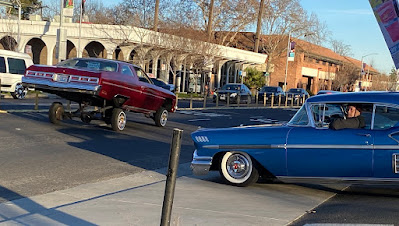


Jasper was impressed at the turnout.

On Monday, a U.S. district judge halted construction of two geothermal power plants on public land in Nevada. The decision was in response to a lawsuit filed in December by the Center for Biological Diversity, an environmental nonprofit, and the Fallon Paiute-Shoshone Tribe, against the Bureau of Land Management, or BLM, for approving the project.
Geothermal power plants pump hot water from deep underground and use it to generate steam to produce clean electricity. The Nevada plants are set to be built on a verdant wetland in the desert called Dixie Meadows. The suit alleges that the project threatens to dry up the hot springs that support the wetland and are of religious and cultural significance to the Fallon Paiute-Shoshone. The ecosystem is also home to the Dixie Valley toad, a species that is not known to exist anywhere else on Earth.
...Geothermal power plants currently produce a small fraction of U.S. electricity — only about 0.5 percent in 2020. But an analysis by the Department of Energy found that with improvements in technology, that number could go up to 8.5 percent by 2050. Geothermal power plants have several relative advantages, in addition to not directly producing any carbon emissions. They have a small physical footprint compared to wind and solar farms, and they can provide power 24/7. This kind of always-available, dispatchable source of electricity will be critical for grid reliability as intermittent sources of energy like wind and solar increase.
...The plaintiffs have reason to be skeptical. The geothermal company behind the Dixie Meadows project, Ormat Technologies, opened a geothermal power plant in 2011 about 40 miles away on another hot springs called Jersey Valley. The springs dried up entirely a few years after the plant began operating.
The lawsuit also asserts that the project violates the American Indian Religious Freedom Act. “Many of the other springs in the area have been damaged or ruined by development,” the lawsuit says. “Dixie Meadows Hot Springs is therefore the most important and sacred spring to the Tribe, and one of the very last remaining springs in the area.” Members of the Fallon Paiute-Shoshone Tribe use the site for “healing, soaking, camping, and harvesting native plants for weaving and other uses. These practices require quiet for contemplation, and darkness to see the night sky.”
A breeding colony of 60 million fish has been discovered in Antarctica's ice-covered Weddell Sea -- a unique and previously unknown ecosystem that covers an area the size of Malta.
...The vast colony, believed to be the world's largest, is home to the remarkable icefish (Neopagetopsis ionah), which has a see-through skull and transparent blood. Icefish are the only vertebrates to have no red blood cells.
To survive at such low temperatures, it has evolved an anti-freeze protein in its transparent blood that stops ice crystals from growing.
...The breeding colony was discovered in February 2021 by the German polar research vessel Polarstern, which was surveying the seabed about half a kilometer below the ship. It used a car-sized camera system attached to the stern of the ship that transmits pictures up to the deck as it's being towed.
..."We just saw fish nest after fish nest for the whole four hours, and during that time we covered maybe six kilometers (3.7 miles) of the sea floor," said Autun Purser, a postdoctoral reseacher at the Alfred Wegener Institute in Bremerhaven, Germany. He's the lead author of a study on the icefish colony that published in the journal Current Biology on Thursday.
...The colony covers more than 240 square kilometers (93 square miles), the researchers said. With, on average, one nest for every three square meters, they estimated that the colony includes about 60 million active nests.
..."Some animals like to be social, but there's a limit. Congregating may give them advantages for finding mates but provides a rich point source for predation."
The fish appear to be attracted by an area of warmer water, which is around 2 degrees Celsius warmer than the surrounding sea bed, which is a chilly 0 degrees Celsius, said Purser. (Sea water freezes at a lower temperature than fresh water.)
...The findings reveal a globally unique ecosystem, according to the researchers, and they say it should be designated a protected area. ...While the Weddell Sea is covered with sea ice all year round, the ice is relatively thin -- three feet thick -- meaning that photosynthesis can still take place and life can thrive. Purser said the Weddell Sea floor is far from barren, with sea sponges, corals, octopuses and star fish lurking along the seabed.
But early-20th-century archaeologists in mainland Greece thought that there might be some truth to the existence of lions in the region in ancient times. Why else would these creatures feature so prominently—and realistically—in art from the late Bronze Age, as well as in myths and actual reports by later scholars from the Classical period, such as Aristotle and Herodotus?
Though such theories were long dismissed by other researchers, in 1978, two prominent German zooarchaeologists made a startling discovery. During an excavation of Tiryns—the same city whose legendary king dared Hercules into action—they chanced upon a feline heel bone near a human skeleton. It was unmistakably from a lion, they concluded, and possibly of the same species that inhabits parts of the African continent today.
The bone was only the first of dozens to surface in Tiryns and elsewhere over the following decades. Though some details remain unclear, many archaeologists and historians now use this evidence to conclude that modern lions once lived alongside people in parts of what is today Europe, including Greece, for hundreds of years. Today lion bones offer a rare glimpse into the Bronze Age world and the fraught relationship that humans had with these fierce predators, animals that inspired legends and creative works for centuries.
“Now it’s possible to say that some [lion images] could have been recalled from real experiences on the [Greek] mainland,” says the art historian Nancy Thomas. The finds, she adds, cast “a whole different light on the art … and how hunting real lions could have played into the elite structure development that was going on in Greece at the time.”
...The fossil record suggests that modern Panthera leo populations were once widespread, stretching from parts of Africa through the Middle East to India. But the route these cats would have taken to reach Europe, whether across the mainland or crossing the Bosporus over an ancient land bridge, remains a mystery.
Scholars such as Bartosiewicz speculate that lions ventured around the Black Sea into Ukraine, then moved south to the Balkans. From there, some could have roamed farther south to Greece.
This corner of Diyala province, which stretches from the center of Iraq to the country’s east, was once famous for its pomegranates. Everywhere you drove, you’d encounter acres of trees laden with blood-red baubles. Yassin had three fields and a vineyard.
Not these days. Standing in one of his plots, Yassin pointed out a few desiccated-looking trees and the churned brown of recently tilled fields. Like other farmers in Diyala, he had given up. Over the last few months he cut down most of his pomegranate trees; he just finished plowing over his vineyard.
“If you saw this area 10 years before, I swear you would think you’re in Eden,” he said.
“But there’s just no water. We couldn’t do it anymore.”
Diyala is perhaps the starkest example of Iraq’s impending Great Thirst. The country — fed not by one but two mighty rivers, the Tigris and the Euphrates — is thought to be where humans first started cultivation: Mesopotamia, the land of plenty.
But another year of crippling drought and of competition with equally parched neighbors means there isn’t enough water to go around. Both Turkey and Iran have activated dams and tunnels to divert water from tributaries of the Tigris and Euphrates, leaving downstream Iraq — which relies on the two rivers’ largesse for 60% of its freshwater resources — with an acute shortage.
This year, inflows from Turkey fell by almost two-thirds; from Iran they’re about one-tenth of what they were, Mahdi Rashid Hamdani, Iraq’s minister of water resources, said in an interview.
In desperation, Baghdad has appealed to its neighbors to help mitigate the crisis. In October, the Water Ministry invoked an agreement with Ankara that’s supposed to ensure Turkey’s “fair and equitable” contributions to the Tigris and Euphrates. In Tehran, the appeal has been met with silence, Iraqi officials say.
“Iran hasn’t cooperated with us at all. It diverted rivers to areas inside the country and doesn’t work with us to share the damage from the drought,” Hamdani said, adding that his ministry has completed procedures for a lawsuit against Iran and asked the Iraqi Foreign Ministry to contact the International Court of Justice. A spokesman for the Foreign Ministry did not respond to questions on the matter.
The water scarcity is compounded by wider shifts in the environment. This year, temperatures in Iraq reached 125 degrees, and the country is experiencing 118-degree days more frequently and earlier in the year. Berkeley Earth, a California-based climate science organization, found that temperatures in Iraq have increased at double the world average.
Last year, Iraq ranked No. 5 on the United Nations’ list of countries most vulnerable to the effects of climate change. By 2050, the World Bank said in a report last month, a temperature increase of 1 degree Celsius (1.8 degrees Fahrenheit) and a precipitation decrease of 10% could cause Iraq to lose fully one-fifth of its available fresh water.
That’s already the reality in Diyala. Almost all of the province was dropped from the government’s agricultural plan for summer crops, excluding farmers there from water appropriations in favor of irrigating strategic crops such as barley and wheat. The same thing happened in October. Instead, Diyala’s farmers have had to rely on roughly 200 wells to slake their orchards’ thirst as well as their own.
For many here, the changes mean the end of a way of life.


Hundreds of homes have been lost after two wildfires started and grew quickly Thursday as high winds whipped through the Front Range in Colorado, forcing tens of thousands of residents from their homes, the Boulder County sheriff said.Sheriff Joe Pelle estimated 580 homes or other structures in and around Superior may have been lost.
A shopping center and a hotel in Superior also were engulfed by the flames.
"Historic" 80-100 mph winds, with gusts in the state as high as 115 mph, fed the wildfires that injured at least six people, prompted a hospital to send patients elsewhere and forced the evacuation of Superior and Louisville near Boulder.


The Sierra has officially beat a snow record for this month that was set more than 50 years ago.
As of Tuesday morning, the new December record is at 202.1 inches. According to the UC Berkeley Central Sierra Snow Lab, the previous record was set in 1970 at 179 inches.
Even more snow is expected to come to Northern California Tuesday night into Wednesday.
Although the previous record is from 1970, that year is also the first time they began keeping track of Sierra snow. It’s possible there may have been years before 1970 with more snow that wasn’t recorded.
 And wham! - just like that, new Covid-19 case rates in the U.S. are now at the highest level of the entire pandemic. There are places overseas with higher rates, but the U.S. keeps striving. New Covid-19 cases in Washington D.C., and the state of New York, are just as high as in Denmark.
A California woman has pleaded guilty to punching a flight attendant in the face -- bruising her and chipping three of her teeth -- during an argument over mask wearing and other air safety requirements.
Vyvianna Quinonez, a 28 year old resident of Sacramento, had initially claimed she was acting in self-defense, before accepting Wednesday the federal charge of "interference" of a flight, which carries a maximum penalty of 20 years in prison and a $250,000 fine.
The incident took place on May 23, when Quinonez's Southwest flight began its descent into Sacramento, according to the plea agreement.
The flight attendant requested Quinonez to fasten her seatbelt, stow her tray-table and to reposition her mask so that it covered her mouth and nose.
In response, Quinonez pushed the flight attendant and then began "punching her in the face and head with a closed fist and grabbing her hair," the agreement stated.
"The flight attendant who was assaulted was simply doing her job to ensure the safety of all passengers aboard the plane," said Randy Grossman, a federal prosecutor in California.
The prosecutor's office said it intends to ask for a jail sentence of four months plus six months of house arrest.
Quinonez will also be banned from flying for three years.
In the new research, scientists turned to the Tanis fossil site in western North Dakota, a part of the vast Hell Creek Formation, a geological layer that spans several states and is dated to have been laid down at the time of the impact. Some 10 – 13 minutes after the impact in Mexico, immense seismic waves passed the Tanis site, causing flooding that most likely came from the nearby Western Interior Seaway, a huge but shallow sea that ran north/south across western North America at the time. This in turn created what’s called a seiche, a huge standing wave in water that can generate waves a hundred meters high. This is similar, for a much smaller and mundane scale, to when you scooch back and forth in a bathtub in time with the waves generated, amplifying the crests enough that you can splash water out of the tub.
Now picture the tub being a lake, and the waves reaching 20 stories high.
This happened quite suddenly at Tanis, and the geography of the area makes it possible to actually get extremely fine time resolution of the events. It’s also replete with fossils, including fish, insects, plants, and more. Here’s where this gets cool: By examining these fossils, it’s possible to figure out the time of year of the impact.
 RIP, Joan Didion, Sacramento's native daughter. Here is her childhood home, just a short bike ride away.


Runner and statistician Ken Young, who practically single-handedly revolutionised the way road running is tracked, passed away on 3 February, aged 76.
While working on his Ph.D at the University of Chicago, Ken joined the school’s track club where he met Ted Haydon, an assistant coach for the USA Olympic team. Haydon got Ken to help him with statistics for a handicap race which launched his lifelong passion for computer analysis of running data. He began to compare results from different distances to determine who the faster runners were and developed a model to predict race times. He visited libraries across the US and Canada to collect running data from their archives. In 1973 he founded the National Running Data Center.
Under Coach Haydon’s guidance Ken targeted particular records. In 1972 he succeeded in setting a world indoor marathon record of 2:41:29 in Chicago. Later that year, on an outdoor track, he set an American Records on separate occasions for 40 miles (4:08) and 50km (3:08).
Through his National Running Data Center he became the official record keeper of the USATF Long Distance Running Committee from 1979–1988. He also took a keen interest in the measurement and certification of running courses.
In the early 1990s these various interests coalesced in the publication of a statistics-heavy newsletter, The Analytical Distance Runner.
In 2003 he banded together with other like-minded statisticians to establish the Association of Road Racing Statisticians (ARRS) which maintains the website arrs.net. By 2016 the ARRS database included more than 1.1 million performances from 214,000 races. He maintained a system of ranking elite runners worldwide for head-to-head competition which race directors used to decide who to invite to their races.
Over about a 40-year period he spent about 40 hours a week sorting through running data. “The world is full of so much chaos, and I’m a born planner, an organizer,” he said. “I try to make sense out of things and look for an underlying structure.”
When former Gov. Chris Christie of New Jersey requested federal aid for Hurricane Sandy in 2012, Paul criticized Christie for having a "gimme, gimme, gimme," attitude. In 2017, the Senate passed a disaster relief bill for Hurricanes Harvey, Irma, and Maria, with Paul being one of 17 senators — all Republicans — who voted No. Paul, speaking against the bill, said "People here will say they have great compassion and they want to help the people of Puerto Rico, the people of Texas, and the people of Florida. But notice they have great compassion with somebody else's money." Aaron Rupar, former journalist at Vox, wrote on Twitter, "Turns out, @RandPaul, that people can't bootstrap their way out of a storm destroying their house."

"Young Dems more likely to despise the other party," blares Tuesday's Axios headline, noting in the article that "5% of Republicans said they wouldn't be friends with someone from the opposite party, compared to 37% of Democrats," and "71% of Democrats wouldn't go on a date with someone with opposing views, versus 31% of Republicans."
...On the right, there was a lot of trumpeting how this supposedly proves the left are the ones who are "really" intolerant. Radio talker Matt Murphy whined that liberals "don't believe in our republic cannot abide people who think differently than them." As if not getting to have sex with or go to parties with liberals is exactly the same as having your basic rights as a citizen stripped from you. "This doesn't bode well," complained GOP lawyer and ABC commentator Sarah Isgur, who previously defended the Trump administration's policy of separating families at the U.S.-Mexico border as a former spokesperson in the Justice Department.
...This is about desirability, not "tolerance." Democrats are desirable as friends and lovers, not just to their fellow party members, but to Republicans, as well. But Republicans? They apparently don't have much to offer to Democrats as friends, and certainly not as lovers. Digging into the polling shows why this is.
As the Axios write-up by Neal Rothschild notes, young Democrats believe that GOP positions "spearheaded by former President Trump — are far outside of the mainstream and polite conversation." In particular, "human rights, and not just policy differences, are at stake." Which, no duh. Just last week, the GOP-controlled Supreme Court made it clear they plan to strip basic bodily autonomy rights from everyone with a uterus. The Republican Party is rallying around violent and white supremacist rhetoric.


NEW YORK (AP) - Stephen Sondheim, the songwriter who reshaped the American musical theater in the second half of the 20th century with his intelligent, intricately rhymed lyrics, his use of evocative melodies and his willingness to tackle unusual subjects, has died. He was 91.
...Sondheim influenced several generations of theater songwriters, particularly with such landmark musicals as "Company," "Follies" and "Sweeney Todd," which are considered among his best work. His most famous ballad, "Send in the Clowns," has been recorded hundreds of times, including by Frank Sinatra and Judy Collins.
The artist refused to repeat himself, finding inspiration for his shows in such diverse subjects as an Ingmar Bergman movie ("A Little Night Music"), the opening of Japan to the West ("Pacific Overtures"), French painter Georges Seurat ("Sunday in the Park With George"), Grimm's fairy tales ("Into the Woods") and even the killers of American presidents ("Assassins"), among others.
Tributes quickly flooded social media as performers and writers alike saluted a giant of the theater. "We shall be singing your songs forever," wrote Lea Salonga. Aaron Tveit wrote: "We are so lucky to have what you've given the world."
"The theater has lost one of its greatest geniuses and the world has lost one of its greatest and most original writers. Sadly, there is now a giant in the sky," producer Cameron Mackintosh wrote in tribute. Music supervisor, arranger and orchestrator Alex Lacamoire tweeted: "For those of us who love new musical theater: we live in a world that Sondheim built."
Six of Sondheim's musicals won Tony Awards for best score, and he also received a Pulitzer Prize ("Sunday in the Park"), an Academy Award (for the song "Sooner or Later" from the film "Dick Tracy"), five Olivier Awards and the Presidential Medal of Honor. In 2008, he received a Tony Award for lifetime achievement.
Sondheim's music and lyrics gave his shows a dark, dramatic edge, whereas before him, the dominant tone of musicals was frothy and comic. He was sometimes criticized as a composer of unhummable songs, a badge that didn't bother Sondheim. Frank Sinatra, who had a hit with Sondheim's "Send in the Clowns," once complained: "He could make me a lot happier if he'd write more songs for saloon singers like me."
To theater fans, Sondheim's sophistication and brilliance made him an icon. A Broadway theater was named after him. A New York magazine cover asked "Is Sondheim God?" The Guardian newspaper once offered this question: "Is Stephen Sondheim the Shakespeare of musical theatre?"
A supreme wordsmith - and an avid player of word games - Sondheim's joy of language shone through. "The opposite of left is right/The opposite of right is wrong/So anyone who's left is wrong, right?" he wrote in "Anyone Can Whistle." In "Company," he penned the lines: "Good things get better/Bad gets worse/Wait - I think I meant that in reverse."
He offered the three principles necessary for a songwriter in his first volume of collected lyrics - Content Dictates Form, Less Is More, and God Is in the Details. All these truisms, he wrote, were "in the service of Clarity, without which nothing else matters." Together they led to stunning lines like: "It's a very short road from the pinch and the punch to the paunch and the pouch and the pension."
Taught by no less a genius than Oscar Hammerstein, Sondheim pushed the musical into a darker, richer and more intellectual place. "If you think of a theater lyric as a short story, as I do, then every line has the weight of a paragraph," he wrote in his 2010 book, "Finishing the Hat," the first volume of his collection of lyrics and comments.
One October morning in 1977, Maria Rubio was in her small green stucco house in southeastern New Mexico, preparing her husband’s lunch. It was 6 a.m., and she was making burritos—cooking beans, scrambling eggs, and preparing tortillas from scratch. And then she saw it, as she was putting together the second burrito: a burn mark on one of the tortillas, in the shape of a little face. Maria felt chills, and she could sense her body moving, though she wasn’t sure if it was out of joy or fear.
Maria shouted at her 17-year-old daughter, Rosy, to come into the kitchen. She asked Rosy what the burn mark looked like to her. “Oh, my God,” Rosy recalls thinking. “That looks like the face of Jesus.” Maria agreed. She hadn’t wanted to say it out loud, because she didn’t want Rosy to think she was crazy.
...That image was about an inch tall and an inch wide. If you look at photos from back then, the likeness is unmistakable: It’s Jesus Christ in profile, complete with a beard and a crown of thorns. Maria and Rosy were overwhelmed with excitement. But Eduardo felt warier. He worried the tortilla might be a bad omen.
...By the end of 1977, more than 6,000 visitors had signed Maria’s guest books. People streamed in from all over New Mexico, many of them Latino, drawn by word of mouth and local news stories. “We related a lot more to the Mexican Catholic people,” Rosy says. “Those were the people I remember just coming in with a lot of faith, with a lot of intention.” The visitors prayed for sick relatives and lit votive candles. One woman said that she was “looked down upon because she [was] poor and Mexican American.” She believed that Jesus had appeared “in a poor person’s house to show … people are all the same.”
...Maria and Rosy did a lot of interviews. But the one they taped in 1994 was their biggest yet. The Phil Donahue Show was recorded in front of a live studio audience in New York City. That trip was the first time that Maria had ever been on a plane. As they took off, Maria said, “I think I’m going to die now.” For Rosy, it was thrilling to be in New York, but Maria was overwhelmed. When they went to a nice dinner downtown, Maria was too nervous to eat her apple pie.
Filming the show itself wasn’t any easier. The studio audience started laughing less than 30 seconds in, when Donahue uttered the phrase “Jesus in a tortilla.”
...On The Phil Donahue Show, Maria and Rosy got presented as potential scammers. “If you give up your caution and your common sense,” one guest, a well-known debunker of phony religious miracles, said, “any charlatan with a pocketful of magic tricks can come in and take your money and sometimes your life.” Later in the episode, an audience member told Donahue, “Although I’m not much for tortillas, I am going to keep a close eye on my potato chips.”
On the outside, Rosy managed to keep her composure. But on the inside, she says, “I remember just seething.” What she wanted to do most of all was give that potato chip woman the finger.
After that experience in New York, Maria told Rosy that she was done with TV interviews. The next year, when The Oprah Winfrey Show called, Rosy went to Chicago without her mother. But her second big television appearance didn’t go much better than the first. “I just don’t know why Jesus would want to be on a tortilla,” Oprah said. And the crowd roared with laughter.
...By the 1990s, Jesus on a tortilla had become a kind of small-scale meme. Kurt Cobain wrote in his journal, “I saw Jesus on a tortilla shell.” The Simpsons referenced it. (“Now, if you’ll excuse me, I have to appear on a tortilla in Mexico,” God tells Homer.) There’s even a feature film, Tortilla Heaven, about Jesus’ image miraculously appearing on a tortilla in New Mexico. The Rubios weren’t consulted for that movie, which critic Justin Chang called “as flat as a tortilla and considerably less nourishing.”
In Tortilla Heaven, everyone tries to make a buck off the holy image, charging admission fees to see it and selling tortilla merchandise. That was the popular conception—that anyone who saw Jesus on a tortilla surely had impure motives. But for Maria, the tortilla was always a duty. Something she’d been asked to share, for reasons she didn’t understand. In 1977, she opened her home to the entire world. But over many years, very gradually, that sense of obligation to the public started to go away.
...The tortilla broke sometime around 2005. “My mom says she lent it out to one of my nieces,” Angelica says. But she thinks nobody wants to tell the real story. “They’re afraid of what might happen,” she says, “which is nothing. Like, the tortilla’s a tortilla, it was bound to break at some point.” The tortilla now sits in pieces, and the part with the actual burn mark has gone missing.