Wednesday, November 29, 2006

Render Unto Mammon That Which Is Mammon's

Strange socioreligiocultural signs......

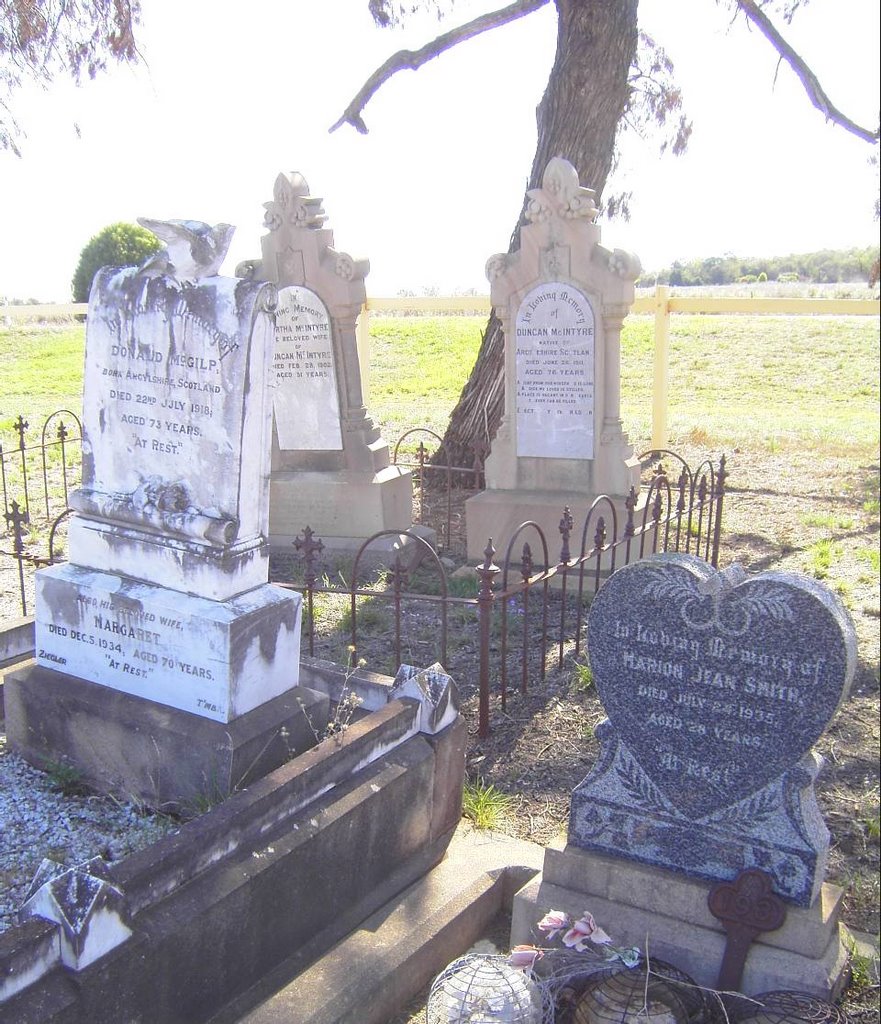
Various Queensland Cemeteries

Left: Miles' Pioneer cemetery.


A theme I like in gravestones here is the broken pillar: lives come to ruin.....


Left: Jondaryan cemetery (not far from the Jondaryan Woolshed, a notable Australian museum devoted to the history of sheep ranching on the Darling Downs).


Left: Gatton cemetery, recording a trace of the soldiers who left Australia long ago in service to the British Empire around the world.
Closing The Southern Loop

Left: Gold Coast skyline from the Gold Coast Turf Club.


On Wednesday, after checking out of Conrad Jupiters, I encountered two musicians, a violinist and a guitarist, strolling through the hotel. Turns out , they were contractors, paid to play mood music on Wednesdays & Saturdays. I said "it's Tchaikovsky's 'Swan Lake'!", but they said no, it was the swan theme from Sansonnes (sp?) 'Carnival of the Animals.' Apparently Tchaikovsky lifted the theme for Swan Lake. Figures: a 19th-century Andrew Lloyd Webber!

I checked the canal outside Conrad Jupiters for sharks. Gold Coast canals are renowned for their unusual number of predators. Saw many small fish, but no sharks, and, oddly, almost no birds, not even my favorite showboat dumpster divers, those Australian White Ibises.

Stopped briefly to watch a fire alarm evacuation and to scan the beaches of the Gold Coast. Beautiful beaches!

Tension-filled, crowded urban traffic. Got distracted looking for a Greek Orthodox Church - what is such a thing doing in a place like this? - and nearly collided with a car in a traffic circle. Had to squeal to an embarrassing stop, but, most importantly, no contact was made. Never found the Church either, but found the Gold Coast Turf Club instead.

Didn't want to go to Chevron Island - went to Chevron Island. Wandered hither and yon (Beauwon? Beendall?), but finally broke clear, crossed the Nerang River, picked up the Pacific Highway at Nerang (smoke in the hills) and ate at Coomera (they have a 'McOz' sandwich at McDonalds here - they also include beetroot on their various sandwiches). Took the Logan Expressway (and its damned insidious tolls), skirted the Brisbane metropolitan area, met up with the Warrego Highway, headed west, and detoured for a few more photos in Gatton before returning Andrew his precious Subaru Forester at the UQ Gatton campus.

On the way back to Mt. Glorious, we ran into a big, noisy thunderstorm that pelted the Lowood and Fernvale area with rain and hail. Some rain - intense but unfortunately short-lived - fell on Mt. Glorious.

Tuesday, November 28, 2006

'Tempo Rouge' at Conrad Jupiters

A rapid-fire stage extravaganza, as conceived mostly by ballroom dancers and jugglers. The cost was surprisingly-low, less than half the rate of a Las Vegas show.

The house seated about 800 people. It was half full on a slow Tuesday night. I grabbed a Bundaberg rum-and-cola in a bottle, some popcorn, and sat amongst a group of folks from the remote northwestern Queensland mining town of Mt. Isa. The fellow next to me seemed surprised to see an American here, but in truth, there may have been many foreigners here. Like in an American casino, there were many Asians here, some of whom may have been from overseas on holidays.

As in American casinos, this was a tough crowd for the performers: undemonstrative Asians, and local clods. Why are casino audiences the worst? Come on, don't be bitter, it's just money! Clap your hands, hoot and holler - I can't do it all alone, dammit!

The ballroom dancing was straight-ahead ballroom, like in 'Dancing With The Stars', featuring Latin rhythms, starting with Salsa, and extending to Samba and International Rumba. There were also Tango and Jive segments.

Australia has excellent opportunities to learn ballroom dancing, and likely far more excellent ballroom dancers per capita than you could ever imagine. I remember when we hosted Australians Roy Mavor, and his daughter Natalie, at UNM's Ballroom Dance Club in the late 70's. Legends all!

This show must be an important stepping-stone for young Australian professional ballroom dancers. For a top-tier dancer, the ensemble work is likely pretty easy to learn, so it would be fairly-easy to drop out of the show, to head to Malaysia, or New Zealand, or wherever, for professional or pro-am tournaments, and then drop back into it again. Dance, earn some money, stay sharp! Fun!

Features include:
  • bright colors, flouncy arm ruffles, headdresses, angel wings, and high heels;
  • pyrotechnics;
  • a mistress of hoops and skeletal structures, from Florida, USA;
  • a ring, rod and ball juggler from Las Vegas, USA;
  • an older, but flexible, contortionist (let's hear it for the older blokes!), who was brought on stage in a small box, and who climbed into and out of a slightly-oversized plexiglass water cooler jug equipped with a door;
  • African tumblers;
  • entrances and exits via cable from the highest point of the proscenium arch;
  • Latin juggling and comedy duo;
  • a grandiose tribute to Bollywood;
  • tributes to zoot suiters and 50's doo-wop; and,
  • excellent lead male & female singers.
As good as the leads were, I fell in love instead with a young blonde ballroom dancer named Prue, who had the most expressive hands - better than anyone else's!

An excellent show!
Conrad Jupiters - Premier Hotel/Casino On The Gold Coast
Travelled from Byron Bay to the Gold Coast as Tuesday's sunset came. The main Pacific Highway was awkward: heavy traffic, but in places, the multi-lane coastal freeway was incomplete, forcing delays and detours. This prime conduit for Australia's N-S traffic reminded me of California freeways in the 1950's or 1960's - still incomplete, and subject to snarls.

Nevertheless, still managed to find Conrad Jupiters in the endless, high-rise commercial strip known as Surfer's Paradise. Arrived at 7:30 p.m. (saved because I was now back in Queensland, and standard time, so I had an extra hour to make the trip). Hurtled through check-in, a quick shower, and then down to the theater by 8 p.m. showtime, helped by pleasant, random strangers who pointed me in the right direction.

Came to see 'Tempo Rouge', the big stage spectacular here.

After the show, I wanted to gamble, but discovered I had little money to play with, either in my packet or in my checking account (I wrote out a bunch of checks before I left California, and surprise! surprise! they had already cleared the account).

No problem, I thought, I'll just put it all on a credit card. Well, I forgot my PIN, so I can't use an ATM machine for the credit card. So, I'll just use their credit-card-based cheque-cashing service, like I would do in the U.S. Turns out, that's illegal, according to prudent Queensland law designed in order to limit problem gambling. There was one last route I didn't try: using an internal paper credit card handed to me at check-in. I surrendered: I was out of luck (or, as some would have it, very much in luck). This problemo gambler was foiled by the authorities - the federal or the Queensland legislatures!

Often, Australia seems over-regulated: a nanny state run amok. For example, speed limits are enforced not so much by policemen, but by randomly-placed roadside cameras. You never, ever know if you've been spotted doing 110 km/hr in a 100 km/hr zone. There are warning signs everywhere: watch your step, watch your head, don't step off the trail, no skateboarding, no cell phones while driving, no photos by strangers of underage children at schools, no support for terrorist organizations, etc., etc., etc. It's enough to make even milquetoasts rebel. But then, in the middle of it all, a really-sensible regulation is found, like a gem, like these credit limitations!

Thank you, Australia nanny state!

Of course, these restrictions mean this hotel/casino makes less money than similar-sized compatriots in Las Vegas, but c'est la vie. The Tuesday-night pace seemed slow - slower than Vegas on a Tuesday night. The slot machines looked different than up north - a sleek, sci-fi look that I envied. As I've noted before in another blog post, most slot machines these days are made in Australia, so hopefully they'll introduce this look up north sometime soon.

The women here dress well - many young women look great, but as in America, their boyfriends looked like slobs. There was no discotheque Tuesday night, just the noisy Prince Albert club, with a live band and big-screen cricket. Do young women here dress well because the standard of beauty is so high, fed as it is by sleek fashion magazines and music videos, or is it because young women have few opportunities, in general, in rough-and-ready Australia to do so? This place is a land of extremes, in some ways!

Nice place, this Conrad Jupiters!
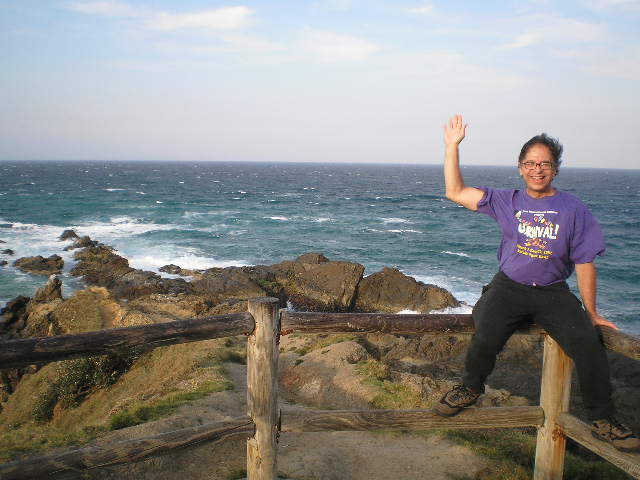
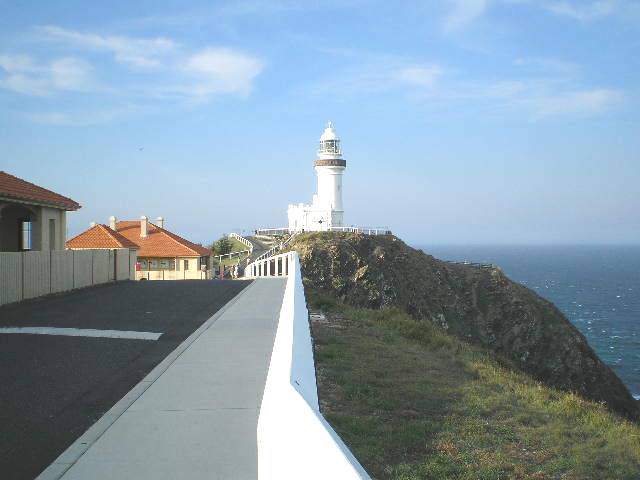
Cape Byron - Easternmost Place In Australia

Left: Cape Byron Lighthouse


Left: Looking NE from the bluffs

Left: Here I am, second easternmost man in Australia
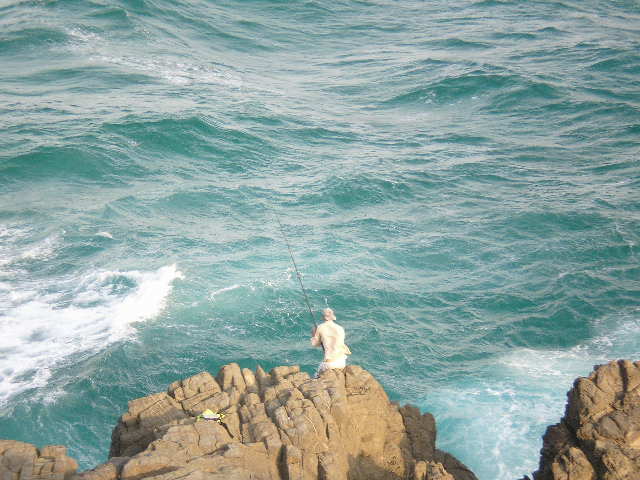
Left: This fisherman on the rocks is the easternmost man in Australia
What a drop! Very windy and very exposed and very beautiful. Ideal for humpback whale watching (May-August). What would this place be like on a bad day, in a storm? I'm having trouble holding onto my camera!

After doing the walk, it was time to quickly head north.
Drive To The Coast

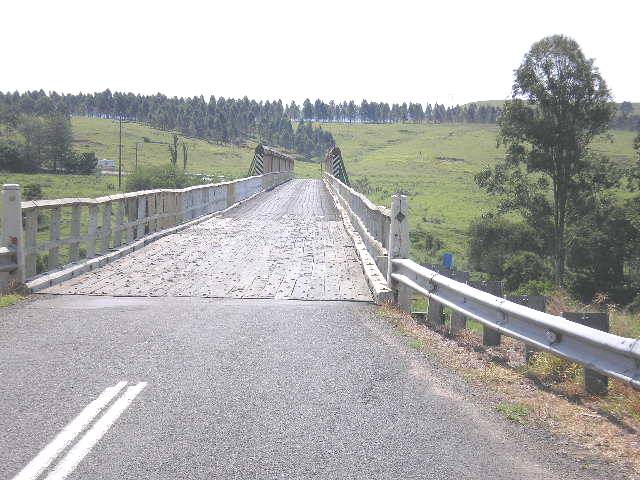
Left: One-lane wooden bridge (on a "major" highway, no less!) across the Clarence River.


After returning to New South Wales (NSW) and Tenterfield, I headed east on the big highway to the coast indicated on the map, which, as often happens in Australia, was actually a small, winding, mostly two-lane road.

Once I reached Drake Village, the road plummeted into valleys and temperatures climbed uncomfortably. The two-lane road even reduced to one lane, in order to cross the surprisingly-large Clarence River on a wooden bridge. Soon, towns were encountered and the traffic level increased.

Groggy with fatigue at the town of Casino. Confused by a succession of traffic circles (Australians prefer to avoid installing traffic lights, and install traffic circles instead). Stopped at a small park and annoyed people because I parked wrong - 90 degrees to the proper direction. Misread a traffic island and momentarily turned onto the right hand side of a street: I quickly parked, but traffic was light and no problem resulted. Went through a McDonald's drive through window & got a McFlurry.

Passed through the town of Lismore. Annoyed at the map again. At 145,000 people, Lismore is 50% larger than Toowoomba's 100,000, but because it's in the populated eastern coastal strip, Lismore's name gets little letters on the map but inland Toowoomba's name gets big, big letters - utterly misleading!

After passing through Lismore, the road climbed unexpectedly as it got closer to the coast - one last extravagance of the easternmost extent of the Australian land mass before it fell into the Pacific. The land was increasingly-beautiful and lush - even the grazing cattle looked lush. There were some strange pine tree farms: what looked like Bunya Pines in exacting rows and columns on the hillside slopes. But the road wasn't falling even close to sea level as it approached the coast. Somewhere ahead must lay one dizzying drop! But where? Evening was approaching, and the map said I was near the coast, but still, I was far from sea level.

Suddenly ahead appeared Byron Bay, with its counterculture friendly town and its singular white lighthouse.
A Wet Eucalyptus Forest Is A Happy Eucalyptus Forest - Girraween National Park

Left: Balancing Rock, Girraween National Park


Checked out of the motel and talked to the manager of the motel about how VOIP and other Internet technologies will change telecommunications in Australia. Right now, he wants to rip out his land line phones - they cost him an arm and a leg.

Drove back over the border, to Queensland's Girraween National Park. Nice place, with rounded granitic boulders. The place has a fine eucalyptus forest, with some rare species of eucalyptus, and it reminded me of similarly pleasant places in the States - the back sides of the Sandia and Manzano Mts. in NM, or Mt. Lemmon near Tucson, AZ.

Climbed the Pyramid at Girraween, a small pyramidal peak, as the cicadas in the newly-wet forest thundered across the granitic hills. The granite wasn't rotten in any place - fine friction climbing everywhere.

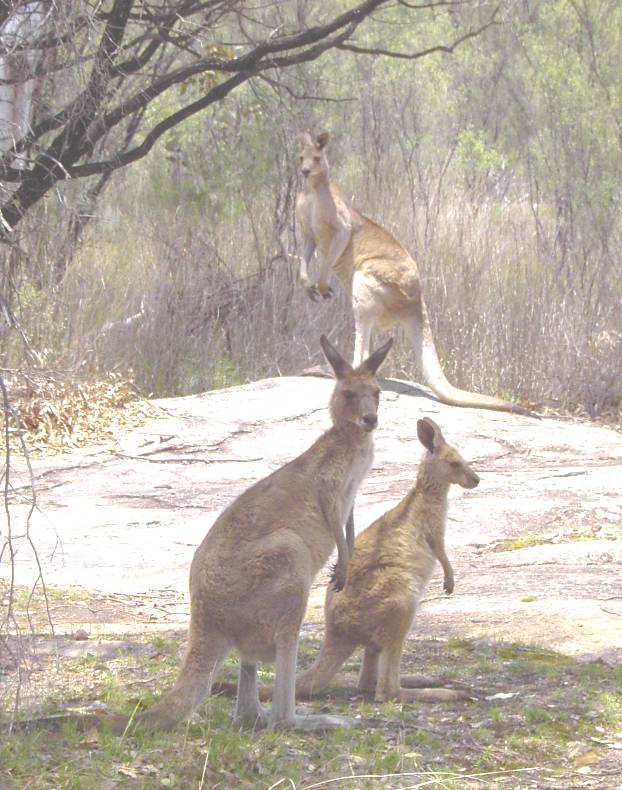
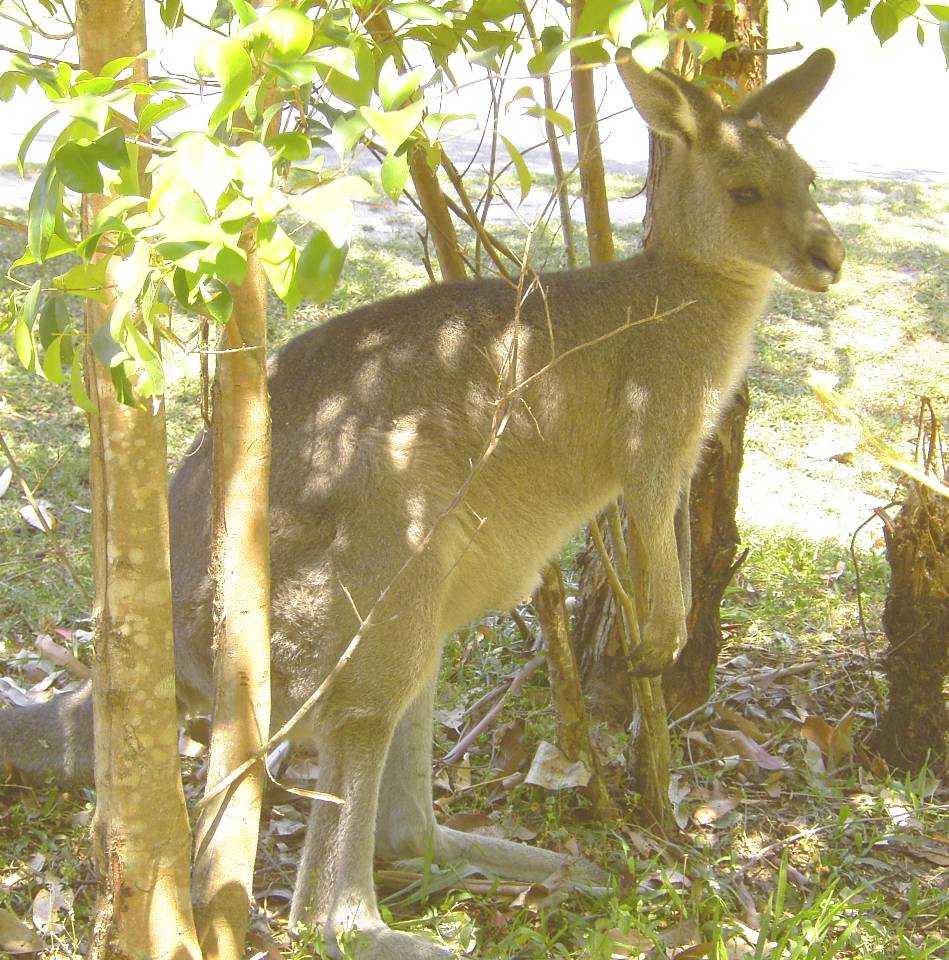
Upon return, I found six kangaroos near the Visitor's Center. The big kangaroo (five feet tall, about 150 lbs.) was wary, but the rest seemed people-friendly. I'm sure I'm not the only one ever to make the observation, but kangaroo seem to fill the same ecological niche that deer do in the Northern Hemisphere. They even look like deer (well, from the neck up).
Rainy Night In Tenterfield

Stayed at the Jumbuck Motel, adjacent to downtown Tenterfield (population about 3,500). I was hungry, but just then, a very powerful thunderstorm chockers full of lightning struck the town - just about the only place in Australia experiencing rain at the instant. An hour later, after repeated power failures, I finally walked to a sopping and quiet downtown area.

It was 9:15 p.m., after closing time for the Chinese restaurant, but, unaccountably, it was still open (tourists travelling the New England Highway were changing a flat tire right in front of the place, so closing time may have been delayed). The Chinese manager was sullen and abrupt, barking commands at me, but he did sell me some chicken chow mein for take out. Crap service, and the noodles were those awful supermarket hard things, but the sauce was good, and there was way too much of it. Without cutlery, I scooped the stuff up in a drinking glass and made do.
Fortunate Plateaus

Monday, after lunch, I left Gatton and headed SW and approached the area known as the New England Tablelands, passing through the Ma Ma and Heifer Creek areas, through Warwick and around Stanthorpe, before crossing the border into New South Wales at Wallangara (and advancing an hour because NSW is on daylight savings time), and finally stopping for the night at Testerfield.

These plateaus, or tablelands as they call them, are privileged landscapes: they get more rain than most areas in the vicinity. I've even noticed this phenomenon looking at the FNMOC computer weather forecasts for Australia back in Sacramento. Storms linger here when they disappear elsewhere.

Sunday, November 26, 2006

Heading South

This afternoon, I'll drive to the Stanthorpe area, and Girraween National Park, before heading towards O'Reilley's, and Lamington National Park, then towards the Gold Coast and perhaps Byron Bay, seeing 'Tempo Rouge', the big nightly show at Conrad Jupiter's.
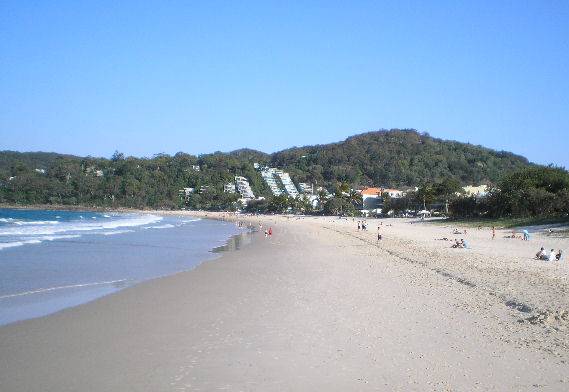
Noosa

Left: Noosa Beach


The beaches at Noosa were gorgeous. It's a classic, high-end resort community, like La Jolla or Malibu, with crashing waves on headland rocks, long stretches of beach where beautiful people lay in the sun, and hiking trails in the adjacent national parks. In addition, there's a downtown area where one can shop for fashionable clothes, buy real estate at insane prices from ReMax or Century 21, or eat in a sidewalk cafe. And there's a Sheraton, if one wants to stay.

Left: The walk along the coast, Noosa Headlands
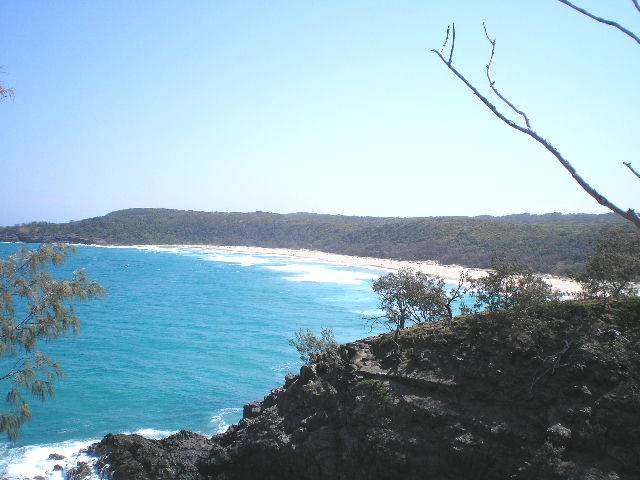

We walked along the coast throught the teatree trees, and through the coastal wallum. At park headquarters, there were reports of koalas in the trees along this trail, but I was too distracted by the bizarre plant community, including a deciduous tree of some sort sporting cones, to look upwards that much. The forest on the east side of the Noosa Headlands was really novel: low-growing, unfamiliar shrubs, but dry, sandy soil, and bird-poor. On the west side of the headlands, the forest was much more familiar, even featuring a few of the fig trees seen on Mt. Glorious, and there were many more birds. Apparently the east coast of Australia features many diverse natural communities, and the number of species are great, but because the coastal strip is so narrow, and crowded with people, so many of the communities are under stress, and endangered.

Temperatures were about 29 deg C, which was quite comfortable with the sea breeze. It was humid, but only because the ocean was right there. It's been so dry lately everywhere, despite the supposed start of the rainy season, that there were no mosquitoes. In general, it's been much, much more pleasant than I expected a semi-tropical location like this could be at this time of year.

Left: Alexandria Beach


We hiked to beautiful Alexandria Beach, and I reluctantly stopped taking pictures when Andrew said he would disown me if I continued. Alexandria Beach is clothing-optional, and indeed, several couples frolicked in the surf sans clothing. One woman posed for cheesecake photos with nothing on but a thong, as her boyfriend snapped away, but mostly, it was hairy guys walking to-and-fro. I stood out because I was the only one wearing sweatpants (I should go shopping). We ate lunch and gazed east, seeing a boat in the distance, but otherwise, nothing else, all the way to the eastern horizon.

We walked back over the headlands, cruised downtown, drove along the beachfront road to Coolum Beach, then headed back for Mt. Glorious.
Return Of The Turtle

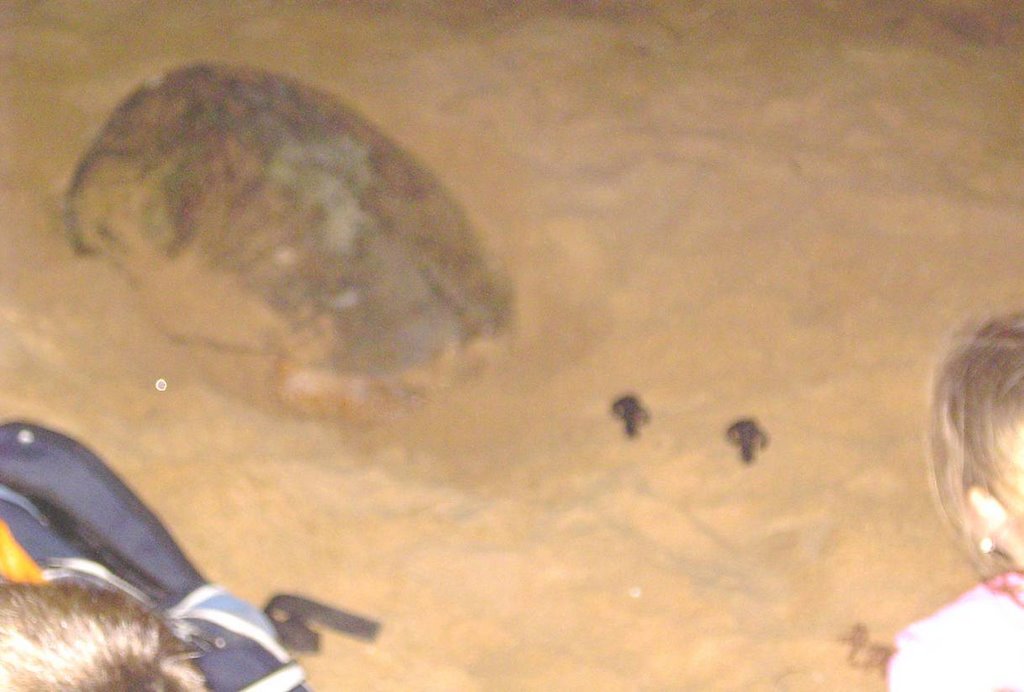
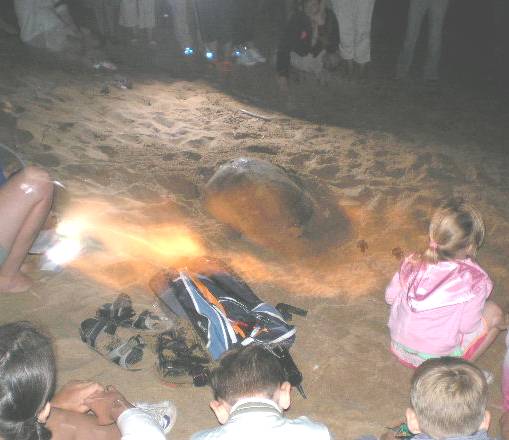
(Left) Loggerhead turtle lays her eggs as children watch in fascination.


We went to Mon Repos Conservation Area, near Bargara, on the beach near Bundaberg, to watch returning loggerhead turtles lay their eggs at the beach. The annual spectacle is popular, as is the hatching of the eggs, which starts in January, after 6 weeks gestation on the beach. The staff at Mon Repos take reservations, log people in, and divide them into groups of about 70 people each, taking each group to a turtle as radio reports come in about turtles arriving. Some nights, especially when the hatchlings appear, as many as 1000 come out to watch (not that busy tonight).

Years ago, I remember seeing a National Geographic or Jacques Cousteau television special about these exact same turtles. Loggerhead Turtles are large and long-lived, taking 30 years to reach maturity. After the baby turtles hatch, they scramble for the surf in a mad rush, and disappear for 17 years into the vast South Pacific, before settling into more-shallow areas. They wander far - tagged Australian loggerhead turtles have been logged as far away as Peru. Only one in a thousand hatchlings reach maturity. Numbers have been declining, reaching a low of only 100 nesting females at this beach in the mid-1990's.

Since the 1970's, a variety of preservation methods, including the trapping of predatory foxes and changed fishing practices have helped - last year, about 300 nesting females were observed here. Still, given their long life spans, it can be decades before changes in practices have their effect on turtle numbers. Their efforts have definitely boosted the survival rate on land, however, always among the most-dangerous place for turtles in the natural world.

Sand temperature determines sex: above 28.7 deg C, eggs produce females: below, males. On darker, warmer beaches like Mon Repos, females predominate. Over roughly a month-long period, females lay several clutches of eggs, roughly two weeks apart per clutch, fertlizing each clutch with stored sprem.

Saturday night, 200 of us assembled at Mon Repos, and we were divided into three groups. We were in Group 1, and we waited for our turtle. We ate a snack, but had to hastily finish when reports came at 7:30 p.m. of a turtle on the beach. Occasionally stumbling over grass and rocks, we were hastily marched eastwards along the beautiful, pleasant, breezy beach in the dark. I was towards the back, and like the Sermon on the Mount scene in Monty Python's 'Life of Brian' I frequently couldn't eaxctly hear our guide against the sound of the crashing waves.

Turtles guide themselves by light, and we were warned not to take flash photos until given permission. City and seaside lights can confuse them. Once the turtle had laid 20 eggs or so, and had gone into a kind of trance, we could take photos as we pleased, until it was time for the turtle to return to the sea. Turtles navigate by dark horizon (land) and bright horizon (surf).

Suddenly, our guide said stop. Based on radio reports, she said the turtle was on the beach directly above us, and facing our way. Since she could see us quite well in the light of the crescent moon, in order to avoid making her panic, it was imperative we remain still and act like a rock. So, we 70 strangers stopped and awkwardly tried to pretend we were a rock. To pass the time, the guide asked us to find the constellation of the Turtle in the beautiful northeastern sky. In the northeast, Orion was rising from the sea. The beak of the Turtle seemed to be in-between the left flipper (the Pleiades) and the right flipper (near Orion), with the bottom of the turtle still in the water (not sure I have this right, but it's easy to see what you want sometimes among the connect-a-dot stars).

Then we were given the go-ahead: the turtle was now facing west and laying eggs. The 12-to-15 kids were allowed to approach first. The turtle was laying her eggs in a chamber she had dug deep in the sand. They had placed a small light at the chamber's mouth so we could see the eggs falling into the chamber (the eggs are leathery and resist fracture). Then we were given permission to take photos, and it was as if a celebrity had arrived, all the flashes going off at once. Mon Repos staff measured her size and took notes. A cheer went up among the staff when her tags matched their records - this turtle had laid eggs previously here in 2002 and was about 40 years old. A woman next to me looked at the spectacle and remarked "can I get a job?" I laughed, then agreed with her that this would be an excellent job indeed.
After Mama Loggerhead had finished laying eggs, she buried the chamber with her back flippers at seemed to almost bury herself at first. Then, following the guide's light as a lure, she slowly made her way back to the bright surf as we eagerly followed behind.

Meanwhile, Mon Repos staff had determined the egg chamber was too low on the beach to avoid the egg-damaging water of high tide (same as had happened with two turtles last night at this beach). The staff had already dug their own chambers in the sand higher up the beach, so they excavated the egg chamber, counted the eggs (137), and utilized our group to help transport the eggs.

As we cupped our hands together and lined up to take turns carrying eggs, Andrew remarked "it looks like Holy Communion!" It was a little scary, as I first carried one egg, then three, stumbling in the dark over pits in the sand, and hummocky grass, knowing that all of us, kids included, carried The Future of the Species with us.

As we walked back along the beach, The Turtle Constellation had fully risen from the surf in the velvety-black southern night sky. Gorgeous!

The Spirit of the Turtle reigned triumphant tonight!
Steve Irwin's 'Australia Zoo', at Beerwah

Wonderful place! Not a huge zoo yet, but they are expanding. The emphasis here is on kids, kids, kids, and conservation education. The bigger, brasher, and bolder, the better!

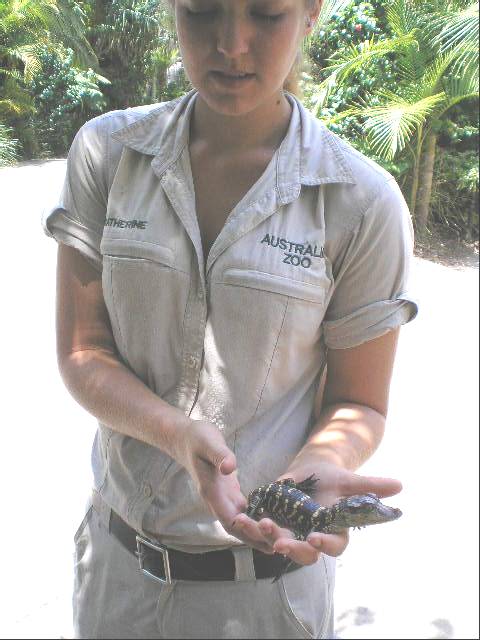
Left: When we entered, a staff member (beautiful!) approached carrying an American Alligator baby (also beautiful!) for us to pet. The theme here is CROCODILE!

Shortly after we arrived, it was showtime at the Crocoseum, the specially-built set of grandstands used for public crocodile spectacles (and which I had seen before on Internet video, where Bindi Irwin, Steve's daughter, had given her eulogy for her father during Australia's recent special day of remembrance, and which was televised all around the world).

Showtime included snakes, birds, and Murray the Crocodile.

Four large snakes (pythons) were featured, including the world's longest, Australia's own Reticulated Python, which I believe he said grew to weigh 280 kg - enough to kill people and livestock by constriction, if given a chance. An actor, playing a stereotyped Australian Boor, entered and acted the part. He started beating a rubber snake, all the while yelling 'you're a quitter, just like that Ian Thorpe!' (Australia's pre-eminent 2000 & 2004 Olympic Gold Medal champion swimmer, who had just announced his retirement several days before). The audience gasped and loudly booed the Boor. Then the rubber snake struck the Boor, and he fell over dead. The audience cheered. Then the staff called in the medics, who came with a stretcher and carried the rubber snake away. The audience cheered again. All very funny, and very effective education, on how Australian kids should not treat snakes!

The first birds released were a set of homing pigeons, who then swooped around the Crocoseum, and flew far, far away. Periodically thereafter, the staff member who released them was seen running panicked around the Crocoseum, trying to catch his birds again. Very funny! Then they released a number of parrots, who swooped around the Crocoseum and landed on the arms of volunteers chosen for the task from the audience. These birds were free to fly away if they chose, but they nevertheless stayed in the grandstands (the only exception being a somewhat-unhappy macaw, who clung to a fence, and whom staff had to fetch when he refused to return). Both native parrots (black & brilliant cockatoos) and South American macaws were featured.
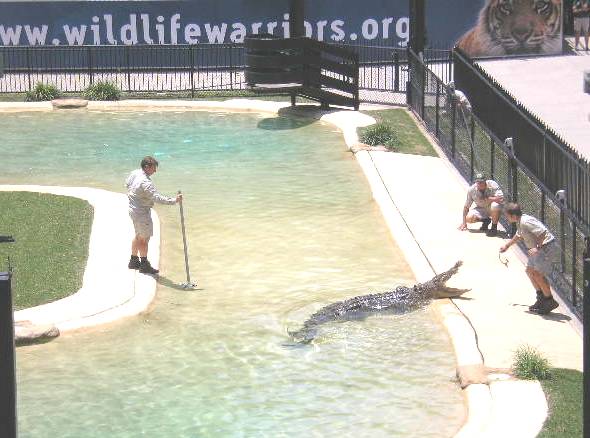
Murray the Crocodile was one scary dude, and the staff treated him ginger respect. They lured him on with food as he swam around the Crocoseum's pool, and his chomping jaws echoed with power. Crikey!
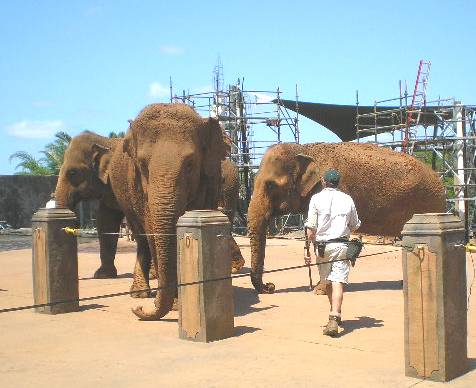
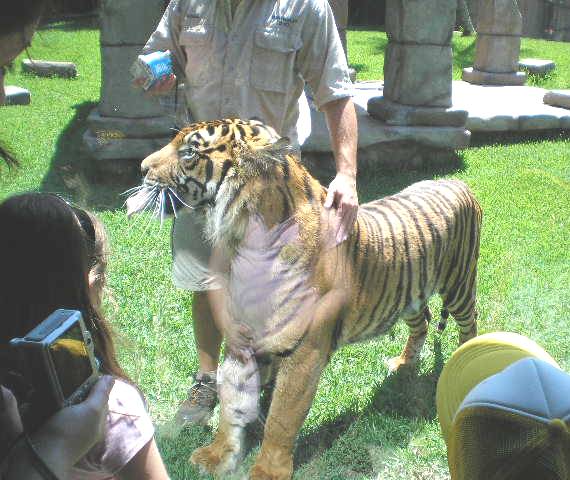
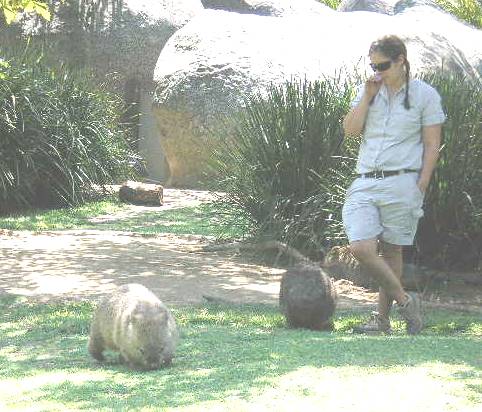
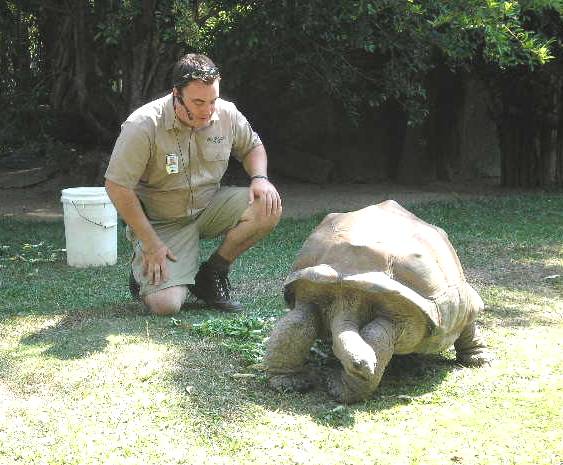
After the show, we looked at the rest of the zoo. All kinds of creatures were there, including cassowaries, koalas, wombats, Galapagos Tortoises, Tasmanian devils, Asian elephants, and tigers.

People from around the world had also signed a number of Australia Zoo khaki shirts, and fashioned the shirts into a makeshift Wall of Remembrance for that inspirational advocate of conservation, the Crocodile Hunter himself, Steve Irwin.

Asian Elephants

Tigers

Wombats

Cassowary

Galapagos Tortoise
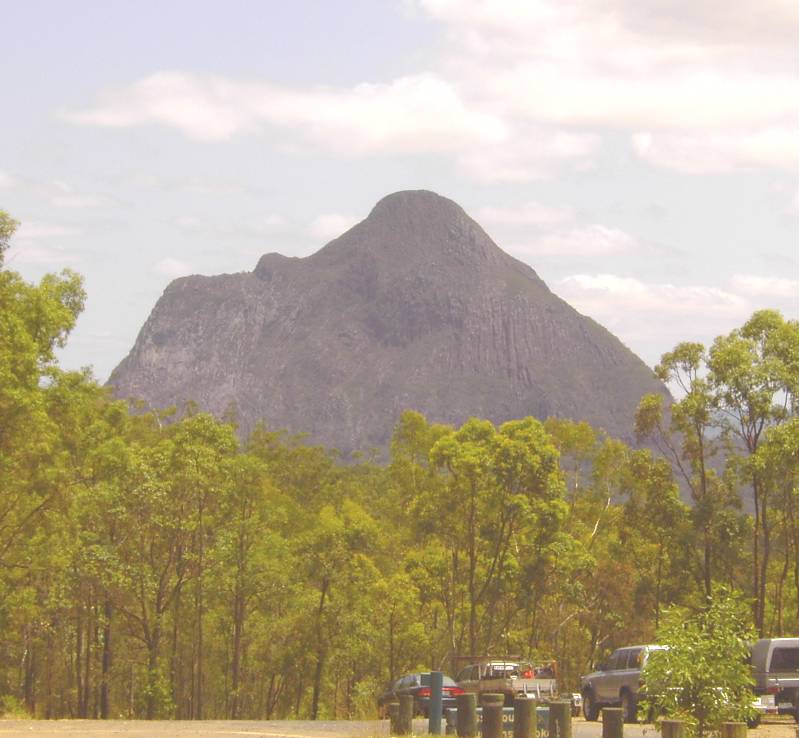
Glass House Mountains

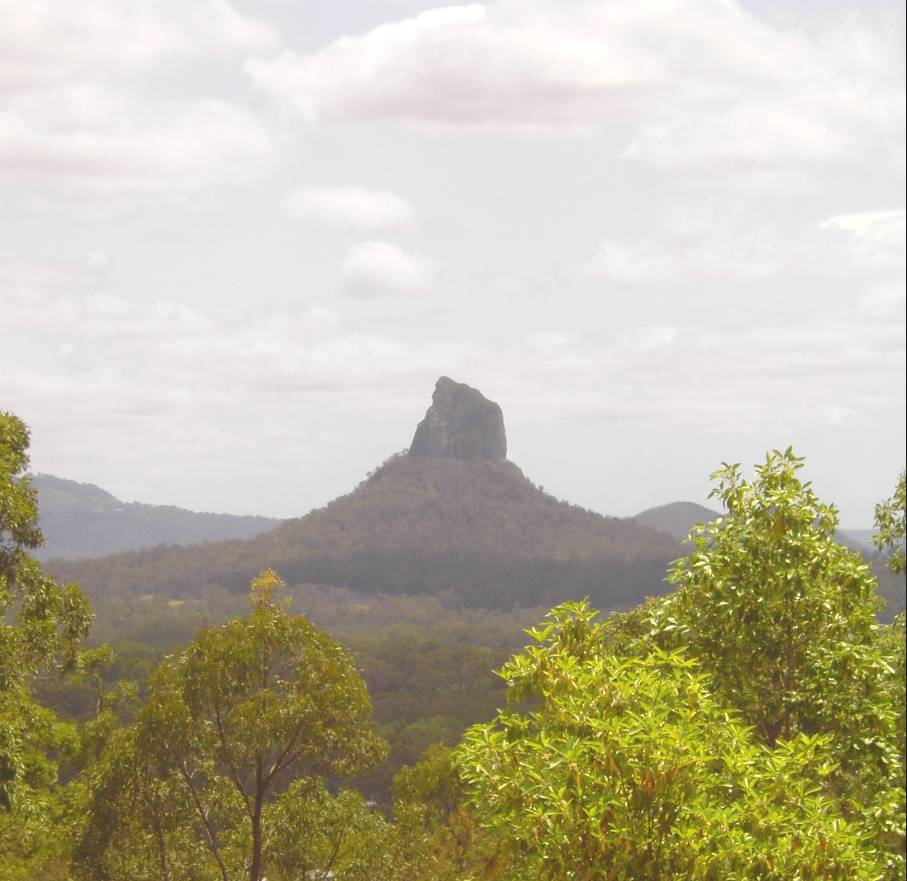
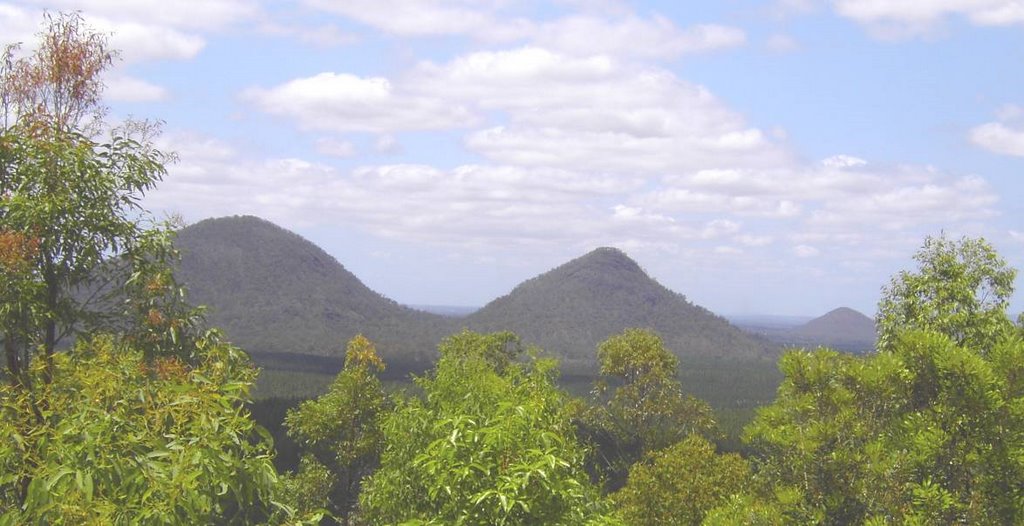
Named by Captain James Cook, these extinct volcanic plugs look very striking.


Left: Mt. Coonawrin (377 m)

Left: Mt. Tibrogargan (364 m)

Left: Tunbubudula (or The Twins), with Mt. Miketee (338 m/294 m, and 199 m)

Left: Mt. Beerwah (556 m)
Weekend Overview

On Saturday, we drove north, to Bundaberg, and returned on Sunday.

On Saturday, we stopped to look at the Glass House Mountains, and the Australia Zoo, the place made famous by Steve Irwin on the television show 'Animal Planet.'

We stopped and ate fish and chips at Neptune's Restaurant, in Gympie. We passed through Maryborough and Childers, passing sugar cane and pineapple fields, before arriving late at Bundaberg. We had no time, so we went straight away to watch the nesting loggerhead turtles at Mon Repos Conservation Area near Bargara, on the beach.

Despite the fact our turtle was polite enough to stay on our timetable, we barely made it back in time to Bundaberg in time to check in. Andrew used fuzzy recollections, dead reckoning and deductive insight to find our hotel, the Quality Inn, arriving exactly at 10 p.m., the hotel's closing time. (Australia, in general, doesn't allow late check-ins, so if you are too late in arriving, you get to sleep in the car instead).

The Quality Inn (same motel chain I had stayed in in Roma) was situated on the mangrove-lined banks of the Burnett River - really a fine view! In the morning, we watched Bronze Man, and other colorful locals, preparing their boats for cruises on the sea, as the Bundaberg foundry across the river made incredibly loud scraping noises, for a quiet Sunday morning.

On Sunday, we drove back, stopping again at the same place in Gympie for lunch.

We stopped at the fashionable beach community of Noosa, and took a hike around the Noosa Headlands. Beautiful spot! We also went and looked at the shops in trendy, fashionable Noosa.

After driving down the beach to Coolum Beach, we headed inland and drove back to Mt. Glorious.
Household Spiders

(Left) Australia's Brown Huntsman Spider


There are several common household spiders here, including the Brown and Grey Huntsman spiders. Both kinds of spiders are harmless, but quite large.

This Brown Huntsman (left) is as large as a Tarantula. It was running around the dining room like a crazed lizard. We couldn't ignore it. When it sought refuge under a stuffed chair, we had to take the chair outside in order to flush the monster out.

Meanwhile, there was a civil, smaller (about the size of a 50-cent piece) Grey Huntsman Spider sitting quietly in the kitchen sink. Leave that baby alone!

Thursday, November 23, 2006

Quiet Friday

Blogged on Friday, and attended a farewell tea for three University of Queensland employees. Budget cutbacks hurt, and the St. Lucia campus appears to be gobbling up the satellite Gatton branch.

There have been any number of fires nearby for days, some controlled burns, but some uncontrolled as well. Today there was thick smoke up on Mt. Glorious.

I went bird watching again at UQ Gatton's Lake Lenore, and saw that familiar, yet unknown, species of spider again in the bird blind. It looks nasty - I won't touch it...

Saw several birds, including:
  • Dusky Moorhen;
  • Australian White Ibis; and,
  • Plumed Whistling Ducks.
In the evening, Andrew, Gary, and myself went to a Christmas dinner for Campus Staff. I wondered why the Christmas dinner was so early, and Gary said it was because the semester was now over, and if they wanted to do anything at all for Christmas, they had to do it now, or few people would be left on campus for a December dinner.

The meal selection was excellent: roast turkey and ham, sweet potatoes, and plenty of vegetables. It was appropriate that it was also Thanskgiving Day in America.

On the drive back from Theodore, on the radio, the station's Washington correspondent reported on the strange American tradition of the U.S. President pardoning Thanksgiving turkeys. 'Flyer' and 'Fryer' had been pardoned by President Bush and would live out their lives at Disney World, which struck the Australians as surreal.
Toying With The Serpent - Part II

On the drive back to Mt. Glorious, Andrew skidded to a halt: a carpet python lay stretched out on the pavement, soaking up the pavement's heat in the early evening. This was a dangerous place for a python, lying across a road, but how to make it move?

I've read that stretched-out snakes can't strike easily - they need to be coiled to get maximum strike. So, I took a six-inch long branch and lightly stroked it over the very tip of the python's tail.

Just because it's hard to strike doesn't mean they won't try. The snake's head lunged towards the tail, simultaneously bringing the tail in, and coiling, making an impressive display of anger and power. The first effort was for show, but now coiled, the python would subsequently be much more accurate and pack more punch. They aren't poisonous, but that doesn't mean they can't hurt you.

Since the snake was now safer, coiled up in the middle of the road, we decided to leave. Presumably, the aroused snake left soon after we did.
How Do You Wash A Car In Dalby?

I wanted to wash Andrew's car before I returned it, but I was driving through the the First World's tightest water restriction area anywhere - really stringent!

The only car wash in Dalby is at a BP station. You get two options:
  • hand wash, with buckets and rags; or,
  • automatic wash.

I chose automatic wash, and I marvelled at just how little water the process used. The water is said to be 85%-recycled. We need these car washes everywhere!

So Chumpy You Can Carve It!

Left: Isla Gorge National Park


At 5 a.m., the Moura dump workers showed up. I quickly drove past them, rolling down my window and waving a cheery hello as they scowled back, one worker sarcastically saying "All right, then!"

Haunted by the raptor, I drove into town but found an intense traffic jam at the Mobil gas station. Male workers in some sort of uniform - vinyl jackets with an orange top half and a blue bottom half, with two horizontal white or yellow stripes, and blue pants - were frantically jamming the station. I waited till nearly 6 a.m. before I could wedge my way in. Turns out, the workers were trying to make the morning shift at the nearby, large Dawson Coal Mine.

As I waited, I listened to country music on the radio. I had always been puzzled by reports that country music was very popular in Australia - C/W singer Keith Urban, for example, is an Aussie, if I'm not mistaken - but it wasn't till I got here that I understood why. Urban Australia is a wafer-thin veneer on the eastern and southeastern coasts of the nation. Everything inland is very like the western United States, in many ways. I some ways, Aussie country is more country than U.S. country is. I listened to one woman singer sing the graces of having grown up country, in the Burnett River area. That area is just a few miles west of Bundaberg, on the Capricornia coast. Imagine, if you will, San Francisco being just the way it is, but Oakland being just like Muskogee.

Driving south on the Leichhardt Highway, I passed Theodore, and I was happy to see the Dawson River had more water in it than it did upstream. I stopped briefly at an overlook at Isla Gorge National Park and I ate breakfast at a sandwich shop in Taroom. I stopped at an Internet cafe in Wanoan, but it was closed, despite posted hours: the huge cricket match between England and Australia was underway. The contest to see who possess the 'urn of ashes' was taking everyone's attention.

I stopped at a supermarket. The first supermarkets in the U.S. were just glorified stores like the Curtis Park market in Sacramento: same here. The three aisles of the Wanoan supermarket were jammed with familiar and unfamiliar merchandise.

I saw a can of dog food - the large can signalling the discount variety. The label was blue and featured a terrier, the same kind as President Bush's dog, Barney. The label proclaimed "CHUM - with Chicken." Chum's motto was:
So Chumpy, You Can Carve It!
That's got to be the best advertising slogan ever!
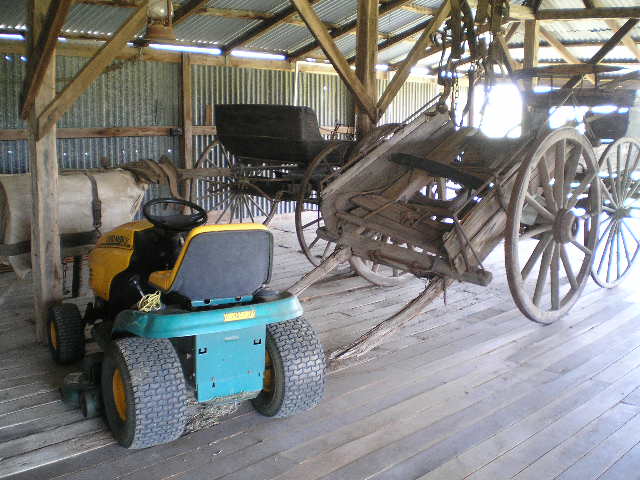
Left: Historic Australian vehicles on display at the Wanoan Historical Site


I visited the Wanoan Historical site, where the original sheep station had been, and finally joined the Warrego Highway again at Miles. Miles, which had seemed like a shockingly-small town on the way out, now seemed like a vital hub of commerce and civilization.

Then east, towards Dalby, Toowoomba, and Gatton!
The Road To Moura

After Carnarvon, I felt a kind of gnawing anxiety, a kind of terror at being so far from people, so far from help should I need it. Instead of heading back south the way I had come, I headed north, through the nighttime, towards the closest town of Rolleston.

At Rolleston, however, the whole town had gone to sleep. Troubled by my emptying gas tank, and still anxious, I drove east on the supposedly major highway, the Dawson Highway, which was really a very bumpy two-lane road, which sometimes was a lane-and-a-half wide, with no central dotted line. Nobody, but nobody, was on the road tonight - I was in the middle of oblivion! Every so often, however, a vehicle passed - an enormous road train or two, but that's it.

Arriving at Bauhinia, I was downcast: everyone had gone to sleep there too. I hated the idea of just stopping without an assurance of nearby petrol, and even though it was late, I decided to continue pressing east, towards Moura.

Within thirty minutes, three events:
  • A large raptor was startled by my vehicle's approach and tried to outfly it. It lost. I smacked into the bird with the windshield and it tumbled over the top of the vehicle;
  • I ran over a rabbit; and,
  • My tires left the pavement as I reached to change the radio station. I had to wrestle for control, and nearly joined the other animals as a victim of Australia's roads.
I can justify the rabbit by saying that, even though I love rabbits, they are not native to Australia, are pests here, and probably should be eliminated. Thus, I was doing a public service. But not a beautiful raptor! Compounding my guilt was that I didn't stop to see if I could help. Maybe the bird died outright, but maybe it was merely injured. I didn't know where to take it, but I could have at least tried. In the brief two seconds I saw it, I thought it was an owl, but my wildlife books don't show an owl that white - it may have been a Black-Shouldered Kite instead.

Paraphrasing that old, cynical saying from Vietnam days:
Become an international tourist! Travel to distant Australia, met the rare and unique wild animals there, and kill them.
Finally, about 11:30 p.m., I arrived at Moura. That town was shut down too, but at least I could see they had a gas station. Poking around residential side streets, I discovered the refuse tip, so (appropriately enough), around midnight, I fell asleep in the driver's seat of the car, without dinner, in the Moura town dump, not far from the pile of glass recyclables. I was awakened only once, by a curious cat.
Checking Out The Night Sky

At home, I have a star chart with the southern constellations, but I forgot it at home. The names are odd, as if a navigator under Captain James Cook was given half an hour to come up with names and he just looked around his cabin: easel, ship's keel, telescope, swordfish, and the like.

At Roma, I first tried to scan the night sky. Orion dominated the northern sky. The star Sirius, the brightest star in the sky, always seemed so washed-out in the northern sky because it is so close to the light-filled southern horizon. Here, Sirius rules! There were two amazingly-large smudges in the sky too! Nebulae of some sort, maybe the galactic center, or the Large and Small Magellanic Clouds. Interrupting my reverie, two horses approached, no doubt looking for an apple or two.

After Carnarvon, I stopped to look again, and, for the first time ever, clearly saw the Zodiacal Light, the light scattered by interplanetary dust in the plane of the ecliptic of the Solar System. The Zodiacal Light is present every night, but it's very hard to see back home due to the light generated by cities. Here, that city light was mostly absent, so you can clearly, clearly see it!

Amazing!
A Cavalcade Of Kangaroos

(Left): A Carnarvon Gorge kangaroo gets bolder as the day grows long.


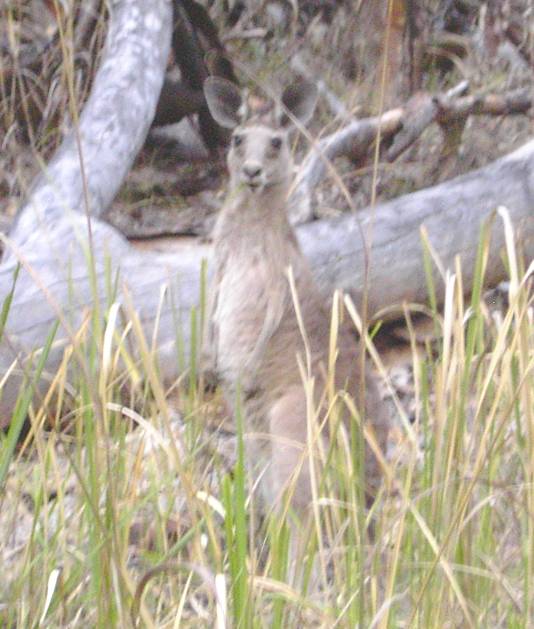
The Carnarvon kangaroos were very skittish earlier in the afternoon, far upstream of the Visitor's center, but as I descended the Gorge, and the afternoon got longer, they seemed to get more numerous and more relaxed, until at the bottom, they were almost tame.

Left: This roo looks more like a wallaby than a kangaroo.

Yummy grass is to be found on the lawn at the Carnarvon Gorge National Park Visitors' Center.

Left: I tried, but failed, to pet this kangaroo.
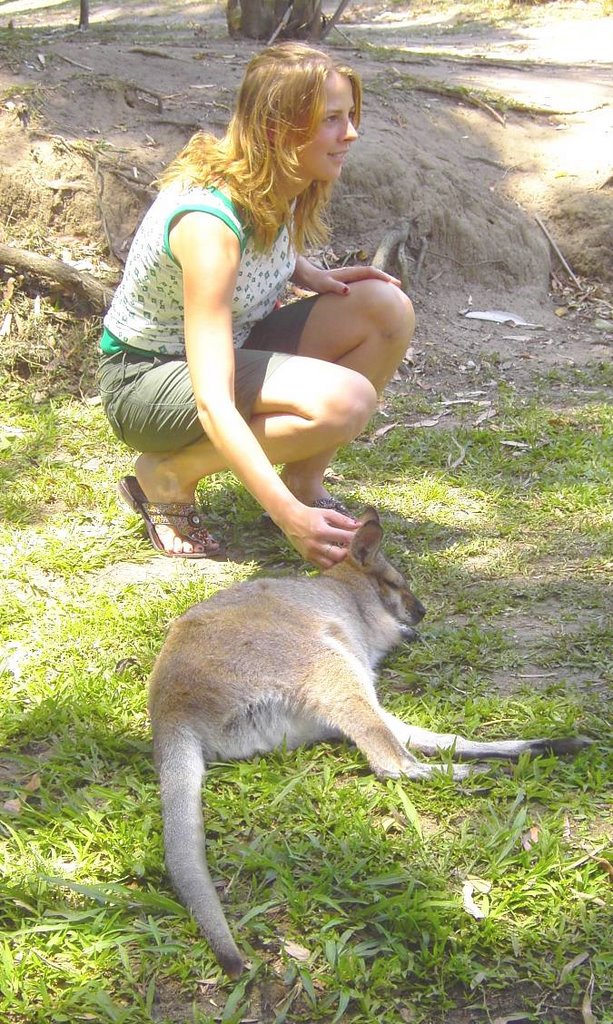
Tamer kangaroos are to be found at the Australia Zoo.
Australia Zoo baby.

Left: Girraween National Park kangaroos. The big one was fretful and suspicious of my intentions.

Left: At Lake Wivenhoe, near Fernvale, Thursday evening, Andrew and I saw a wonderful sight: a mother kangaroo, with a joey poking up out of her pouch (left). The mother kangaroo was trapped between us and a fence, or so we thought, until she decided to leave. From a dead stop, she simply jumped OVER the fence, baby and all, with plenty of room to spare, and bounded away into the forest to join the other kangaroo!
Carnarvon Gorge, And The Hunt For The Wild Platypus

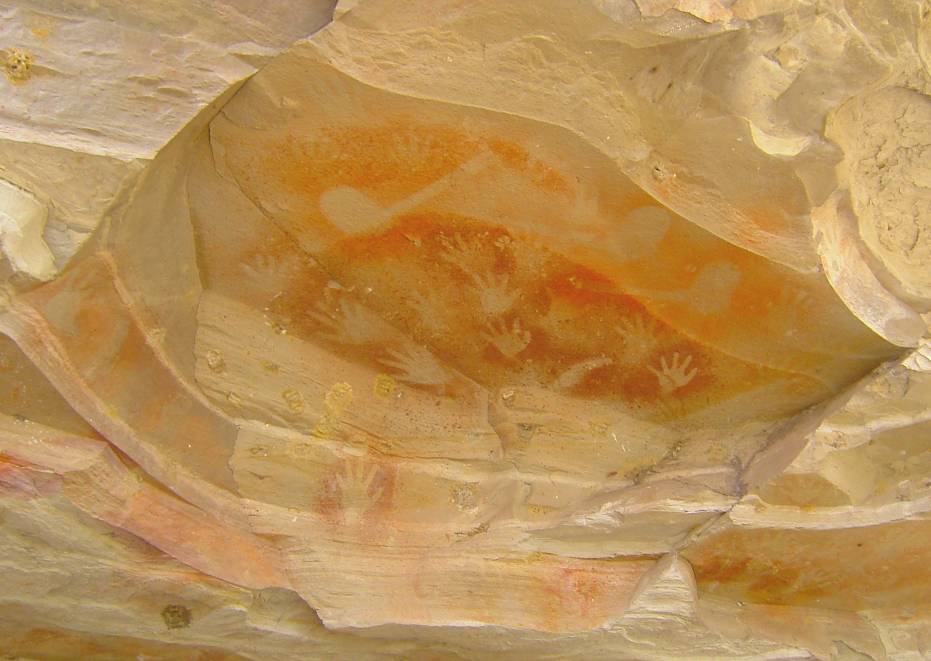
Left: Aboriginal cave paintings at Baloon Cave. Interesting place!


Left: Peeling Spotted Gum Tree.


The forest here is very noisy compared to the western U.S. With the wind blowing and the spotted gums peeling and the cabbage palms scratching and the lizards scampering and the parrots squawking and the kookaburras laughing, it's an amazing racket.

Very few people were in this park, midweek - 20 or so. Amazing, considering how crowded parks like Grand Canyon get in the U.S.!

There is an unconformity between permeable sandstone above and impermeable shale below in the Carnarvon Mountains. The result are many springs in the Canyon, generating that rarest and most valuable of all Australian commodities: permanent, fresh-flowing water. In Carnarvon Creek, untroubled for millions of years by growing continental-wide drought, lived that strangest of all of the world's animals, the platypus, with the famous designed-by-committee look. But it was a shy, secretive animal. Would I get to see one?

I walked west, up the canyon. The canyon wasn't that remarkable by western U.S. standards - bigger than Sycamore Canyon west of Nogales, Arizona, for example, but smaller than Sabino Canyon near Tucson. In general, Australia's mountains are much older than America's, and thus more-eroded and lower in elevation. Still, it wasn't the relief of the terrain that was of most interest - it was the unique wildlife, isolated here in the arid fastness of the world's driest continent.

I walked to the Moss Garden and the Aboriginal Art Gallery.

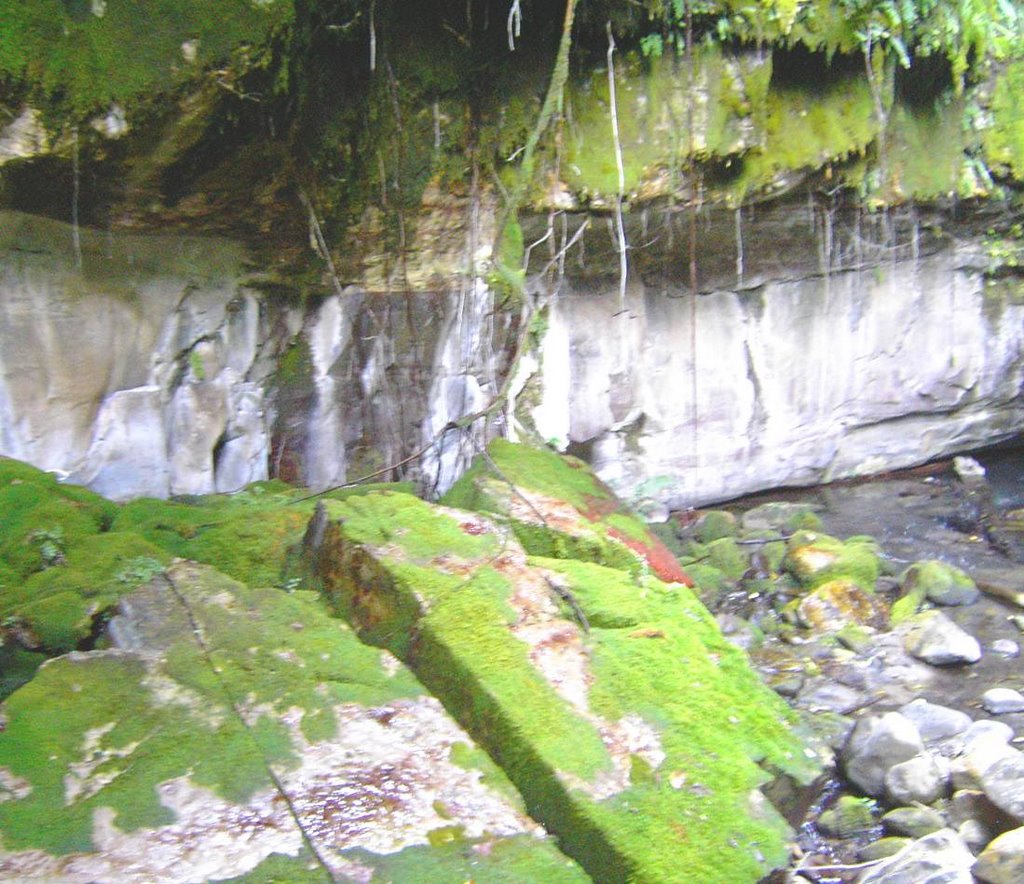
Left: Moss Garden - permanent water at the sandstone/shale unconformity!

Left: Art Gallery. The daily concerns of Aboriginal life are all evident here: paired hunting boomerangs, painted three-toed emu and longer kangaroo footprints, ovals representing water-carrying bark baskets, hand prints and carved vulvas.
I saw:
  • Kangaroos:
  • a water snake of some sort; and, most importantly,
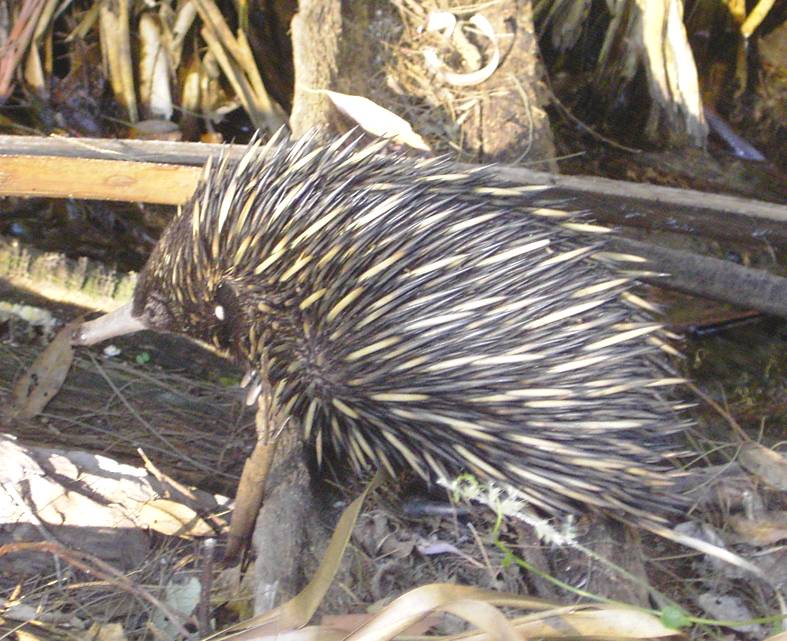
  • an echidna, or spiny ant-eater.

Left: An echidna, or spiny anteater, one of the few animals in the world in the monotreme class, and one of Australia's strangest and most exotic of animals.


The ant-eater was very cute. When I stepped next to it, it would hide its head under a branch and freeze for a few seconds, like any sensible ant-eater should, but then resume snuffling for ants.

Since I didn't spend much time looking for the platypus, I never saw one. I didn't know exactly where they lived and so didn't want to cut into valuable hiking time looking fruitlessly in pools. Rumor had it one lived in the 'Rock Pool' near the Visitor's Center, but I got lost before I could look (damned Northern Hemisphere navigational instincts again!) in the Visitor's Center parking lot as the daylight swiftly vanished, and I almost failed to find the car before nightfall.

I kind of wanted to stay, but knew I'd have trouble getting back to Gatton by Thursday evening if I didn't leave, and besides, I had no authority to camp here, so I crawled out the same way I had come, on the bumpy dirt road.
The Road North

Wednesday morning, I looked for breakfast at the restaurant, but it was closed. I asked the desk clerk where 'brekky' was, and she gave me a wan smile of the sort usually reserved for the slow, and said, "brekky is in the hatch!" I asked, "where is the hatch?" (hutch?) She said next to the door of my room. Oh! They deliver breakfast here! How nice!

I drove from Roma north towards Injune, sharing the bumpy, narrow road with the enormous semi-trucks they call road trains. A passing vehicle from the other way came close to forcing me off the road - they shouldn't pass on curves!

The land was dominated by a very arid-looking deciduous forest, obviously suffering through drought. After the last, destructive El Nino in 2002, there were no good years of rainfall at all, and now there is a new El Nino this year. Even though the rainy season is supposed to be starting now, the climatologists are saying it may be delayed, or maybe never occur at all this year, so people are very concerned whether the vegetation here can possibly hang on much longer.

Analogous to the western U.S., stockmen have cleared forest to promote grass growth. In other places, the forest looked like it was dying. In yet other places, both processes seemed to be occurring.

Just south of Injune, the ground began to look a touch greener, as if some rain had fallen here not that long ago, or maybe the elevation was slightly higher here. A sign announced the central highlands of Queensland, and a new plant appeared: the low-lying cabbage palm.

I stopped to look at the Dawson River, which the road crossed several times. The river was a series of isolated, discontinuous pools - bad, considering the Dawson is a major Queensland river:
And the story you told,
about a river that flowed,
made me sad to think it was dead.
Soon, some better-tended grazing fields appeared - a surprise, actually, considering the terrain - and then there appeared the road west to Carnarvon Gorge National Park.

The road was nice at first, but then turned to dirt. Cattle wandered all over the road. Since I went slowly, so as not to damage Andrew's vehicle, it seemed nearly-forever before I reached the Aboriginal Cultural Trail parking lot, the first sight at Carnarvon Gorge.