This post describes Surrealist artistic influences in "Breaking Bad" and "Better Call Saul" (last updated March 28, 2025).
Let me know if you have any problems or questions (E-Mail address: valdezmarc56@gmail.com).
Let me know if you have any problems or questions (E-Mail address: valdezmarc56@gmail.com).
--------------------------

"A Guidebook To 'Breaking Bad' Filming Locations: Including 'Better Call Saul' - Albuquerque as Physical Setting and Indispensable Character" (Sixth Edition)
Purchase book at the link. This book outlines thirty-three circuits that the avid fan can travel in order to visit up to 679 different filming locations for "Breaking Bad" and "Better Call Saul" in the Albuquerque area. Some background is provided for each site, including other movies that might have also used the site for filming.
"‘Breaking Bad’ Signs and Symbols: Reading Meaning into Sets, Props, and Filming Locations” (Second Edition)
Purchase book at the link. “‘Breaking Bad’ Signs and Symbols,” aims to understand some of the symbolism embedded in the backgrounds of “Breaking Bad” and “Better Call Saul,” in order to decode messages and stories Vince Gilligan and crew have hidden there. A series of tables are used to isolate how certain (particularly architectural) features are used: Gentle Arches, Tin Ceilings, Five-Pointed Stars, Octagons, etc. Daylighting innovations that were either pioneered or promoted in Chicago are examined: Glass Block Windows, Luxfer Prismatic Tile Windows, and Plate Glass Windows.
Certain symbols advance the plot: foreshadowing symbols like Pueblo Deco Arches, or danger symbols like bell shapes and stagger symbols. Other features, like Glass Block Windows or Parallel Beams in the Ceiling, tell stories about the legacies and corruptions of modernity, particularly those best-displayed at Chicago’s “Century of Progress” (1933-34).
To avoid unnecessary friction, I have redacted the addresses of all single-family homes in these books. (These addresses are still available at Marc Valdez Weblog, however.) The pictures in the print editions are black-and-white, in order to keep costs down.
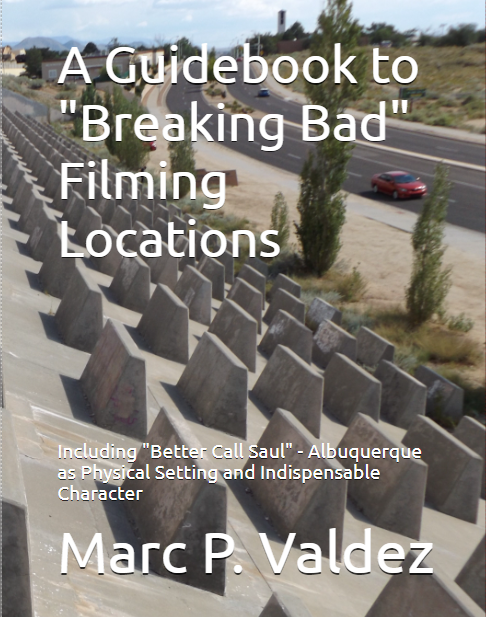
"A Guidebook To 'Breaking Bad' Filming Locations: Including 'Better Call Saul' - Albuquerque as Physical Setting and Indispensable Character" (Sixth Edition)
Purchase book at the link. This book outlines thirty-three circuits that the avid fan can travel in order to visit up to 679 different filming locations for "Breaking Bad" and "Better Call Saul" in the Albuquerque area. Some background is provided for each site, including other movies that might have also used the site for filming.
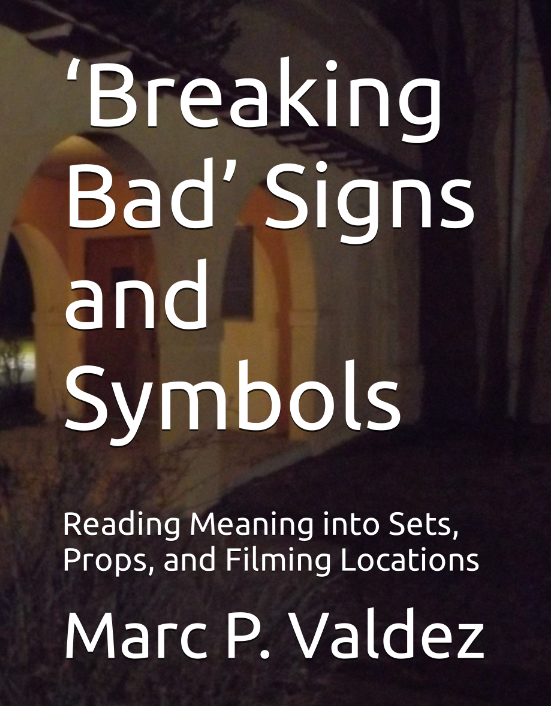
"‘Breaking Bad’ Signs and Symbols: Reading Meaning into Sets, Props, and Filming Locations” (Second Edition)
Purchase book at the link. “‘Breaking Bad’ Signs and Symbols,” aims to understand some of the symbolism embedded in the backgrounds of “Breaking Bad” and “Better Call Saul,” in order to decode messages and stories Vince Gilligan and crew have hidden there. A series of tables are used to isolate how certain (particularly architectural) features are used: Gentle Arches, Tin Ceilings, Five-Pointed Stars, Octagons, etc. Daylighting innovations that were either pioneered or promoted in Chicago are examined: Glass Block Windows, Luxfer Prismatic Tile Windows, and Plate Glass Windows.
Certain symbols advance the plot: foreshadowing symbols like Pueblo Deco Arches, or danger symbols like bell shapes and stagger symbols. Other features, like Glass Block Windows or Parallel Beams in the Ceiling, tell stories about the legacies and corruptions of modernity, particularly those best-displayed at Chicago’s “Century of Progress” (1933-34).
In addition, a number of scenes in the show are modeled after Early Surrealist artworks. The traces of various artists can be tracked in both shows, including: Comte de Lautréamont, Giorgio De Chirico, Man Ray, Max Ernst, Leonora Carrington, René Magritte, Toyen, Yves Tanguy, Remedios Varo, Paul Klee, and in particular, Salvador Dalí.
--------------------------
Video Section
I've produced several videos on this general topic over the last several years.
The Influence of Salvador Dalí in “Breaking Bad” and “Better Call Saul” (as prepared for the Dali Museum in St. Petersburg, FL)
The Influence of Salvador Dalí in “Breaking Bad” and “Better Call Saul”
The Impact of Michel Foucault and Surrealist Artists on “Breaking Bad” and “Better Call Saul”
End Game – Streamline Moderne and Surrealism in the Last Two Seasons of “Better Call Saul”
-----
Wizards - Salvador Dalí, and the Surrealists


Saul punches a hole in his office wall to retrieve diamonds (BCS 405, “Quite a Ride”)
 Giorgio De Chirico’s “Mystery and Melancholy of a Street” (1914).

The Industrial Laundry in “Breaking Bad.”
Dalí did set design for “Los Sacos del Molinero” (1949), a ballet whose set design features numerous sacks of grain that look very much like the hanging sacks at the Industrial Laundry in “Breaking Bad” (e.g., BrBa episodes “Sunset,” “Shotgun,” “Cornered,” “‘End Times,” and “Face Off”; BCS 409, “Wiedersehen”).

In a surrealist touch, at the Upholstery Shop in “Better Call Saul,” chairs are suspended above the work area (BCS 306, “Off Brand”).
Flying chairs are a Dalí specialty - witness Philippe Halsman’s 1948, photograph, “Dalí Atomicus.”

The Cousins make a purchase.

Salvador Dalí’s 1983 painting, “The Truck (We'll be arriving later, about five o'clock)” appears to have inspired the scene in “Breaking Bad” where The Cousins purchase bulletproof vests from a traveling truck driver (BrBa 307, “One Minute”).

Rooftop of the Gizmo Store. 410 Central Ave. SW (at one time, a J.C. Penney's store).

Dalí’s 1930 painting “Vertigo – The Tower of Pleasure” is referenced with respect to the rooftop where Walt spies on Gus and plots to blow him up with a bomb (BrBa 412, “End Times”). Certain features in Dalí’s painting catch the eye: Walter White appears to stand in for the unstable blue ball, and drug lord Gus Fring plays the role of the menacing shadow.

Dalí provides unusual points of view. For example, the view of the crucifix as seen from above – as when extended to a supplicant - in his 1951 painting, “Christ of Saint John of the Cross” looks very much like our view of Chuck during his hospital visit after he had fallen and hit his head (BCS 210, “Klick”).

“Christ of Saint John of the Cross” (1951).

Walt rolls his barrel of money up to a house (BrBa 514, "Ozymandias").


Dalí’s 1929 painting “The First Days of Spring” may inspire this view along a fence at the Native-American home where Dung-Beetle Walt arrives with his rolling barrel of money (BrBa 514, “Ozymandias”). The view isn’t exact – Dalí’s work has steps where “Breaking Bad” features a fence. Still, the view is suggestive.

Dalí’s “Naked Woman in the Desert” (1948), together with a painting of horses by M.C. Escher, inspired the lyrics of the 70s soft-rock song “A Horse With No Name,” by the rock group “America” (BrBa 302, “Caballo sin Nombre”). Thus, the song is an indirect reference to Salvador Dalí.


I particularly like how set design and bold lighting in the Superlab facilitate comparison to Dalí’s “The Last Supper” (1955). Christ gestures with his right hand very much like lab assistant Gale Boetticher does, and the various disciples have their heads bowed like Walt does while looking at the chessboard (BrBa 306, “Sunset”).

Salvador Dalí’s “The Last Supper” (1955).


In 1859, Jean-François Millet painted "The Angelus," which honors a prayer said at the end of the work day, said in this case by two potato farmers. The 19th-Century French painting was famous, and an object of patriotic pride. To Dalí, however, everything about this painting was suspicious or enigmatic, and he became obsessed with it. Dalí referred to "The Angelus" in a number of his own paintings.
There are images in "Breaking Bad" that make one pause. For example, there is one view of Skyler at the Car Wash as seen through her office window (BrBa 409, “Bug”). On the left side of the image, we have Skyler with her head bowed, and on the right, inanimate objects are present, like a broom, a duster, and a squeegee. This image may be inspired by "An Archaeological Reminiscence of Millet's Angelus" (1933).


Salvador Dali's "Four Armchairs in the Sky" (1949).

Walt in armchair (BrBa 506, "Buyout"). Note that the left chair arm is deliberately hidden.

For example, on his way to confront Uncle Jack’s group, Walt leaves his watch on a gas pump (BrBa 516, “Felina”). Explanations vary as to why Walt does this. I think the show’s creators have him do this as an homage to Salvador Dalí and his melting clocks (e.g., “The Persistence of Memory,” 1931).

Dalí created an artwork called “Disembodied Telephone in the Desert” (1968). “Better Call Saul’s” promotional art features a disembodied telephone in the desert too, at the end of which you find Saul Goodman.

Dalí's “Disembodied Telephone in the Desert” (1968).

In the first episode of “Breaking Bad,” Walt takes his life’s savings and hands them to Jesse in order to buy an RV (BrBa 101, “Pilot”). Jesse asks him, “Why are you doing this?” Walt responds cryptically “I am awake”:

What does Walt mean? Is Walt encouraged by the business possibilities of making meth, or is Walt just as egocentric as Salvador Dalí?:

Dalí invented certain "Breaking Bad" staples: for example, the importance of breakfast (an attribute the writers then assign to Walter, Jr.). The exterior of Dalí's Theatre-Museum in Figueres, Catalonia, Spain, is studded with representations of eggs and bread.


Walter White, Jr., aka Flynn.


Breaking Bad’s Golden Moth ultimately comes from Salvador Dalí. In 1929, he worked with Luis Buñuel to create a silent film called “Un Chien Andalou.” It was the first film to feature the ominous, squeaking Death’s-Head Hawkmoth. The Hawkmoth has a feature on its back that looks like a skull. The Golden Moth in “Breaking Bad” is an abstracted Hawkmoth. The Hawkmoth has proven popular among filmmakers, and appears, for example, in promotional materials for the film “The Silence of the Lambs.”

There are many poisons in the world but “Breaking Bad” chooses to use Lily-of-the-Valley. Why that poison?


Hank sings "Eye of the Tiger" by Survivor (BrBa 409, "Bug").

At a terrible time, Hank meets the Tigers.

The Eyes of a Tiger.

In 1962, Dalí painted “Fifty Abstract Paintings Which as Seen from Two Yards Change into Three Lenin’s Masquerading as Chinese and as Seen from Six Yards Appear as the Head of a Royal Bengal Tiger,” or “The Royal Tiger” for short. Hank sings Survivor’s song “Eye of the Tiger” to Walt as he imagines bringing Gus to justice (BrBa 409, “Bug”), but the only Tigers that Hank ever meets is a girls’ athletic team. We see the Eyes of a Tiger, one of the principal players of the team, as Hank suffers his greatest humiliation and learns that his witnesses in custody have all been executed (BrBa 508, “Gliding Over All”).

The empty White family's pool, used for skateboarders (BrBa 501, "Live Free or Die").
Salvador Dali's "Suez" (1932).

At different times, they all had the Paranoiac Visage.
Paranoiac Visage (1935).

Jimmy takes Kim to a Modern Home for sale (BCS 502, "50% Off").
Bay Windows.

A surprise shower (BCS 502, "50% Off").


Illicit money is hidden in the tires (BCS 209, "Nailed").
 Aperture Center, UNM's Mesa del Sol facility, University Blvd. & Stryker Rd. SE (BCS 307, “Expenses”; BCS 309, “Fall”).
 Pugash Hall at the Anderson-Abruzzo International Balloon Museum is the location of both the shoe store where Marie shoplifts a pair of shoes and where Walt and Gretchen discuss the composition of the human body (BrBa 103, “…And the Bag’s in the River”). The western half of Pugash Hall is used for the Shoe Store and eastern half for the Human Body Classroom.

Human Body Classroom (BrBa 103, “…And the Bag’s in the River”).
 Salvador Dali's “Melancholy Atomic and Uranic Idyll” (1945),

In “The Persistence of Memory,” we see a beach landscape. A melting clock sits on a platform and a fly sits on the clock – perhaps an inspiration for the episode “Fly.” Ants swarm on a pocket watch, signifying decay. There is a bare olive tree with another melting clock draped on its branch. In the distance, we have the headland of Cadaqués, a familiar landscape feature located near where Dalí lived. And a slug-like feature is present that represents Dalí himself.
In “The Disintegration of the Persistence of Memory,” we see the same scene, but the insects are gone. Everything is being stripped down to its basics. The platform is a grid of bricks, as is the beach, and the bricks are flying off as conical warheads that proceed to harass the various clocks. Everything is disintegrating. The olive tree is in pieces, and the ocean surface is hung up in a tree on the left. The headland is floating just above the ocean surface. A fish has appeared. Perhaps the Nail Salon’s and Jimmy's fish tanks were suggested by this fish. Like this painting, after Chuck’s death, Jimmy’s moral universe fragments and disintegrates.

We see a lot of grids, triangles, and cones later in “Better Call Saul.” For example, we see Jimmy’s ice cream cone mobbed by ants (BCS 503, “The Guy For This”).

At Hector Salamanca’s birthday party, everyone is wearing conical hats on their heads (BCS 509, “Bad Choice Road”). At Louie’s Bar, we have a lot of conical-shaped lamps above the pool tables (BCS 503, “The Guy For This”). These same lamps had been seen in “Breaking Bad,” but very much in the background. In “Better Call Saul,” they are very much in the foreground.

After the Tweaker Party in Season 5 (BCS 502, “50% Off”), we see a stolen gnome, with a conical shaped head and a triangular-shaped break that covers half its face.

Jimmy carries a cone to assist with driving away with Howard’s car (BCS 604, “Hit and Run”).


Gian Bernini’s 1667 statue. The obelisk represents divine wisdom, but Egyptian, not Christian.
 Figure 14: Blue bars in the Albuquerque Sunport Parking Garage (BrBa 209, “4 Days Out”).

The 2nd-level stairwell was the place where Walt calls Jesse and tries to convince him to come with him and cook. Jesse replies that he has plans, and Walt says: "Smoking marijuana, eating Cheetos and masturbating do not constitute 'plans' in my book.” The word “masturbating” is a red flag for Salvador Dalí’s influence, given the number of works Dalí painted on the subject. This location has an unusual point-of-view for “Breaking Bad” – neither at ground level, nor elevated, but somewhere in the middle – making one think the creative team was trying to mimic a specific view somewhere. But what view? Does Salvador Dalí have a view that works?

“Palladio's Corridor of Thalia” (1937).
“Palladio's Corridor of Dramatic Disguise” (1938).
Andrea Palladio’s Teatro Olimpico in Vicenza (1580; Stage Set by Vincenzo Scamozzi)


 Salvador Dalí’s “The Hand – Remorse” (1930).

The third mystery is: Why is there a small fake tree in the background of the desert scene that starts the episode BrBa 507, “Say My Name”? If you go to the actual location you won’t find the tree - it was a prop. It’s supposed to be a juniper tree, but it is very unusual-looking for a juniper. Most juniper trees are round, or perhaps have a tapered shape, but this tree is too small and top-heavy, and leans over to the side. Nevertheless, in one scene, the tree’s image appears very close to (and thus is associated with) the image of Mike Ehrmantraut.

Then, later in the same episode, when Mike is disposing his guns down a well, we see a second tree, a tall Cottonwood in the distance. The tree is also leaning over to the side and it is also closely associated with Mike Ehrmantraut.
The image of the tree is associated with the image of Mike Ehrmantraut. And then, I remembered that Salvador Dalí has a painting, “The Three Sphinxes of Bikini” (1947). In 1946, the United States detonated three atomic bombs at Bikini Atoll in the Pacific. Subsequently there were more, but in 1947 there had been three.


I also wanted to learn a little bit more about the girl that finds Walt’s gas mask at the end of BrBa 102, ”Cat’s in the Bag…” Just who is she, in a symbolic sense?

Salvador Dalí’s “Nostalgic Echo” (1935).

Salvador Dalí’s “Landscape with Girl Skipping Rope” (1936)
Salvador Dalí’s “Anthropomorphic Echo” (1937).
Left end of Salvador Dalí’s “Anthropomorphic Echo” (1937).
Right end of Salvador Dalí’s “Anthropomorphic Echo” (1937).

In 1969, Dalí did a number of illustrations for Lewis Carroll’s “Alice in Wonderland.” He returns to his original approach of the girl jumping rope. In Dalí’s painting “Down the Rabbit Hole” (1969), Alice in Wonderland jumps rope on top of a large mushroom. We see the White Rabbit and we also see a Walking Stick. A Walking Stick was presented in a desert rendezvous scene (BrBa 202, “Breakage”), symbolic of the rabbit hole that Walter and Jesse have taken the audience down on their meth-making adventure. The creative team of “Breaking Bad” wanted to explore some of these “Alice in Wonderland” concepts for the girl who finds Walt’s gas mask.

“Advice From a Caterpillar” (1969)

The “Breaking Bad,” creative team would originally have wanted to bring the girl into the scene in a bell skirt jumping rope, but there are important practical considerations. One, it’s impossible to jump rope while wearing a bell skirt. Two, it’s impossible to travel quickly while jumping rope. And so, they introduce her running playfully along as her playmate kicks a ball. The creative team needs to identify her as Alice in Wonderland, though, and the way they do that is by dressing her in a denim jumper. The girl in the jumper is the one who jumps. She is Alice in Wonderland. As she enters the scene, music from Glen Phillips’ “The Hole” is playing – the rabbit hole. She finds Walt’s gas mask, which he had discarded in a fit of frustration, and puts it on.


We have a young woman wandering across an empty Dalinian landscape. She sees an obelisk with a figure frozen in it – a figure representing time. She also sees the shadow of a bell tower, and a bell (“Dalí and Disney – Destino: The Story, Artwork, and Friendship behind the Legendary Film,” David A. Bossert, Disney Editions, Disney Book Group, Los Angeles, CA, 2015).

The bell’s shadow is symbolic of the purity within herself, and she clothes herself in the shadow.
Then a transformation occurs. The young woman is now wearing the bell skirt. She has a half-hoop over her head, but instead of a jump rope it is her own hair.
And the figure in the obelisk begins to come to life as she dances with joy and love.

Skyler in anguish (BrBa 514, "Ozymandias").
Salvador Dalí’s "Angel de la Victoria" (1985).

Huell mans the door.

Salvador Dalí’s "The Will-of-the-Wisp" (1966).

Walter White.

Salvador Dalí’s "Surrealist King" (1971).

The attack at Uncle Jack's clubhouse (BrBa 516, "Felina").

Salvador Dalí’s "Breathing Pneumatic Armchair" (1975).

René Magritte’s “The Great Century” (1954) might be the model upon which so many ground-based points-of-view are based in these TV shows, such as the view of the ceiling of the courtroom where Chuck loses his cool in BCS 305, “Chicanery.” (See ‘An Emphasis on Ceilings,’ page 248).


Chuck doesn't attach a picture of an eye to the metronome, or destroy it, but he does destroy the musical piece - a piece that was important to Rebecca. The motivations are different. Chuck was frustrated with his mental illness and Man Ray was bitter about the end of his romance. Still, the creative team of “Better Call Saul” used this little bit of Surrealist history for their own purposes. Note that the tip of the metronome’s pendulum repeatedly slashes across Chuck's eye. This can’t be by accident. The slashing calls to mind the eye slashing in "Un Chien Andalou," a Surrealist film made by Luis Buñuel and Salvador Dalí in 1929.

Chuck's Metronome (BCS 202, “Cobbler”).

Man Ray's Metronome.


"Les Chants de Maldoror" cover.

An important book influenced all the Surrealists - "Les Chants de Maldoror" - an 1869 book by the self-styled Comte de Lautréamont. Lautréamont was the nom de plume of a French poet named Isidore Ducasse, originally born in Uruguay. He died young, at age 24. Years after his death, Surrealists and Dadaists stumbled across his obscure work and proclaimed it as one of their chief inspirations. Several Surrealists took turns over the years illustrating different versions of the book.

Jimmy makes a two-faced appearance as he eyes the grieving family of the man murdered by his client, Lalo (BCS 507, “JMM”). Like the hermaphrodite, Jimmy wants to console them, as well as capably represent his client Lalo, but he can't do both.


"Electro-Sexual Sewing Machine" (1934), by Oscar Dominguez.

Interpreting Broad-Brimmed Lights or Umbrellas as masculine symbols helps explain very brief and unexpected appearances in “Breaking Bad” and “Better Call Saul.” For example, in the narcocorrido scene that opens episode BrBa 207 “Negro y Azul,” we see a man carrying an unexpected umbrella on a sunny day, and in BCS 110, “Marco,” as Marco awaits the arrival of Jimmy and their Rolex mark, we see a broad-brimmed light appropriate only for interiors, but unexpectedly present in the exterior environment of the alley. This broad-brimmed light is not present in other views of the alley; only once, for all of five seconds.


Giorgio De Chirico’s “The Anxious Journey” (1913).

Giorgio De Chirico painted “The House in the House” (1924), anticipating Vamonos Pest’s placement of tents within the houses they fumigate. Jesse gives a prosaic reason for using the tents – to avoid fumigating draperies – but I suspect honoring Giorgio De Chirico is the real reason.

Keys
Eyes

"Days of Wonder" mural, Central Ave. at Amherst St. NE, in Albuquerque.

"Days of Wonder" mural
"Days of Wonder" mural

"Piazza d'Italia" by Giorgio De Chirico.

Doc Review at HHM.

The Czech artist Toyen painted “Safes” (1945), with bloody patches at each of the open safe doors in a vault, apparently inspiring the room of safe-deposit boxes at Cradock Marine Bank (BrBa 507, “Say My Name”). Toyen’s “Safes” may also be the model for HHM’s Doc Review (BCS 107, “Bingo”).
 The Czech artist Toyen painted “Safes” (1945), with bloody patches at each of the open safe doors in a vault.


Leonora Carrington’s painting, “Green Tea” (1942), captures a dream Carrington had while she was undergoing drug therapy in a Spanish madhouse. She paints herself as being in a straitjacket, and her two avatars, the hyena and the horse, are tied up as well.

Walter White's Goorin hat.

Max Ernst’s work, “The Hat Makes The Man,” (1920), a collage made from sales-catalog clippings, may have urged the showrunners to introduce Heisenberg’s trademark porkpie hat. A century ago, Ernst’s painting was understood to be a Freudian twist on a popular advertising slogan. The Surrealists were particularly impressed by the phallic hat displays in Ernst’s collage.
 I noticed the cucumber slices - "Cucumber Water For Customer Only!" - are seven-sided in "Better Call Saul".
Seven sides could be a reference to Sigillum Dei, or perhaps to the Thelemic Star of Babalon. If the latter, it would complement Vince Gilligan's use of Jack Parson's story for Gus Fring's demise in Breaking Bad.

 Jimmy McGill does what he wants when he defies Mrs. Nguyen when she says: “Cucumber water for customer only” (BCS 101, “Uno”). I believe the mysterious crystal in the painting is the connection to the television scene. The table-top of the crystal has seven sides, as do the cucumber slices in the water.

Walter White bids farewell to Gretchen and Elliott Schwartz in their Felina House (BrBa 516, Felina").

There is something deeply unsettling about having the paths of a man and woman depart at a ninety-degree angle from each other in Remedios Varo’s painting, “The Farewell” (1958). The woman goes off to the right, and the man goes to the left. They are in a de-Chirico-inspired space. Despite the difference in architecture, in Walter White’s farewell to Elliot and Gretchen, the disturbing ninety-degree angle is recreated in Elliot and Gretchen’s living room (BrBa 516, “Felina”).

In 1916, like so many others, Paul Klee was a soldier on the frontlines of the Great War. Two of Klee’s most-promising artistic classmates and friends were killed in battle, and authorities realized they might inadvertently kill off all the best artists of the next generation. So, Klee was pulled off the frontlines sent to do aircraft maintenance instead. Klee painted in his spare time.

Walt’s right hand is on his hip and his left hand appears to be pointing at, or perhaps pointing something towards, the viewer. A pistol, perhaps?
It would be interesting to learn the full story of how Walt started from here and ended up in the New Mexico desert 91 years later.

Salvador Dalí’s ”The Piano of Mozart” (1965).
Gene looks at the piano (BCS 612, “Waterworks”).

A row of hats (BCS 612, “Waterworks”).

Giorgio de Chirico’s “The Red Tower” (1920).

Gene in the loft (BCS 612, “Waterworks”).
Mary Colter's "Desert View Watchtower" at the Grand Canyon (1932).
I started this line of thought by investigating what appeared to be a few references to the work of Surrealist artist Salvador Dalí in "Better Call Saul." To my surprise, after a bit of digging, I found Salvador Dalí’s influence is pervasive in "Breaking Bad" and "Better Call Saul." And not just Salvador Dalí: other Surrealist artists too!
Salvador Dalí
Some quick facts regarding Salvador Dalí. He was a prolific artist, known best for his many dream-like Surrealist paintings. He was also open to the nuclear revolution of the 20th Century, and painted accordingly. Politically, he was difficult to characterize - both an anarchist and a monarchist. After World War II he was an international celebrity - perhaps the second-most famous artist in the world, eclipsed only by Pablo Picasso.
Salvador Dalí and Vince Gilligan alike share a background of traditional Catholicism and enthusiasm for science. Salvador Dalí was convinced that the separate worlds of science and religion can coexist. I attended a talk where Vince Gilligan described himself as a seeker after truth and expressed thoughts similar to those of Dalí. “Better Call Saul’s” co-producer Peter Gould has a background in art. The shows’ creators wanted to impart a surreal atmosphere to the shows, and what better way to do that than by following the lead of the master surrealist himself?
Regarding Salvador Dalí:
I suspect the creative teams of these television shows often consult Salvador Dalí’s legacy of paintings, drawings, sculptures and other artworks, for inspiration, and in order to engineer Surrealism into the television shows.
Salvador Domingo Felipe Jacinto Dalí i Domènech, 1st Marquess of Dalí de Púbol (11 May 1904 – 23 January 1989) was a Spanish surrealist artist renowned for his technical skill, precise draftsmanship, and the striking and bizarre images in his work.
Born in Figueres, Catalonia, Dalí received his formal education in fine arts in Madrid. Influenced by Impressionism and the Renaissance Masters from a young age, he became increasingly attracted to Cubism and avant-garde movements. He moved closer to Surrealism in the late 1920s and joined the Surrealist group in 1929, soon becoming one of its leading exponents. His best-known work, “The Persistence of Memory,” was completed in August 1931, and is one of the most famous Surrealist paintings. Dalí lived in France throughout the Spanish Civil War (1936 to 1939) before leaving for the United States in 1940 where he achieved commercial success. He returned to Spain in 1948 where he announced his return to the Catholic faith and developed his "nuclear mysticism" style, based on his interest in classicism, mysticism and recent scientific developments.
Dalí's artistic repertoire included painting, graphic arts, film, sculpture, design and photography, at times in collaboration with other artists. He also wrote fiction, poetry, autobiography, essays and criticism. Major themes in his work include dreams, the subconscious, sexuality, religion, science and his closest personal relationships.
…There are two major museums devoted to Salvador Dalí's work: the Dalí Theatre-Museum in Figueres, Spain, and the Salvador Dalí Museum in St. Petersburg, Florida.
...From 1927 Dalí's work became increasingly influenced by Surrealism. …Influenced by his reading of Freud, Dalí increasingly introduced suggestive sexual imagery and symbolism into his work.
…Some trends in Dalí's work that would continue throughout his life were already evident in the 1920s. Dalí was influenced by many styles of art, ranging from the most academically classic, to the most cutting-edge avant-garde. His classical influences included Raphael, Bronzino, Francisco de Zurbarán, Vermeer and Velázquez.
Salvador Dalí is not the only Surrealist artist who has an impact. René Magritte, Man Ray, Giorgio De Chirico, Toyen, Leonora Carrington, and others have also had their impacts. Many of the Surrealist paintings are available online at this website.
Angelo Restivo’s Take
In his book on the influences of 20th-Century cinema on “Breaking Bad” (“Breaking Bad and Cinematic Television,” Angelo Restivo, Duke University Press, Durham and London, 2019), Angelo Restivo (from Georgia State University), notes that Surrealism plays a role. Nevertheless, Restivo cautions about reading too much into the Surrealistic influences. Restivo notes:
To begin with, I would want to stress that in this video – which juxtaposes images from the television series “Breaking Bad” with scenes from the archive of surrealist filmmaking – I am decidedly not claiming that these resonances and rhymes were intentional citations by the production team of the television series. It is certainly true that “Breaking Bad” is rife with echoes of the classical and postclassical cinematic canon, and many of these echoes must be seen as conscious choices on the part of the production. This is clear as early as in the pilot episode, where the savvy viewer can see that in its very inciting premises, the series will be channelling Nicholas Ray’s great 1956 melodrama “Bigger Than Life.” In my recently-published book on the series, I track many more of these echoes of the cinematic canon in the series; but what I argue is that these ‘cinematic hauntings’ have little in common with the blank parody or pastiche that has come to be seen as a central characteristic of postmodern aesthetic practice. Instead (to take the example from “Bigger Than Life”), the expressive problems faced by the film – how to render visible the new relations between spaces, social subjects, and institutions resulting from the post-war modernisation, from the development of the suburban tract house to the new wonder drugs developed by Big Pharma – now, in “Breaking Bad,” become the starting point for thinking through similar expressive problems within the present historical moment, and within the aesthetic mode of post-network serial television, where the extended form allows us to live with the world of the series over a much more extended period of time.
Here are some of the Surrealist cinema references that Restivo notes in his video and book (Table 1):

Based on Restivo’s choice of films, I would add the following:
- Gratuitous beetle-stomping scene: (BrBa 206, “Peekaboo”) – “L’Age d’Or” (1930); and,
- Chuck dismantles his house in search of electricity (BrBa 310, “Lantern”), Saul punches a hole in his office wall to retrieve diamonds (BCS 405, “Quite a Ride”), and Mike retrieves a bullet from the wall of Kim and Jimmy’s apartment (BCS 409, “Fun and Games”) - Guests start punching holes in the walls and dismantling their host’s house in search of water – “The Exterminating Angel” (1962).

Saul punches a hole in his office wall to retrieve diamonds (BCS 405, “Quite a Ride”)
I’m impressed how Restivo and I independently gravitate to some of the same scenes as reflecting Surrealist influences. To the young girl wearing a discarded gas mask in the desert (“Cat’s in the Bag…”), Restivo responds by juxtaposing images from the 1965 Buñuel film, “Simon of the Desert.” I respond in my own video by juxtaposing images from the Disney/Dalí production “Destino.” Yet, the images for both films have a common origin in Giorgio De Chirico’s painting called “Mystery and Melancholy of a Street” (1914) and Salvador Dalí’s paintings from the mid-1930s. We both essentially see the same thing!

Nevertheless, I would maintain that the Surrealist influences that Restivo notes are but the most-obvious tip of a submerged Surrealist iceberg that the production teams repeatedly and consciously rely on for television success. Below, I enumerate some of the Surrealist influences that I have found.
Salvador Dalí’s Reach
Dalí provides visual models for the television shows. Here is a listing of his works of art – mostly paintings - that seem to have influenced “Breaking Bad” and “Better Call Saul.”
“Los Sacos del Molinero” (1949)

The Industrial Laundry in “Breaking Bad.”

Dalí did set design for “Los Sacos del Molinero” (1949), a ballet whose set design features numerous sacks of grain that look very much like the hanging sacks at the Industrial Laundry in “Breaking Bad” (e.g., BrBa episodes “Sunset,” “Shotgun,” “Cornered,” “‘End Times,” and “Face Off”; BCS 409, “Wiedersehen”).
The sacks resemble bodies cocooned by spiders. The hanging theme is echoed by the hanging human toy contested by the young Cousins (BrBa 307, “One Minute”) and by upside-down hanging teenage thugs in “Better Call Saul” (BCS 406, “Piñata”).
“Dalí Atomicus” (1948)

In a surrealist touch, at the Upholstery Shop in “Better Call Saul,” chairs are suspended above the work area (BCS 306, “Off Brand”).
Flying chairs are a Dalí specialty - witness Philippe Halsman’s 1948, photograph, “Dalí Atomicus.”
“The Truck (We'll be arriving later, about five o'clock)” (1983)

The Cousins make a purchase.

Salvador Dalí’s 1983 painting, “The Truck (We'll be arriving later, about five o'clock)” appears to have inspired the scene in “Breaking Bad” where The Cousins purchase bulletproof vests from a traveling truck driver (BrBa 307, “One Minute”).
“Vertigo – The Tower of Pleasure” (1930)

Rooftop of the Gizmo Store. 410 Central Ave. SW (at one time, a J.C. Penney's store).

Dalí’s 1930 painting “Vertigo – The Tower of Pleasure” is referenced with respect to the rooftop where Walt spies on Gus and plots to blow him up with a bomb (BrBa 412, “End Times”). Certain features in Dalí’s painting catch the eye: Walter White appears to stand in for the unstable blue ball, and drug lord Gus Fring plays the role of the menacing shadow.
“Christ of Saint John of the Cross” (1951)

Dalí provides unusual points of view. For example, the view of the crucifix as seen from above – as when extended to a supplicant - in his 1951 painting, “Christ of Saint John of the Cross” looks very much like our view of Chuck during his hospital visit after he had fallen and hit his head (BCS 210, “Klick”).

“Christ of Saint John of the Cross” (1951).
“The First Days of Spring” (1929)

Walt rolls his barrel of money up to a house (BrBa 514, "Ozymandias").

Here is visual evidence of the tenuous boundary between civilization and chaos.

Dalí’s 1929 painting “The First Days of Spring” may inspire this view along a fence at the Native-American home where Dung-Beetle Walt arrives with his rolling barrel of money (BrBa 514, “Ozymandias”). The view isn’t exact – Dalí’s work has steps where “Breaking Bad” features a fence. Still, the view is suggestive.
“Naked Woman in the Desert” (1948)

Dalí’s “Naked Woman in the Desert” (1948), together with a painting of horses by M.C. Escher, inspired the lyrics of the 70s soft-rock song “A Horse With No Name,” by the rock group “America” (BrBa 302, “Caballo sin Nombre”). Thus, the song is an indirect reference to Salvador Dalí.

A painting of horses by M.C. Escher. There’s no particular reason to have “A Horse With No Name” in the show, except in order to honor Dalí.
“The Last Supper” (1955)

I particularly like how set design and bold lighting in the Superlab facilitate comparison to Dalí’s “The Last Supper” (1955). Christ gestures with his right hand very much like lab assistant Gale Boetticher does, and the various disciples have their heads bowed like Walt does while looking at the chessboard (BrBa 306, “Sunset”).

Salvador Dalí’s “The Last Supper” (1955).
“Corpus Hypercubus” (1954)

I was struck by the similarities in composition between the overhead image of Jimmy McGill lying on his bed in his Nail Salon office (BCS 102, “Mijo”) and Salvador Dalí’s 1954 work, “Corpus Hypercubus,” which mimics an unfolded hypercube cross. A hypercube cross is an unfolded tesseract; a four dimensional cube unfolded into three dimensions.
'

Dali was convinced that the separate worlds of science and religion can coexist. I attended a talk in Davis, CA on 12/10/15 where Vince Gilligan expressed essentially the same thought.
When we see Jimmy’s Nail Salon office from above, there’s a metal grid in the foreground of the scene that calls to mind the composition of the hypercube cross painting. A hypercube cross reappears on a background mural in Season 3 of “Better Call Saul,” as Jimmy McGill cross-examines his brother Chuck (BCS 305, “Chicanery”).

A traditional Spanish-mission-style cross can also be seen in the Chicanery mural adjacent to the hypercube cross, together with symbols of war, signifying a battle between Tradition and Modernity – or, if you will, perhaps a reference to New Mexico’s Battle of Taos (1847), where there really was an armed conflict between the forces of tradition and modernity. When the hypercube cross is clearly-visible, Chuck says, “Electricity is everywhere in the modern world.” Indeed, electricity distinguishes the modern world from the world of tradition.

Here is my attempt to recreate the hypercube cross in the background mural. The individual squares in the cross resemble Schlegel diagrams of tesseracts.

Here are the ruins of San Gerónimo de Taos, the church at Taos Pueblo that was bombarded, set afire, and destroyed by American forces fighting the Taos Rebellion in 1847. (My photo, taken in 1995.)
“An Archaeological Reminiscence of Millet's Angelus" (1933)

In 1859, Jean-François Millet painted "The Angelus," which honors a prayer said at the end of the work day, said in this case by two potato farmers. The 19th-Century French painting was famous, and an object of patriotic pride. To Dalí, however, everything about this painting was suspicious or enigmatic, and he became obsessed with it. Dalí referred to "The Angelus" in a number of his own paintings.

There are images in "Breaking Bad" that make one pause. For example, there is one view of Skyler at the Car Wash as seen through her office window (BrBa 409, “Bug”). On the left side of the image, we have Skyler with her head bowed, and on the right, inanimate objects are present, like a broom, a duster, and a squeegee. This image may be inspired by "An Archaeological Reminiscence of Millet's Angelus" (1933).

"An Archaeological Reminiscence of Millet's Angelus" (1933).
Millet’s “Angelus” and Armchairs

In "Breaking Bad" and "Better Call Saul," characters sometimes tell stories while sitting in studded armchairs or couches. When seen from the front, the rows of studs on both armchair ends look like the silhouettes of heads bowed in prayer, but with the heads facing outwards rather than inwards.
When stories are being told about the past and its regrets, the creative teams of the shows make sure we see the studs of only one arm of the chair or couch. Views of the other arm are blocked. Only one arm is shown, in order to avoid the strange look of two heads bowed in prayer away from one another. "Breaking Bad" makes sure we see only the right arm (as seen from the point of view of the person sitting in the chair). In contrast, "Better Call Saul" makes sure we see only the left arm. Prayerful furniture may be used here as a silent comment on the stories.

Salvador Dali's "Four Armchairs in the Sky" (1949).

Walt in armchair (BrBa 506, "Buyout"). Note that the left chair arm is deliberately hidden.
- I can’t help but feel these studded bowed head silhouettes are references to Millet’s “Angelus.” Here are four examples: Walter White tells Jesse about selling out his stake in Gray Matter Technologies for only $5,000. The left chair arm is not shown (BrBa 506, “Buyout”);
- Embattled Hank Schrader tells Walt about simpler days in his youth, when he was tagging trees for removal. The left chair arm is obscured by what looks like a masculinity sign – maybe a Chihuly glass spiral (BrBa 508, “Gliding Over All”);
- Chuck McGill tells Kim about Jimmy's role in undermining their dad's store. The right couch arm is not shown (BCS 205, “Rebecca”);
- Jimmy McGill tells Kim about the alcohol-and-anger management problems of the cop who arrested Huell. View of the right couch arm is blocked by a chair (BCS 407, “Something Stupid”).
Various Dalinian Ideas
Dalí provides more than just visual models for the television shows. He also provides ideas that the shows elaborate upon.

For example, on his way to confront Uncle Jack’s group, Walt leaves his watch on a gas pump (BrBa 516, “Felina”). Explanations vary as to why Walt does this. I think the show’s creators have him do this as an homage to Salvador Dalí and his melting clocks (e.g., “The Persistence of Memory,” 1931).

Dalí created an artwork called “Disembodied Telephone in the Desert” (1968). “Better Call Saul’s” promotional art features a disembodied telephone in the desert too, at the end of which you find Saul Goodman.

Dalí's “Disembodied Telephone in the Desert” (1968).
Dalí had a very rocky relationship with his father. In response, Dalí adopted various father figures in his life. For a number of years, Sigmund Freud was his father figure. Then Dalí became excited by the physics revolution of the 20th century, and after a time he dropped Freud and adopted Werner Heisenberg, known best for the Uncertainty Principle, as his father figure. It’s through Dalí and the world of art that Heisenberg enters “Breaking Bad,” and not directly from the world of science. In his "Anti-Matter Manifesto,” Salvador Dalí created Walter White’s moniker as it is understood in “Breaking Bad.”
As Dalí said:
In the Surrealist period I wanted to create the iconography of the interior world and the world of the marvellous, of my father Freud. Today the exterior world and that of physics, has transcended the one of psychology. My father today is Dr. Heisenberg.What better way to illustrate the failings of modern masculinity (represented by Walter White) than by incorporating Salvador Dalí’s imagery directly into the two television shows?

In the first episode of “Breaking Bad,” Walt takes his life’s savings and hands them to Jesse in order to buy an RV (BrBa 101, “Pilot”). Jesse asks him, “Why are you doing this?” Walt responds cryptically “I am awake”:
Jesse Pinkman: Nah, come on, man. Some straight like you, giant stick up his ass, all a sudden at age, what, 60, he's just gonna break bad?
Walter H. White: I'm 50.
Jesse Pinkman: It's weird, is all. Okay, it doesn't compute. Listen, if you've gone crazy or something, I mean, if you... If you've gone crazy, or depressed. I'm... I'm just saying. That... That's something I need to know about. Okay, I mean, that affects me.
Walter H. White: I am awake.
Jesse Pinkman: What?
Walter H. White: Buy the RV. We start tomorrow.

What does Walt mean? Is Walt encouraged by the business possibilities of making meth, or is Walt just as egocentric as Salvador Dalí?:
“Each morning I wake and I experience again a supreme pleasure, the pleasure of being Salvador Dalí.”
Breakfast and Bacon

Dalí invented certain "Breaking Bad" staples: for example, the importance of breakfast (an attribute the writers then assign to Walter, Jr.). The exterior of Dalí's Theatre-Museum in Figueres, Catalonia, Spain, is studded with representations of eggs and bread.

Dalí was the first to explore a connection between bacon and the passage of time, with his “Soft Self Portrait with Fried Bacon” (1941), which features a strip of bacon. Crutches hold up the sagging jowls and eyelids as Dalí’s face ages. In “Breaking Bad,” of course, strips of bacon were broken into pieces and formed into numerical digits in order to mark birthdays.

Walter White, Jr., aka Flynn.

Dalí uses a lot of crutches in his work. Crutches support his various fantastical architectural creations, holding up things that couldn’t support themselves otherwise. The creative team at “Breaking Bad,” I’m sure, wanted to follow Dalí and use a lot of crutches in their show too, but the only way they could reliably do that was to have a regularly-appearing character who needed to use crutches. And hence, we have Walter Junior, a.k.a. Flynn, who needs to use crutches. In “Better Call Saul,” Kim does a scam using crutches (BCS 409, “Wiedersehen”).
(As an aside, Lady Gaga uses a lot of crutches in her music videos. That Surrealist tradition has great reach.)


Breaking Bad’s Golden Moth ultimately comes from Salvador Dalí. In 1929, he worked with Luis Buñuel to create a silent film called “Un Chien Andalou.” It was the first film to feature the ominous, squeaking Death’s-Head Hawkmoth. The Hawkmoth has a feature on its back that looks like a skull. The Golden Moth in “Breaking Bad” is an abstracted Hawkmoth. The Hawkmoth has proven popular among filmmakers, and appears, for example, in promotional materials for the film “The Silence of the Lambs.”

There are many poisons in the world but “Breaking Bad” chooses to use Lily-of-the-Valley. Why that poison?

As it turns out, Lily-of-the-Valley is a popular ingredient in perfumes. Salvador Dalí went into the business of making perfumes twice in his life, in the 1940s, and again in the 1980s. Today you can order Salvador Dalí perfumes on the web, and about a third of them contain Lily-of-the-Valley. I think it’s because Lily-of-the-Valley would’ve been important to Salvador Dalí that “Breaking Bad” chooses to use it.

Hank sings "Eye of the Tiger" by Survivor (BrBa 409, "Bug").

At a terrible time, Hank meets the Tigers.

The Eyes of a Tiger.

In 1962, Dalí painted “Fifty Abstract Paintings Which as Seen from Two Yards Change into Three Lenin’s Masquerading as Chinese and as Seen from Six Yards Appear as the Head of a Royal Bengal Tiger,” or “The Royal Tiger” for short. Hank sings Survivor’s song “Eye of the Tiger” to Walt as he imagines bringing Gus to justice (BrBa 409, “Bug”), but the only Tigers that Hank ever meets is a girls’ athletic team. We see the Eyes of a Tiger, one of the principal players of the team, as Hank suffers his greatest humiliation and learns that his witnesses in custody have all been executed (BrBa 508, “Gliding Over All”).
The tiger makes another appearance with Kim’s boyfriend’s shirt (BCS 612, “Waterworks”).
Suez

The empty White family's pool, used for skateboarders (BrBa 501, "Live Free or Die").

Salvador Dali's "Suez" (1932).
Paranoiac Visage

At different times, they all had the Paranoiac Visage.

Paranoiac Visage (1935).
Plate Glass Windows Arrayed in a Convex Semi-Circle
Certain architectural features in Albuquerque appear to be used as Dalinian icons. For example, Plate Glass Windows arrayed in a convex semicircular arc (when viewed from the interior), such as bay windows, may represent the remarkable alcoves present in the interior courtyard of the Dalí Theatre-Museum in Figueres, Spain. Dalí’s museum was built on the site of the former Municipal Theatre of Figueres, destroyed in a fire at the end of the Spanish Civil War. The alcoves are remnants of the original theater, and now are inhabited by mannequins that look into the interior courtyard. The interior space is a theatrical space, with the audience looking in rather than the actors looking out. Bay Windows in the two television series should be understood similarly.

Jimmy takes Kim to a Modern Home for sale (BCS 502, "50% Off").

Bay Windows.

A surprise shower (BCS 502, "50% Off").

Here is the Modern Home for sale, 8904 Roys Pl. NE (BCS 502, “50% Off”). OldeSaultie sends a realtor link.
In "Better Call Saul," Jimmy takes Kim to tour a modern home for sale (BCS 502, “50% Off”). The house features Bay Windows on both first and second floors. Hanging blue cone-shaped lights are present too. The living room features various niches and alcoves reminiscent of the alcoves at Dalí’s Figueres Museum. Most importantly, a shower is present on the second floor, which Kim playfully uses to douse Jimmy.

At Dalí’s Figueres Museum, an automobile is present with a mannequin inside. You can sit in the passenger seat, insert a coin into a slot, and get hit by a blast of water. The automobile is called “Rainy Taxi,” or sometimes “Rainy Cadillac,” an installation placed right at the center of the museum's courtyard. Who doesn't need an unexpected shower to refresh the day? A tower of tires is present as well (and there are towers of tires at the Regalo Helado Warehouse; e.g., BCS 208, “Fifi”).

Illicit money is hidden in the tires (BCS 209, "Nailed").
Large niches arrayed in a circle are present in Saul’s bedroom (BCS 601, “Wine and Roses”; BCS 609, “Fun and Games”).
Plate Glass Windows in configurations other than in a convex semicircular arc won’t work as references to Salvador Dalí. For example, the Plate Glass Windows at Albuquerque’s Aperture Center are set in a concave semicircular arc. Despite the Aperture Center being used twice in “Better Call Saul,” the large Plate Glass Windows are never shown.
 Aperture Center, UNM's Mesa del Sol facility, University Blvd. & Stryker Rd. SE (BCS 307, “Expenses”; BCS 309, “Fall”).
 Jimmy sabotages Chuck here, by endangering his malpractice insurance, and Mike waits here to talk with Madrigal’s Lydia, yet these Plate Glass Windows are never shown on TV.
The Aperture Center, located across the street from "Q" Studios, was designed by renowned New Mexico architect Antoine Predock. I’ve never met Antoine Predock, but I did take an excellent ‘Introduction to Dance’ class taught by his lovely wife Jennifer Predock-Linnell, in the fall of 1979, in the Student Union Building (SUB) ballroom at the University of New Mexico.
 Pugash Hall at the Anderson-Abruzzo International Balloon Museum is the location of both the shoe store where Marie shoplifts a pair of shoes and where Walt and Gretchen discuss the composition of the human body (BrBa 103, “…And the Bag’s in the River”). The western half of Pugash Hall is used for the Shoe Store and eastern half for the Human Body Classroom.
Human Body Classroom (BrBa 103, “…And the Bag’s in the River”).
I’m intrigued by the various chairs in the scene of the Human Body Classroom. Salvador Dalí’s paintings present helpful associative imagery. For example, in Dalí’s “Melancholy Atomic and Uranic Idyll” (1945), elephants stand high above an empty landscape on spindly legs, dropping spheres in a way that suggests B-29 bombers dropping bombs over Japan. The chairs, with their spindly legs, are like Dalí’s elephants, dropping dangerous figurative bombs of their own as Walt neglects the weight of the human soul.

“The Persistence of Memory” (1931)
Among Dalí’s most famous paintings are “The Persistence of Memory” (1931), and 23 years later, “The Disintegration of the Persistence of Memory” (1954). I suspect both paintings are important visual inspirations for the television shows. I like to think “Breaking Bad” represents the first painting and “Better Call Saul” represents the second.

In “The Persistence of Memory,” we see a beach landscape. A melting clock sits on a platform and a fly sits on the clock – perhaps an inspiration for the episode “Fly.” Ants swarm on a pocket watch, signifying decay. There is a bare olive tree with another melting clock draped on its branch. In the distance, we have the headland of Cadaqués, a familiar landscape feature located near where Dalí lived. And a slug-like feature is present that represents Dalí himself.

In “The Disintegration of the Persistence of Memory,” we see the same scene, but the insects are gone. Everything is being stripped down to its basics. The platform is a grid of bricks, as is the beach, and the bricks are flying off as conical warheads that proceed to harass the various clocks. Everything is disintegrating. The olive tree is in pieces, and the ocean surface is hung up in a tree on the left. The headland is floating just above the ocean surface. A fish has appeared. Perhaps the Nail Salon’s and Jimmy's fish tanks were suggested by this fish. Like this painting, after Chuck’s death, Jimmy’s moral universe fragments and disintegrates.
Cones

We see a lot of grids, triangles, and cones later in “Better Call Saul.” For example, we see Jimmy’s ice cream cone mobbed by ants (BCS 503, “The Guy For This”).

At Hector Salamanca’s birthday party, everyone is wearing conical hats on their heads (BCS 509, “Bad Choice Road”). At Louie’s Bar, we have a lot of conical-shaped lamps above the pool tables (BCS 503, “The Guy For This”). These same lamps had been seen in “Breaking Bad,” but very much in the background. In “Better Call Saul,” they are very much in the foreground.

After the Tweaker Party in Season 5 (BCS 502, “50% Off”), we see a stolen gnome, with a conical shaped head and a triangular-shaped break that covers half its face.

Jimmy carries a cone to assist with driving away with Howard’s car (BCS 604, “Hit and Run”).
What is the general understanding of cones in Salvador Dalí’s work? They are variously interpreted as atomic warheads or as symbols of spiritual order in the universe. Perhaps the orderly grid of bricks in “The Disintegration of the Persistence of Memory” dissolves into cones of menace as the decay continues. By extension, ordinary, atomized people can lose their bearings and become threats to society as the decay continues
Obelisks and Hourglasses
When Mike informs Gus that dead gunmen had a specific tattoo identifying them as Columbian cartel members, Gus asks Mike to draw out the tattoo (BCS 509, "Bad Choice Road"). The drawing is quite abstract. I didn't positively recognize it, but it looks to me like a simplified Minkowski Diagram, used in Special Relativity to distinguish regions of the universe where causality holds (within the light cones) from regions where causality doesn’t. Similar shapes have been seen before: for example, the pedestal ashtrays used for the Human Body Classroom (BrBa 103, “…And the Bag’s in the River”).
Alternatively, the hour-glass shape might be more mundane, referring instead to the length of a prison sentence. Perhaps all Columbian cartel members are required to understand physics? The criminal world is a tougher place than I realized!
Interestingly, an hourglass is present in the Delmar house of Gene’s victim (BCS 611, “Breaking Bad”).

The most notable triangles that appears in Dalí’s works are obelisks. In his painting “The Temptation of Saint Anthony” (1946), we see Saint Anthony with his cross, trying to ward off a whole variety of temptations that come in on spindly-legged elephants, including an obelisk on an elephant’s back, an idea which comes from Gian Bernini’s 1667 statue. The obelisk represents divine wisdom, but Egyptian, not Christian.

Gian Bernini’s 1667 statue. The obelisk represents divine wisdom, but Egyptian, not Christian.
Mystery 1: Why Was The Albuquerque Sunport Parking Garage Chosen as a Filming Location?
And so, having learned a little about Salvador Dalí and his works, I wanted to solve several mysteries about the choice of filming locations in “Breaking Bad.”
The first mystery I wanted to address was why was the interior space of the Albuquerque Sunport Parking Garage chosen as a filming location (BrBa 209, “4 Days Out”)?
 Figure 14: Blue bars in the Albuquerque Sunport Parking Garage (BrBa 209, “4 Days Out”).
The 2nd-level stairwell was the place where Walt calls Jesse and tries to convince him to come with him and cook. Jesse replies that he has plans, and Walt says: "Smoking marijuana, eating Cheetos and masturbating do not constitute 'plans' in my book.” The word “masturbating” is a red flag for Salvador Dalí’s influence, given the number of works Dalí painted on the subject. This location has an unusual point-of-view for “Breaking Bad” – neither at ground level, nor elevated, but somewhere in the middle – making one think the creative team was trying to mimic a specific view somewhere. But what view? Does Salvador Dalí have a view that works?
Actually Dalí does have views that work! Two of them, actually: “Palladio's Corridor of Thalia” (1937) and “Palladio's Corridor of Dramatic Disguise” (1938). A mid-level point of view is chosen for both paintings. At the end of the corridor in both paintings, a girl in a long skirt jumps rope.

“Palladio's Corridor of Thalia” (1937).

“Palladio's Corridor of Dramatic Disguise” (1938).

Andrea Palladio’s Teatro Olimpico in Vicenza (1580; Stage Set by Vincenzo Scamozzi)

Trompe-l'œil Stage Set of Teatro Olimpico. And who was Palladio? Andrea Palladio designed the Teatro Olimpico in Vicenza, Italy in 1580. Palladio died before the theater was completed, so the area behind the proscenium was designed by Vincenzo Scamozzi.
And so, my hypothesis is that the interior space of the Airport Parking Structure in the episode ‘4 Days Out’ was chosen as a filming location because it was the closest approximation one could find in Albuquerque to the trompe-l'œil stage set of Teatro Olimpico.
Mystery 2: Why Does Walt Use a Skimmer Pole to Fetch a Band-Aid from a Swimming Pool?

At the start of Season 3 of “Breaking Bad,” Walt feels remorse for his plane-crash victims, and starts to burn his money in his back yard barbeque (BrBa 301, “No Más”). He changes his mind, though, and throws the barbeque, the money, and himself in the pool. He then exits the pool and fishes out the money with a skimmer pole.
All of this seems reasonable. Why then, in the next episode, does Walt, apropos of nothing, use a skimmer pole to fetch a Band-Aid from his apartment complex’s swimming pool? The Band-Aid is virtually invisible to passersby. What does this mean? Can Dalí somehow assist here? Is this still remorse at work?
Apparently, yes, but it’s remorse of a never-ending kind. The long skimmer pole is analogous to the grotesquely-large hand in Dalí’s painting “The Hand – Remorse” (1930). Like Walt with his record of murder victims, Dalí felt remorse about his record of masturbation, but just like Walt, Dalí would never, ever stop.

The Big Hand returns in the episode “Fly,” with Walt’s makeshift flyswatter. Walt’s “delights of remorse” are expressed with neurotic perfectionism - as if fewer people will get killed if things are just done better (BrBa 410, "Fly").

Mystery 3: Why is there a Small Fake Tree in the “Say My Name” Desert Scene?

The third mystery is: Why is there a small fake tree in the background of the desert scene that starts the episode BrBa 507, “Say My Name”? If you go to the actual location you won’t find the tree - it was a prop. It’s supposed to be a juniper tree, but it is very unusual-looking for a juniper. Most juniper trees are round, or perhaps have a tapered shape, but this tree is too small and top-heavy, and leans over to the side. Nevertheless, in one scene, the tree’s image appears very close to (and thus is associated with) the image of Mike Ehrmantraut.

Then, later in the same episode, when Mike is disposing his guns down a well, we see a second tree, a tall Cottonwood in the distance. The tree is also leaning over to the side and it is also closely associated with Mike Ehrmantraut.

The image of the tree is associated with the image of Mike Ehrmantraut. And then, I remembered that Salvador Dalí has a painting, “The Three Sphinxes of Bikini” (1947). In 1946, the United States detonated three atomic bombs at Bikini Atoll in the Pacific. Subsequently there were more, but in 1947 there had been three.

I think the two trees I mentioned are symbolic mushroom clouds foreshadowing Mike’s death at the end of the episode. In the episode “Madrigal,” Mike had told Walt that he was a ticking time bomb and that he didn’t want to be around for the boom. So, what boom was Mike talking about? He was talking about these booms, these figurative nuclear detonations. And so, if we have three mushroom clouds and just two trees, there must be a third tree somewhere…

Salvador Dali's “The Three Sphinxes of Bikini” (1947). And sure enough, towards the end of the episode, we see a tall cottonwood tree that also leans over to the side. But the scene takes place in a grove of trees, so Mike’s death is a figurative nuclear holocaust.
There is a curious echo of the use of trees as mushroom clouds in “Better Call Saul.” Three big trees appear across the street when Kim tries to talk her client Denise into turning herself in (BCS 405, “Quite a Ride”). Denise’s world is faced with collapse due to her arrest for possession of drugs: a figurative nuclear holocaust.
Mystery 4: Who is the Girl Who Finds Walt’s Gas Mask?
I also wanted to learn a little bit more about the girl that finds Walt’s gas mask at the end of BrBa 102, ”Cat’s in the Bag…” Just who is she, in a symbolic sense?
“Cat’s in the Bag…” was filmed in 2007, but the roots of the story start off more than 90 years before. In Giorgio De Chirico’s 1914 painting, “Mystery and Melancholy of a Street,” we see a young girl rolling a hoop along the street. Salvador Dalí adopted the figure of the girl for his paintings, but preferred to use a jump rope – a half hoop – rather than a full hoop. Dalí experimented with the similarity in shapes, between a feminine-shaped bell in a belfry and a girl in a bell skirt jumping rope, in paintings like “Nostalgic Echo” (1935). The girl/belfry theme continued in “Landscape With Girl Skipping Rope” (1936). Dalí‘s “Anthropomorphic Echo” (1937) features a view as he recalled it, looking out his schoolroom window when he was a kid. At the left of the long painting we have a church with a feminine-shaped bell, and way over on the right we have a girl jumping rope.

Salvador Dalí’s “Nostalgic Echo” (1935).

Salvador Dalí’s “Landscape with Girl Skipping Rope” (1936)

Salvador Dalí’s “Anthropomorphic Echo” (1937).

Left end of Salvador Dalí’s “Anthropomorphic Echo” (1937).

Right end of Salvador Dalí’s “Anthropomorphic Echo” (1937).

In 1969, Dalí did a number of illustrations for Lewis Carroll’s “Alice in Wonderland.” He returns to his original approach of the girl jumping rope. In Dalí’s painting “Down the Rabbit Hole” (1969), Alice in Wonderland jumps rope on top of a large mushroom. We see the White Rabbit and we also see a Walking Stick. A Walking Stick was presented in a desert rendezvous scene (BrBa 202, “Breakage”), symbolic of the rabbit hole that Walter and Jesse have taken the audience down on their meth-making adventure. The creative team of “Breaking Bad” wanted to explore some of these “Alice in Wonderland” concepts for the girl who finds Walt’s gas mask.

“Advice From a Caterpillar” (1969)

The “Breaking Bad,” creative team would originally have wanted to bring the girl into the scene in a bell skirt jumping rope, but there are important practical considerations. One, it’s impossible to jump rope while wearing a bell skirt. Two, it’s impossible to travel quickly while jumping rope. And so, they introduce her running playfully along as her playmate kicks a ball. The creative team needs to identify her as Alice in Wonderland, though, and the way they do that is by dressing her in a denim jumper. The girl in the jumper is the one who jumps. She is Alice in Wonderland. As she enters the scene, music from Glen Phillips’ “The Hole” is playing – the rabbit hole. She finds Walt’s gas mask, which he had discarded in a fit of frustration, and puts it on.
Walt’s gas mask is unique in the television series. It has a face shield that bows outwards and so, when we are given a point-of-view from below the girl’s face and she looks upwards, we see the arch over her head formed by the face shield. She holds her arms straight down her sides, but her hands flare out in a bell-like manner. She is in the process of transforming into a bell, but unlike the young woman in “Destino,” this is not a happy transformation. The woman in “Destino” had leapt for joy and had done a dance. Here, in contrast, putting on the mask takes the play out of Alice and paralyzes her. Instead of joy, the experience is like a loss of innocence.

In 1947, Dalí worked on a joint project with Walt Disney, on an animation short called “Destino.” The project was shelved, but it was ultimately completed in 2003. Dalí goes in a slightly-different direction from the girl skipping rope.

We have a young woman wandering across an empty Dalinian landscape. She sees an obelisk with a figure frozen in it – a figure representing time. She also sees the shadow of a bell tower, and a bell (“Dalí and Disney – Destino: The Story, Artwork, and Friendship behind the Legendary Film,” David A. Bossert, Disney Editions, Disney Book Group, Los Angeles, CA, 2015).
I urge everyone to watch “Destino,” which is available on YouTube. Among Destino’s delights are images of the heads of Walt Disney and Salvador Dalí on the backs of turtles (which may have inspired the ‘Tortuga’ scenes in “Breaking Bad”).

The bell’s shadow is symbolic of the purity within herself, and she clothes herself in the shadow.

Then a transformation occurs. The young woman is now wearing the bell skirt. She has a half-hoop over her head, but instead of a jump rope it is her own hair.

And the figure in the obelisk begins to come to life as she dances with joy and love.
Dalí Museum Miscellany
Dr. Kim Macuare, on the staff at the Dalí Museum in St. Petersburg, Florida, asked me to take a closer look at their online catalog of Dalí holdings in order to find other links between Salvador Dalí and “Breaking Bad.” Here is what I’ve found:
- Dalí’s “Angel de la Victoria” (1984-85) may be the inspiration for Skyler White falling to her knees in Breaking Bad’s tragic episode, “Ozymandias.” The cut of Skyler’s sweater resembles that of a simplified, wingless angel silhouette;
- In “Breaking Bad’s” final episode “Felina,” Dalí’s “Breathing Pneumatic Armchair” (1975) continues to breathe even after the person sitting in it has passed away from gunshot wounds;
- Dalí’s “Surrealist King” (1971) eerily resembles Walter White. The Surrealist King is notably bald, as are the men in “Breaking Bad”;
- The imposing door in Dalí’s “Will-of-the-Wisp” (1966) resembles other imposing doors in “Breaking Bad,” including Saul Goodman’s office door; and,
- Dalí’s painting, “Suez” (1932), when combined together with the history of opportunistic Southern California skateboarders using empty swimming pools during droughts, may have inspired the scenes where skateboarders use the White family’s abandoned swimming pool for sport (BrBa 509, “Blood Money”).
“Breaking Bad” and “Better Call Saul” use Salvador Dalí’s works for inspiration, visual models, and ideas. Dalí’s extravagant style and creativity make him a perfect guiding spirit.

Skyler in anguish (BrBa 514, "Ozymandias").

Salvador Dalí’s "Angel de la Victoria" (1985).

Huell mans the door.

Salvador Dalí’s "The Will-of-the-Wisp" (1966).

Walter White.

Salvador Dalí’s "Surrealist King" (1971).

The attack at Uncle Jack's clubhouse (BrBa 516, "Felina").

Salvador Dalí’s "Breathing Pneumatic Armchair" (1975).
Other Surrealists
I wondered if there were Surrealists other than Dalí whose works affected the two television series in the same way. The writers of these two television series, particularly Peter Gould with his background in art, use the history of early Surrealism as a source of ideas and material. Early Surrealism is recent enough to be modern in character, but distant enough in time and space to be unfamiliar to the audience, which makes it ideal as a source of material.
René Magritte
Belgian artist René Magritte's "The Treachery of Images" (1929) - a painting of a pipe labeled "This Is Not a Pipe" – informs the “Breaking Bad” plot. According to philosopher Michel Foucault, what renders this painting “strange” is our own habit of assuming a “natural” connection between text and drawing. The same dissonance applies when Heisenberg holds up a crystal of what appears to be meth, and tells Tuco "This is not meth.” Like Tuco, we assume a connection that just isn’t there (BrBa 106, “Crazy Handful of Nothin’”).

René Magritte’s “The Great Century” (1954) might be the model upon which so many ground-based points-of-view are based in these TV shows, such as the view of the ceiling of the courtroom where Chuck loses his cool in BCS 305, “Chicanery.” (See ‘An Emphasis on Ceilings,’ page 248).
The composition of Magritte’s “The Great Century” also resembles the scene when Saul prepares to leave his office for the last time. Saul punches a hole in his office wall to retrieve diamonds and calls The Disappearer (BCS 405, “Quite a Ride”). We see through the wall hole past Saul to his office’s Glass Block Window. It’s likely that the showrunners had this work, or a similar work of Magritte’s, in mind.
René Magritte also did illustrations for a 1948 edition of "Les Chants de Maldoror," which also influences “Breaking Bad” and “Better Call Saul.”
Man Ray

In BCS 202, “Cobbler,” Chuck sets a metronome to work and plays Gabriel Fauré's 'Sicilienne,’ up to the point where he ruins the music with false notes. What is going on here? In 1923, Surrealist artist Man Ray, an American living in Paris, placed a photo of an eye on the pendulum of a metronome in his studio and set it to work watching him paint.
In 1932, his lover, the poet Lee Miller, left him and returned to New York. In bitterness, Man Ray published instructions to attach a picture of a departed lover’s eye to the pendulum of a metronome, set a tempo, reach a point of extreme irritation, and then destroy the metronome with a single hammer blow. At this stage, the metronome was called "Object to be Destroyed." Man Ray intended to destroy his art work in a public performance someday, but in 1957, reactionary students stole the art work, fired a bullet into it, and destroyed it. Annoyed, Man Ray then made a number of copies of the art work and renamed it “Indestructible Object.”

Chuck doesn't attach a picture of an eye to the metronome, or destroy it, but he does destroy the musical piece - a piece that was important to Rebecca. The motivations are different. Chuck was frustrated with his mental illness and Man Ray was bitter about the end of his romance. Still, the creative team of “Better Call Saul” used this little bit of Surrealist history for their own purposes. Note that the tip of the metronome’s pendulum repeatedly slashes across Chuck's eye. This can’t be by accident. The slashing calls to mind the eye slashing in "Un Chien Andalou," a Surrealist film made by Luis Buñuel and Salvador Dalí in 1929.

Chuck's Metronome (BCS 202, “Cobbler”).

Man Ray's Metronome.

The eye slashing in "Un Chien Andalou," a Surrealist film made by Luis Buñuel and Salvador Dalí in 1929.
Comte de Lautréamont’s "Les Chants de Maldoror" (1869)

"Les Chants de Maldoror" cover.

An important book influenced all the Surrealists - "Les Chants de Maldoror" - an 1869 book by the self-styled Comte de Lautréamont. Lautréamont was the nom de plume of a French poet named Isidore Ducasse, originally born in Uruguay. He died young, at age 24. Years after his death, Surrealists and Dadaists stumbled across his obscure work and proclaimed it as one of their chief inspirations. Several Surrealists took turns over the years illustrating different versions of the book.
Maldoror is the main character, a thoroughly-reprehensible and blasphemous individual, with dirty white hair and lips of sapphire. The book ends with a climactic battle between Maldoror and God, who is also imagined as a thoroughly-corrupt individual. Maldoror defeats God. Maldoror seems like a natural candidate for modern cinema, but no Maldoror projects have ever come to great success. Maybe someday someone will make the iconic Maldoror horror film, but in the meantime, Maldoror serves as an inspiration for the horror genre in general, as well as “Better Call Saul.”
As an example of Maldoror’s reach, Jimmy makes a rousing but cynical speech to scholarship applicant Kristy Esposito (BCS 410, “Winner”):
Jimmy: You’re gonna do whatever it takes. You’re not gonna play by their rules. You’re not even gonna try. Go the other way. Do what they won’t. Be smarter. Cut corners. … Winner takes it all.
Jimmy's speech comes from Maldoror’s speech to an impressionable young man, with advice very similar to Jimmy’s advice to Kristy. The language isn’t verbatim – some allowances had to be made for the changes in language after the passage of 150 years – but in spirit the language is similar.
René Magritte did illustrations for a 1948 edition of "Les Chants de Maldoror." One illustration is for a story about a solitary hermaphrodite splitting in two.
The story states: When [the hermaphrodite] sees a man and a woman walking along ... he feels his body splitting from top to bottom into two parts, and each new part going to embrace one of the walkers; but it is only a hallucination....

Jimmy makes a two-faced appearance as he eyes the grieving family of the man murdered by his client, Lalo (BCS 507, “JMM”). Like the hermaphrodite, Jimmy wants to console them, as well as capably represent his client Lalo, but he can't do both.

In his travels, Maldoror passes through the Faeroe Islands off the coast of Norway and comes across a hard-working Gravedigger. When Saul Goodman first meets Walt and refuses his bribe, Walt and Jesse respond by kidnapping Saul and menacing him with an open grave (BrBa 208, “Better Call Saul”).
Maldoror pleads with the Gravedigger to explain why he is so diligent at digging graves. Saul pleads with Walt and Jesse to explain themselves. Maldoror may be the source of the idea to present Saul with an open grave.
Besides turquoise, the most important blue-tinted mineral of interest in these television shows is sapphire: specifically, 'Zafiro Añejo' (translated as 'Aged Sapphire’). Maldoror has lips of sapphire. Añejo tequilas are smooth and taste great, but it is worth noting that blue sapphire is among the hardest of all minerals. There is no harder tequila than Zafiro Añejo!
Sewing Machines and Umbrellas
In his book, "Les Chants de Maldoror" (1869), the Comte de Lautréamont describes a handsome young Englishman as being “As handsome ... as the chance juxtaposition of a sewing machine and an umbrella on a dissecting table!” This statement about chance juxtapositions became the defining slogan for the entire Surrealist movement. (The slogan seems very clunky in English - I hope it sounds better in the original French.) It’s astonishing that “Better Call Saul” was able to work this slogan into the show. In BCS 306, “Off Brand,” from the distance, we see Nacho at work in the Upholstery Shop. We see the sewing machine and we see two broad-brimmed, umbrella-like lights of the sort usually associated with interiors of Los Pollos Hermanos, and its facilities. And we see the dissecting table too when Nacho dissects his hand. The view from the distance is not particularly striking, but I bet Peter Gould worked for six or seven years trying to make it happen. Then, we get a reprise of the imagery, with Nacho’s father working on upholstery (BCS 609, “Fun and Games”).
In a Freudian frame of mind, the Surrealists generally interpreted the umbrella as a masculine symbol, the sewing machine as a feminine symbol, and the dissecting table as a bed. So, Lautréamont has a big influence on the symbolism in these shows, particularly in “Better Call Saul.” For example, we see an umbrella light reflector in the UNM media classroom (BCS 607, “Plan and Execution”).

"Electro-Sexual Sewing Machine" (1934), by Oscar Dominguez.

Interpreting Broad-Brimmed Lights or Umbrellas as masculine symbols helps explain very brief and unexpected appearances in “Breaking Bad” and “Better Call Saul.” For example, in the narcocorrido scene that opens episode BrBa 207 “Negro y Azul,” we see a man carrying an unexpected umbrella on a sunny day, and in BCS 110, “Marco,” as Marco awaits the arrival of Jimmy and their Rolex mark, we see a broad-brimmed light appropriate only for interiors, but unexpectedly present in the exterior environment of the alley. This broad-brimmed light is not present in other views of the alley; only once, for all of five seconds.
A Taste in Torture
Some of the little artistic tidbits in the show are interesting too. Lydia Rodarte-Quayle’s taste in art is illustrated with her desk statuette of Edgar Degas’ work, “Little Dancer Aged 14,” and a view of her living room with graced one of Alberto Giacometti’s post-WWII tall, thin men (BrBa 502, “Madrigal”). Both artists call to mind torture – Degas for forcing dancer models into uncomfortable poses for hours, and Giacometti for the emaciated look of his statues, harking to the recent Holocaust. A taste in torture says something about Lydia.
Lydia wears Christian-Louboutin red-bottom shoes, which date to no earlier than 1993. Nevertheless, Louboutin's invention was anticipated by the red-bottom shoes of “Shoe Hat,” a collaboration by Elsa Schiaparelli and Salvador Dalí in 1937.
Giorgio De Chirico
The works of Italian artist Giorgio De Chirico often served as models for many of the early Surrealists. De Chirico did a large series of Italian plaza paintings featuring similar elements: two arcades of arches framing a plaza and a background featuring a large building or smokestacks.
It may be that the view favored by “Better Call Saul,” the view looking north towards the Algodones Power Plant, where Pryce makes his drug deals with Nacho (e.g., BCS 201, “Switch”), is influenced by De Chirico’s Italian plaza scenes. The power plant is a popular Albuquerque filming location, but used mostly for interiors. No one else uses this exterior view other than “Better Call Saul.”

Reminds one of Italian painter's Giorgio de Chirico's 1913 painting "The Anxious Journey" (BCS 307, “Expenses”).In his phone call here, Mike informs Pryce that he will assist Pryce with the sale of empty drug capsules to Nacho, putting into motion the plot to kill Hector Salamanca. An “Anxious Journey” indeed!
An arcade of round arches are present at the church (on February 21, 2022), where Stacey's self-help group meets, at Grace United Methodist Church, 420 San Lorenzo Ave. NW (first seen in BCS 306, “Off Brand”).

Giorgio De Chirico’s “The Anxious Journey” (1913).

Giorgio De Chirico painted “The House in the House” (1924), anticipating Vamonos Pest’s placement of tents within the houses they fumigate. Jesse gives a prosaic reason for using the tents – to avoid fumigating draperies – but I suspect honoring Giorgio De Chirico is the real reason.
Keys, Eyes, Insects, and Locomotives
Season 6 of “Better Call Saul” uses a lot of imagery important to Surrealists – keys, cones, insects.

Keys

Eyes
For me, an important landmark is the “Albuquerque 100” mural, where Jimmy parks momentarily with Wendy (BCS 604, “Hit and Run”). In addition to insects, a de-Chirico-inspired locomotive is pictured in the mural.

"Days of Wonder" mural, Central Ave. at Amherst St. NE, in Albuquerque.

"Days of Wonder" mural

"Days of Wonder" mural

"Piazza d'Italia" by Giorgio De Chirico.
Toyen

Doc Review at HHM.

The Czech artist Toyen painted “Safes” (1945), with bloody patches at each of the open safe doors in a vault, apparently inspiring the room of safe-deposit boxes at Cradock Marine Bank (BrBa 507, “Say My Name”). Toyen’s “Safes” may also be the model for HHM’s Doc Review (BCS 107, “Bingo”).

Leonora Carrington

In order to make green tea extra-green, the leaves are placed in the dark before harvesting. Chlorophyll rushes into the darkened leaves to green them up.
In BrBa 201, “737,” Skyler puts a green tea mud masque on her face. Using the green tea mud masque is a very clever way to say that Skyler is in the dark about Walt’s covert activities. And where did that clever idea come from?

Leonora Carrington’s painting, “Green Tea” (1942), captures a dream Carrington had while she was undergoing drug therapy in a Spanish madhouse. She paints herself as being in a straitjacket, and her two avatars, the hyena and the horse, are tied up as well.
Carrington had lost her mind with worry after her lover, the German Max Ernst, had been arrested by French authorities at the outset of World War II. As the Nazis advanced into France, she fled to Spain.
Green tea means more than ignorance; it means powerlessness too. Like Leonora Carrington at the onset of World War II, Skyler White was powerless early in Season 2 of “Breaking Bad.”
Max Ernst

Walter White's Goorin hat.

Max Ernst’s work, “The Hat Makes The Man,” (1920), a collage made from sales-catalog clippings, may have urged the showrunners to introduce Heisenberg’s trademark porkpie hat. A century ago, Ernst’s painting was understood to be a Freudian twist on a popular advertising slogan. The Surrealists were particularly impressed by the phallic hat displays in Ernst’s collage.
Yves Tanguy
 I noticed the cucumber slices - "Cucumber Water For Customer Only!" - are seven-sided in "Better Call Saul".
 Seven sides could be a reference to Sigillum Dei, or perhaps to the Thelemic Star of Babalon. If the latter, it would complement Vince Gilligan's use of Jack Parson's story for Gus Fring's demise in Breaking Bad.

Yves Tanguy made a cryptic painting with the very provocative title, “He Did What He Wanted” (1927).

Remedios Varo

Walter White bids farewell to Gretchen and Elliott Schwartz in their Felina House (BrBa 516, Felina").

There is something deeply unsettling about having the paths of a man and woman depart at a ninety-degree angle from each other in Remedios Varo’s painting, “The Farewell” (1958). The woman goes off to the right, and the man goes to the left. They are in a de-Chirico-inspired space. Despite the difference in architecture, in Walter White’s farewell to Elliot and Gretchen, the disturbing ninety-degree angle is recreated in Elliot and Gretchen’s living room (BrBa 516, “Felina”).
Paul Klee

In 1916, like so many others, Paul Klee was a soldier on the frontlines of the Great War. Two of Klee’s most-promising artistic classmates and friends were killed in battle, and authorities realized they might inadvertently kill off all the best artists of the next generation. So, Klee was pulled off the frontlines sent to do aircraft maintenance instead. Klee painted in his spare time.
Paul Klee’s “Introduction of the Miracle” (1916) appears fantastical, with no signs of the war at all. Near the center of the painting is none other than Walter White from the “Pilot” episode of "Breaking Bad"; green shirt, bare legs, and everything.

Walt’s right hand is on his hip and his left hand appears to be pointing at, or perhaps pointing something towards, the viewer. A pistol, perhaps?
One Last Surrealistic Hurrah at the End of “Better Call Saul”
In the penultimate episode of “Better Call Saul” (BCS 612, “Waterworks”), Gene Takavic takes an unnecessary risk and burgles a cancer victim. Gene’s sojourn in the man’s house is one last opportunity to indulge in Surrealism. Some of the Surrealistic elements include:
- Piano (perhaps a nod to Salvador Dalí’s 1934 painting, “Atmospheric Skull Sodomizing a Grand Piano”);
- Trident shape of upstairs area (like an obelisk);
- Unconscious man writhing his hand - perhaps a nod to the films “Simon of the Desert” (1965) and “The Exterminating Angel” (1962);
- A row of hats (a nod to Max Ernst’s 1920 collage, “The Hat Makes The Man”);
- A slide show featuring various towers, perhaps a nod to Giorgio De Chirico’s 1913 paintings “The Red Tower“ and “The Nostalgia of the Infinite.”

Salvador Dalí’s ”The Piano of Mozart” (1965).

Gene looks at the piano (BCS 612, “Waterworks”).

A row of hats (BCS 612, “Waterworks”).

Giorgio de Chirico’s “The Red Tower” (1920).

Gene in the loft (BCS 612, “Waterworks”).

Mary Colter's "Desert View Watchtower" at the Grand Canyon (1932).


