Since this grass fire occurred Friday evening, it is not the same as Elk Grove's Waterman/Grant Line grass fire, which occurred Saturday afternoon.
So, I had plenty of time to take some pictures.
Below: "No Trucks Beyond This Point". Uh, OK....
Sacramento area community musical theater (esp. DMTC in Davis, 2000-2020); Liberal politics; Meteorology; "Breaking Bad," "Better Call Saul," and Albuquerque movie filming locations; New Mexico and California arcana, and general weirdness.
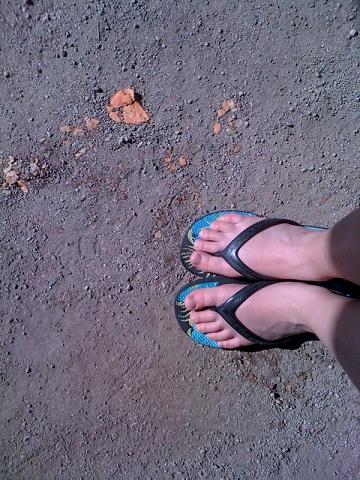
Bet it doesn't have that much 'support': The world's oldest leather shoe, 1000 years older than the Great Pyramid of Giza in Egypt and 400 years older than Stonehenge in Britain, has been found perfectly preserved in a cave in Armenia.
The 5500-year-old shoe was discovered by a team of international archaeologists, who reported details of their finding on Wednesday. It is made of a single piece of cow-hide leather, had laces, and was shaped to fit the wearer's foot.
It is 24.5cm long, 7.6cm to 10cm wide, and dates back to around 3500BC, an era known as the Chalcolithic period.
...The cave where the discovery was made is in the Vayotz Dzor province of Armenia, on the Armenian-Iranian-Turkish borders.
Pinhasi said the stable, cool and dry conditions in the cave meant the various objects found there were very well preserved.
Other finds included large ceramic containers, many of which held wheat, barley, apricots and other edible plants.
The team said preservation was also helped by the fact that the floor of the cave was covered by a thick layer of sheep dung which acted as a solid seal over the objects, keeping them safe for several millennia.
...The oldest known footwear in the world are sandals thought to be around 2500 years older than the Armenian leather shoe. They were found in a cave in Missouri in the United States.
WASHINGTON — A Senate hearing on the Gulf of Mexico oil spill was disrupted Wednesday as a protester poured an oily-looking liquid on herself before being arrested.Or maybe it begins here:
"This is what it feels like to have oil dumped on you," the woman, identified as Diane Wilson, said in comments addressed to Senator Lisa Murkowski of Alaska.
Wilson issued a statement issued later saying she is a fourth generation shrimper from the Gulf and that her protest was directed against Murkowski for supporting the oil industry and opposing measures such as lifting the liability cap on oil firms in offshore spills.
(Southaven, MS) -- Windows at the BP Gas Station on Highway 51 at Custer Drive were shot out overnight. Folks who work at the store believe the suspects were expressing anger over BP and how it's handling the oil spill.Goodness knows there is a Tower of Rage out there that hasn't found an outlet.
"I believe that would be the reason," said Alex Saleh. "We don't have any enemies." He said nothing was taken from the store after the windows were destroyed.
(Image from here)Proposition 16: Local Electricity ProvidersBut how long before PG&E lashes back?
1,837,303 47.6% yes
2,019,686 52.4% no
“When you strike at a king, you must kill him”It's time to put PG&E on the defensive again. It's time to make new efforts to carve up PG&E territory, limit their monopoly, and expand low-cost, accountable public power!
As the crisis in the Gulf of Mexico entered its eighth week Wednesday, fears continued to grow that the massive flow of bullshit still gushing from the headquarters of oil giant BP could prove catastrophic if nothing is done to contain it.The Onion can only touch the surface: the Rolling Stone digs deeper:
Like the attacks by Al Qaeda, the disaster in the Gulf was preceded by ample warnings – yet the administration had ignored them. Instead of cracking down on MMS, as he had vowed to do even before taking office, Obama left in place many of the top officials who oversaw the agency's culture of corruption. He permitted it to rubber-stamp dangerous drilling operations by BP – a firm with the worst safety record of any oil company – with virtually no environmental safeguards, using industry-friendly regulations drafted during the Bush years. He calibrated his response to the Gulf spill based on flawed and misleading estimates from BP – and then deployed his top aides to lowball the flow rate at a laughable 5,000 barrels a day, long after the best science made clear this catastrophe would eclipse the Exxon Valdez.
...Even worse, the "moratorium" on drilling announced by the president does little to prevent future disasters. The ban halts exploratory drilling at only 33 deepwater operations, shutting down less than one percent of the total wells in the Gulf. Interior Secretary Ken Salazar, the Cabinet-level official appointed by Obama to rein in the oil industry, boasts that "the moratorium is not a moratorium that will affect production" – which continues at 5,106 wells in the Gulf, including 591 in deep water.
Most troubling of all, the government has allowed BP to continue deep-sea production at its Atlantis rig – one of the world's largest oil platforms. Capable of drawing 200,000 barrels a day from the seafloor, Atlantis is located only 150 miles off the coast of Louisiana, in waters nearly 2,000 feet deeper than BP drilled at Deepwater Horizon. According to congressional documents, the platform lacks required engineering certification for as much as 90 percent of its subsea components – a flaw that internal BP documents reveal could lead to "catastrophic" errors.
...Enter the Bush administration. Rather than heeding such warnings, MMS simply assumed that a big spill couldn't happen. "There was a complete failure to even contemplate the possibility of a disaster like the one in the Gulf," says Holly Doremus, an environmental-law expert at the University of California. "In their thinking, a big spill would be something like 5,000 barrels, and the oil wouldn't even reach the shoreline." In fact, Bush's five-year plan for offshore drilling described a "large oil spill" as no more than 1,500 barrels. In April 2007, an environmental assessment covering the area where BP would drill concluded that blowouts were "low probability and low risk," even though a test funded by MMS had found that blowout preventers failed 28 percent of the time.
...In reality, MMS had little way to assess the risk to wildlife, since a new policy instituted under Bush scrapped environmental analysis and fast-tracked permits. Declaring that oil companies themselves were "in the best position to determine the environmental effects" of drilling, the new rules pre-qualified deep-sea drillers to receive a "categorical exclusion" – an exemption from environmental review that was originally intended to prevent minor projects, like outhouses on hiking trails, from being tied up in red tape.
...Nowhere was the absurdity of the policy more evident than in the application that BP submitted for its Deepwater Horizon well only two months after Obama took office. ... Instead, it cites an Oil Spill Response Plan that it had prepared for the entire Gulf region. Among the sensitive species BP anticipates protecting in the semitropical Gulf? "Walruses" and other cold-water mammals, including sea otters and sea lions. The mistake appears to be the result of a sloppy cut-and-paste job from BP's drilling plans for the Arctic. Even worse: Among the "primary equipment providers" for "rapid deployment of spill response resources," BP inexplicably provides the Web address of a Japanese home-shopping network. Such glaring errors expose the 582-page response "plan" as nothing more than a paperwork exercise. "It was clear that nobody read it," says Ruch, who represents government scientists.
..."People are being really circumspect, not pointing the finger at Salazar and Obama," says Rep. Raul Grijalva, who oversees the Interior Department as chair of the House subcommittee on public lands. "But the troublesome point is, the administration knew that it had this rot in the middle of the process on offshore drilling – yet it empowered an already discredited, disgraced agency to essentially be in charge."
...BP is the last oil company on Earth that Salazar and MMS should have allowed to regulate itself. The firm is implicated in each of the worst oil disasters in American history, dating back to the Exxon Valdez in 1989. At the time, BP directed the industry consortium that bungled the cleanup response to Valdez during the fateful early hours of the spill, when the worst of the damage occurred. Vital equipment was buried under snow, no cleanup ship was standing by and no containment barge was available to collect skimmed oil. Exxon, quickly recognizing what still seems to elude the Obama administration, quickly shunted BP aside and took control of the spill.
In March 2006, BP was responsible for an Alaska pipeline rupture that spilled more than 250,000 gallons of crude into Prudhoe Bay – at the time, a spill second in size only to the Valdez disaster. Investigators found that BP had repeatedly ignored internal warnings about corrosion brought about by "draconian" cost cutting. The company got off cheap in the spill: While the EPA recommended slapping the firm with as much as $672 million in fines, the Bush administration allowed it to settle for just $20 million.
...The company applied the same deadly cost-cutting mentality to its oil rig in the Gulf. BP, it is important to note, is less an oil company than a bank that finances oil exploration; unlike ExxonMobil, which owns most of the equipment it uses to drill, BP contracts out almost everything. That includes the Deepwater Horizon rig that it leased from a firm called Transocean. BP shaved $500,000 off its overhead by deploying a blowout preventer without a remote-control trigger – a fail-safe measure required in many countries but not mandated by MMS, thanks to intense industry lobbying. It opted to use cheap, single-walled piping for the well, and installed only six of the 21 cement spacers recommended by its contractor, Halliburton – decisions that significantly increased the risk of a severe explosion. It also skimped on critical testing that could have shown whether explosive gas was getting into the system as it was being cemented, and began removing mud that protected the well before it was sealed with cement plugs.
...The effect of leaving BP in charge of capping the well, says a scientist involved in the government side of the effort, has been "like a drunk driver getting into a car wreck and then helping the police with the accident investigation." Indeed, the administration has seemed oddly untroubled about leaving the Gulf's fate in the hands of a repeat criminal offender, and uncurious about the crimes that may have been committed leading up to the initial sinking of the rig. The Obama Justice Department took more than 40 days after the initial blast killed 11 workers to announce it was opening a criminal probe.
From the start, the administration has seemed intent on allowing BP to operate in near-total secrecy. Much of what the public knows about the crisis it owes to Rep. Ed Markey, who chairs the House Subcommittee on Energy and the Environment. Under pressure from Markey, BP was forced to release footage of the gusher, admit that its early estimates put the leak as high as 14,000 barrels a day and post a live feed of its undersea operations on the Internet – video that administration officials had possessed from the earliest days of the disaster. "We cannot trust BP," Markey said. "It's clear they have been hiding the actual consequences of this spill."
But rather than applying such skepticism to BP's math, the Obama administration has instead attacked scientists who released independent estimates of the spill. When one scientist funded by NOAA released a figure much higher than the government's estimate, he found himself being pressured to retract it by officials at the agency. "Are you sure you want to keep saying this?" they badgered him. Lubchenco, the head of NOAA, even denounced as "misleading" and "premature" reports that scientists aboard the research vessel Pelican had discovered a massive subsea oil plume. Speaking to PBS, she offered a bizarre denial of the obvious. "It's clear that there is something at depth," she said, "but we don't even know that it's oil yet."
Scientists were stunned that NOAA, an agency widely respected for its scientific integrity, appeared to have been co-opted by the White House spin machine. "NOAA has actively pushed back on every fact that has ever come out," says one ocean scientist who works with the agency. "They're denying until the facts are so overwhelming, they finally come out and issue an admittance." Others are furious at the agency for criticizing the work of scientists studying the oil plumes rather than leading them. "Why they didn't have vessels there right then and start to gather the scientific data on oil and what the impacts are to different organisms is inexcusable," says a former government marine biologist. "They should have been right on top of that." Only six weeks into the disaster did the agency finally deploy its own research vessel to investigate the plumes.
...Both the government and BP have reasons to downplay the extent of the spill. For BP, the motive is financial: Under the Clean Water Act, the company could owe fines of as much as $4,300 for every barrel spilled, in addition to royalties for the oil it is squandering. For the Obama administration, the disaster threatens to derail the president's plan to expand offshore drilling. "It's crystal clear what the federal response to the tragedy ought to be," said Sen. Frank Lautenberg, who chairs the Senate subcommittee on environmental health. "Bring a dangerous offshore drilling pursuit to an end."
The administration, however, has made clear that it has no intention of reversing its plan to expand offshore drilling. Four weeks into the BP disaster, when Salazar was questioned in a Senate hearing about the future of the president's plan, he was happy to stand up for the industry's desire to drill at any cost. "Isn't it true," asked Sen. Lamar Alexander, a Republican from Tennessee, "that as terrible as the tragedy is, that unless we want $14, $16, $18, $20-a-gallon gasoline, that it's not realistic to think that we would actually stop drilling for oil in the Gulf?" Unbowed by the catastrophe that was still unfolding on his watch, Salazar heartily agreed, testifying that the president had directed him to "move forward" on offshore drilling.
That may help explain why the administration has gone to unusual lengths to contain the spill's political fallout. On May 14th, two days after the first video of the gusher was released, the government allowed BP to apply a toxic dispersant that is banned in England at the source of the leak – an unprecedented practice in the deep ocean. "The effort should be in recovering the oil, not making it more difficult to recover by dispersing it," says Sylvia Earle, a famed oceanographer and former NOAA chief scientist who helped the agency confront the world's worst-ever oil spill in the Persian Gulf after the first Iraq War. The chemical assault appeared geared, she says, "to improving the appearance of the problem rather than solving the problem."
Kevin McCarty - 9,359 - 35.2%
Roger Dickinson - 9,294 - 35.0%
Lauren Hammond - 5,003 - 18.8%
Chris Garland - 2,278 - 8.5%
Adam Sartain - 691 - 2.5%
But that evening an inmate badgered Madoff about the victims of his $65 billion scheme, and kept at it. According to K. C. White, a bank robber and prison artist who escorted a sick friend that evening, Madoff stopped smiling and got angry. “Fuck my victims,” he said, loud enough for other inmates to hear. “I carried them for twenty years, and now I’m doing 150 years.”
For Bernie Madoff, living a lie had once been a full-time job, which carried with it a constant, nagging anxiety. “It was a nightmare for me,” he told investigators, using the word over and over, as if he were the real victim. “I wish they caught me six years ago, eight years ago,” he said in a little-noticed interview with them.
And so prison offered Madoff a measure of relief. Even his first stop, the hellhole of Metropolitan Correctional Center (MCC), where he was locked down 23 hours a day, was a kind of asylum. He no longer had to fear the knock on the door that would signal “the jig was up,” as he put it. And he no longer had to express what he didn’t feel. Bernie could be himself. Pollard’s former cellmate John Bowler recalls a conversation between Pollard and Madoff: “Bernie was telling a story about an old lady. She was bugging him for her money, so he said to her, ‘Here’s your money,’ and gave her a check. When she saw the amount she says, ‘That’s unbelievable,’ and she says, ‘Take it back.’ And urged her friends [to invest].”
Pollard thought that taking advantage of old ladies was “kind of fucked up.”
“Well, that’s what I did,” Madoff said matter-of-factly.
“You are going to pay with God,” Pollard warned.
Madoff was unmoved. He was past apologizing. In prison, he crafted his own version of events. From MCC, Madoff explained the trap he was in. “People just kept throwing money at me,” Madoff related to a prison consultant who advised him on how to endure prison life. “Some guy wanted to invest, and if I said no, the guy said, ‘What, I’m not good enough?’ ” One day, Shannon Hay, a drug dealer who lived in the same unit in Butner as Madoff, asked about his crimes. “He told me his side. He took money off of people who were rich and greedy and wanted more,” says Hay, who was released in December. People, in other words, who deserved it.
...Remarkably, that ego appears to have survived intact. H. David Kotz, the Security and Exchange Commission’s inspector general, investigated his agency’s failure to uncover Madoff’s Ponzi scheme, and Madoff volunteered to speak to him—he is, no doubt, the world’s expert on the subject. He quickly reminded Kotz of his stature—“I wrote a good portion of the rules when it comes to trading,” Madoff said. He insisted that he’d been “a good trader” with a solid strategy, explaining that he’d stumbled into trouble because of his success. Hedge funds—“just marketers,” he said with evident disgust—pushed cash on him. He overcommitted, got behind, and generated a few imaginary trades, figuring he’d make it up—and never did. Whatever his own missteps, Madoff saved his scorn for the SEC. He did impressions of its agents, leaning back with his hands behind his head just as one self-serious agent did—“a guy who comes on like he’s Columbo,” but who was “an idiot,” Madoff said, as recorded in the extraordinary exhibit 104, a twelve-page account of the interview that is part of Kotz’s report. Madoff is no ironist. His disdain for the SEC is professional, even if the agency’s incompetence saved his skin for years—all Columbo had to do was make one phone call. “[It’s] accounting 101,” Madoff told Kotz, still amazed.
Madoff’s ego was on display in prison, too. ... One evening, Bowler, a drug trafficker (“I’m not a con man, I’m a businessman,” he wrote to me), sat next to Madoff watching a 60 Minutes segment about him. Prison authorities keep the volume off, and inmates wear headphones and tune in to the radio signal that broadcasts the sound. Bowler removed one earpiece. “ ‘Bernie, you got ’em for millions,’ I said to him. ‘No, billions,’ he told me.” Another evening, one former inmate was watching a TV news report on the auction of Madoff’s much-chronicled watch collection—he owned more than 40, from Rolexes to a Piaget. The watch featured that evening fetched just $900, and Madoff, whose only watch now is a Timex Ironman that he bought at the commissary for $41.65 and is likely engraved with his inmate number, called out, “They told me that watch was worth $200,000.” The inmates laughed along with him. They didn’t see any reason for Madoff to regret his past. “If I’d lived that well for 70 years, I wouldn’t care that I ended up in prison,” Evans says.
...Prisoners crowded Madoff seeking investment advice—missing the fact that Madoff, being a con man, hadn’t invested for years. Other convicts saw in him a fellow entrepreneur, ignoring the obvious fact that his scheme wasn’t a business at all, just smoke and mirrors. But Madoff had amassed the symbols of success, and for criminals, that counts.
Two new papers based on data from NASA's Cassini spacecraft scrutinize the complex chemical activity on the surface of Saturn's moon Titan. While non-biological chemistry offers one possible explanation, some scientists believe these chemical signatures bolster the argument for a primitive, exotic form of life or precursor to life on Titan's surface. According to one theory put forth by astrobiologists, the signatures fulfill two important conditions necessary for a hypothesized "methane-based life."
...The hydrocarbon mapping research, led by Roger Clark, a Cassini team scientist based at the U.S. Geological Survey in Denver, examines data from Cassini's visual and infrared mapping spectrometer. Scientists had expected the sun's interactions with chemicals in the atmosphere to produce acetylene that falls down to coat the Titan surface. But Cassini detected no acetylene on the surface.
In addition Cassini's spectrometer detected an absence of water ice on the Titan surface, but loads of benzene and another material, which appears to be an organic compound that scientists have not yet been able to identify. The findings lead scientists to believe that the organic compounds are shellacking over the water ice that makes up Titan's bedrock with a film of hydrocarbons at least a few millimeters to centimeters thick, but possibly much deeper in some places. The ice remains covered up even as liquid methane and ethane flow all over Titan's surface and fill up lakes and seas much as liquid water does on Earth.
"Titan's atmospheric chemistry is cranking out organic compounds that rain down on the surface so fast that even as streams of liquid methane and ethane at the surface wash the organics off, the ice gets quickly covered again," Clark said. "All that implies Titan is a dynamic place where organic chemistry is happening now."
A Cheektowaga liver transplant recipient pleaded guilty Friday to driving drunk at seven times the legal limit when he struck a pedestrian, two parked cars and a moving vehicle on French Road in Cheektowaga in late March.
Gurninderjit Thandi had a blood alcohol reading of 0.56 percent after the hit-and-run incident about 3:15 p.m. March 20, said Kelly A. Omel, chief of the Erie County district attorney’s Vehicular Crimes Unit. Omel said that’s the highest reading she has seen in a local drunken driving case.
...Thandi, who came to court with his wife, told the judge during the plea proceedings that he is still under a doctor’s care for the liver transplant he had at a Rochester hospital in January, and that he is taking anti-depression medication and being treated by mental health experts.
Barbour originally claimed several times that the spill "isn't anything like Exxon Valdez." (He was right, it's much worse.) He has appeared on television and gone out of his way to praise both BP and the government's efforts: "BP has never said no to any request," he told CNN, while "the federal government, whether it's the Coast Guard or whomever, has worked hard with us." And he has compared washed up oil to "caramel-colored mousse" and "toothpaste."
Barbour has repeatedly blasted the media for hurting his state's tourism with reports that make the spill sound "like this is Armageddon." He told a local newspaper that cancellations at hotels and other attractions were "are at a record pace, and the reason is they think we are inundated with oil or that it's imminent."
The Governor has also been critical of calls to halt offshore drilling in the Gulf. "A bunch of liberal elite were hoping this would be the Three Mile Island of offshore drilling," he told a business group.
On Tuesday, when oil actually washed ashore on an island off the coast of his state, Barbour initially sounded a different note. "This could turn out to be something catastrophic and terrible," Barbour said, before adding, "but that has just not been the case so far." He called the incident, which occurred 43 days after the explosion on the Deepwater Horizon rig, a "wake-up call." (And he did eventually ask the government for more boats to be stationed off the coast.) Still, the Governor who insisted his state was prepared for spill damage thanked "God's grace" that Petit Bois Island did not suffer more harm. "I don't think the island was hurt one iota," he said. "[Tar balls] are all on the beach, and they should be easy to clean up with rakes and shovels." So all's well.
Meanwhile, three of Barbour's fellow Gulf Coast governors have been front and center with criticisms and demands in response to the catastrophe. Louisiana Gov. Bobby Jindal (R) has slammed both the government and BP for failing to act fast enough in response to the spill. Florida Gov. Charlie Crist (I) has asked BP for millions of dollars to fund a tourism ad campaign. Alabama Gov. Bob Riley (R) has admitted that the spill has forced him to reconsider his support for offshore drilling. And when those three fellow Gulf Coast governors traveled to Louisiana last Friday to be with President Barack Obama while he surveyed the effects of the spill, where was Barbour? He preferred staying home.
Ben Brooks, a lawyer and Republican state senator from coastal Alabama, says he's no fan of big government but he expects an aggressive federal response to the oil spill. "There's nothing inherently contradictory in saying we believe in smaller government and demanding that the government protect public safety," Brooks said. He's not alone. All along the Gulf Coast, where the tea party thrives and "socialism" is a common description for any government program, conservatives who usually denounce federal activism suddenly are clamoring for it.Nevertheless, national conservative leaders would rather sacrifice the coastal South - the real coastal South, where people live and work - rather than pause for thought. Listening to a representative of the Heritage Foundation on the "Jason Lewis Show" last night on Talk Radio 650 KSTE, I was flabbergasted to hear the representative emphatically rule out more regulations on the oil industry, or stronger regulations, as a response to this crisis. That must not be considered. So there you have it! We aren't even supposed to think about these things! AT ALL! These are FORBIDDEN thoughts! FORBIDDEN!
A stunning new letter by the oil-addicted governor of Louisiana gives the lie to right-wing claims that environmentalists are to blame for the BP oil disaster.
On Wednesday, Bobby Jindal, who blames everybody but himself for the environmental disaster hitting his state, wrote to President Obama and Interior Secretary Ken Salazar pleading with them to end the deep water drilling moratorium immediately.
He expresses "grave concerns" for the "economic impact of a six-month (or longer) suspension of activity" at 33 Gulf rigs -- "including and in particular the 22 deepwater drilling rigs currently in operation off the Louisiana coast." Jindal warns that the "announced moratorium of deepwater drilling activity creates a significant risk that many of these drilling platforms would be relocated to other countries -- along with the hundreds of high-paying jobs that they each create."
Jindal seems oblivious to the "significant risk" and potentially devastating economic impact posed by the drilling itself -- risk that will be present until we figure out all of the causes of the spill and how to make sure it never happens again.
Amazingly, Jindal writes:I fully understand the need for strict oversight of deepwater drilling. However, I would ask that the federal government move quickly to ensure that all deepwater drilling is in proper compliance with federal regulation and is conducted safely....Jindal omnisciently -- and mistakenly -- asserts here that current federal regulations are sufficient to avoid another blowout disaster. He has no way of knowing if this is true, whereas we have every reason to believe it is false.
Under the Cheney-Bush administration, efforts to strengthen regulation were blocked and the industry demanded and achieved essentially voluntary, "trust us" self-regulation and self-certification. For instance, when the Minerals Management Service considered requiring an acoustic backup system to shut off the blowout preventer in the event of a disaster, as Brazil and Norway require, lobbying by BP and other oil companies persuaded them not to.
The Wall Street Journal reported that "the safety record of U.S. offshore drilling compares unfavorably, in terms of deaths and serious accidents, to other major oil-producing countries. Over the past five years, an offshore oil worker in the U.S. was more than four times as likely to be killed than a worker in European waters, and 23% more likely to sustain an injury." A 2007 MMS study of 39 blowouts from 1992 to 2006 found, "Nearly all the blowouts examined occurred in the Gulf of Mexico." Big Oil clearly can't be trusted to regulate itself.
That's why some are calling this disaster "Cheney's Katrina." And that's why Obama set up a commission to figure out exactly why this disaster occurred. Until we know all the causes, we can't be sure we are taking every possible step to make sure it doesn't happen again. And that's why the president put in place the moratorium for six months, to wait until the findings from the commission are in. That's also why the president on Tuesday called the disaster a wakeup call that should lead us to once and for all end our addiction to oil.
This image, courtesy of NOAA, maps all tropical storms and hurricanes of the past 100 years that passed near the site of the spill, signified by the red star in the center.
Since f is approximately constant, the flow must assume negative vorticity or anticyclonic turning, i.e. counterclockwise turning in the southern hemisphere. By the same token, on the lee side, the expansion of the isentropic layer demands positive vorticity or clockwise turning. A ridge over mountains and a trough in its lee are often observed. Below the upstream side of the trough a low may form and intensify at the surface (Note 12.L). This process is called lee cyclogenesis and explains why midlatitude cyclones form in the lee of mountain ranges, e.g. to the east of New Zealand and southern South America (Fig 6). These lows or troughs are responsible for most of the rainfall along the coast.
BP CEO Tony Hayward apologized Wednesday for saying recently that he wants his "life back."
Discussing the Gulf of Mexico oil spill over the weekend, the embattled oil executive said, "We're sorry for the massive disruption it's caused their lives. There's no one who wants this over more than I do. I would like my life back."
Hayward came under fire for making the comment at a time when BP is trying without success to contain the oil that's gushing from the company's blown-out well.
“I made a hurtful and thoughtless comment on Sunday when I said that 'I wanted my life back,'" he said in a statement. "When I read that recently, I was appalled. I apologize, especially to the families of the 11 men who lost their lives in this tragic accident."
Last night, former half-term Alaska governor Sarah Palin believed she'd found a way to both absolve her oil-happy politics and blame environmentalists for the spill at the same time, and took to Twitter to rub it in."Extreme Greenies:see now why we push"drill,baby,drill"of known reserves&promising finds in safe onshore places like ANWR? Now do you get it?"
Turkey has a unique role to play linking the East and West. If Turkey lurches too far East, it may become more popular on some Arab streets, but it would lose a lot of its strategic relevance and, more importantly, its historic role as a country that can be Muslim, modern, democratic — and with good relations with both Israel and the Arabs. Once this crisis passes, it needs to get back in balance.After reading Matt Taibbi's many useful and hilarious analyses of Thomas Friedman's writings, I learned it's important to have a dictionary at hand when reading Friedman, and today is no different. Friedman seems to be using the word 'strategic' in this sense:
Ditto Israel. There is no question that this flotilla was a setup. Israel’s intelligence failed to fully appreciate who was on board, and Israel’s leaders certainly failed to think more creatively about how to avoid the very violent confrontation that the blockade-busters wanted.
Important or essential in relation to a plan of actionApparently Friedman's 'plan of action' for Turkey is that it be 'Muslim, modern, democratic'. Nevertheless, heavy thinkers have valued Turkey most for its geographic importance, astride the Bosporus, not for Friedman's 'plans', or anyone's 'plans' that don't involve large armies and navies. So, whether Turkey lurches East, West, North, or South, it will remain strategically important. History in the area has proven much too mercuric for any mortal's 'plans'.
As if the water wasn't deep -- or oily -- enough around British Petroleum's public relations, the company has hired a former spokeswoman for Vice President Dick Cheney to be its public face for the disaster.Hmmm. She's not even on this chart! I hope they update this chart and add her on soon. Get every single dad-gummed elite person and institution in the U.S. onto this chart!
Anne Womack Kolton, former head of public affairs at the Department of Energy and Cheney's onetime campaign press secretary, will take the baton from BP this week.
"No one's listening," says Nick Pozzi, who was an engineer with Saudi Aramco in the Middle East when he says an accident there in 1993 generated a spill far larger than anything the United States has ever seen.
An engineer who witnessed a crude spill in the Persian Gulf in 1993 says BP should use a fleet of empty supertankers to suck crude off the water's surface.
According to Pozzi, that mishap, kept under wraps for close to two decades and first reported by Esquire, dumped nearly 800 million gallons of oil into the Persian Gulf, which would make it more than 70 times the size of the Exxon Valdez spill.
But remarkably, by employing a fleet of empty supertankers to suck crude off the water's surface, Pozzi's team was not only able to clean up the spill, but also salvage 85 percent of the oil, he says.
Methane Hydrate Stability Curve. In this example, the zone in which gas hydrate can exist is between 1200 and 1500 meters. (Actually, methane hydrates can exist anywhere from about 300 to 200 meters, depending on temperature conditions and sediment depth.) To explain the various lines: The "phase boundary" line (a pressure/temperature line) divides the methane as hydrate (that is methane ice) to the left of the line from methane that has dissociated from hydrate on the right. The "hydrothermal gradient" dotted line indicates the water temperature. The "Water/ Sediment" line marks the seafloor. The "geothermal gradient" dotted line indicates the temperature of the sediments, which increases with depth. At some depth (marked by the line "Base of gas hydrate"), the sediments become too warm for hydrate to exist. Below this depth, free ethane can exist, but not methane in ice. Methane hydrate, therefore, can only exist in the speckled area. (Kvenvolden, 1993)
By an vote of 89-0, lawmakers approved Senate Bill 151 by Sen. Robert Adley, R-Benton, sending the measure back to the Senate for approval of clarifying amendments made by a House committee.
Adley's bill defines a "virtual street-level map" as one that is available on the Internet and can generate the location or picture of a home or building by entering the address of the structure or an individual's name on a website.
Rep. Henry Burns, R-Haughton, who handled Adley's bill on the House floor, said that if the map is used in an act of terrorism, the legislation requires a judge to impose an additional minimum sentence of at least 10 years onto the terrorist act.