Friday, December 16, 2005

Mainstream Media Bias

Franklin Foer at The New Republic warns liberal bloggers to go easy on the mainstream media (MSM):
(T)hey don't deserve the savage treatment that they routinely receive in the blogosphere. The problem isn't just that they have been flogged by bloggers desperate for material. It's that the blogosphere nurses an ideological disdain for "Mainstream Media"--or MSM, as it has derisively (and somewhat adolescently) come to be known.

...You would expect this kind of populism from the right, which long ago pioneered the trashing of the MSM, or, as Spiro Agnew famously called its practitioners, "nattering nabobs of negativism." ...(The Right wants) to weaken the press so it will stop obstructing their agenda, a motive that liberal bloggers seem to have forgotten. By repeating conservative criticisms about the allegedly elitist, sycophantic, biased MSM, liberal bloggers have played straight into conservative hands. These bloggers have begun unwittingly doing conservatives' dirty work.

What they're attacking is the MSM's Progressive-era ethos of public-minded disinterestedness. By embracing the idea of objectivity, newspapers took a radical turn from the raw partisanship that guided them in the nineteenth century. "Without fear or favor" was Times owner Adolph Ochs's famous phrase. That "objective" style worked well for many years, because, in the postwar period, political elites shared broad assumptions about policy with one another--and the media. But the Bush administration has violently rejected that consensus. And, instead of playing by the old rules that governed the relationship between reporters and the White House, it has exploited them.

...But, after examining the news media's failings, many liberal bloggers still conclude that the system is beyond repair. They have begun to dismiss the MSM as doomed avatars of the ancien régime. Atrios, one of the most popular of the liberal bloggers, recently threw up his arms: "If idiots destroy institutions there's no reason to continue to respect them." (Their derisive attitude resembles nothing more than the New Left, which charged journalism with dulling the sense and sensibility of the masses, preventing them from seeing the horrors of the capitalist order.)

The mainstream blogosphere (MSB) is only too happy to bury the old media regime, because it has an implicit vision for a new order, one that would largely consist of ... bloggers.

...This model stinks for countless reasons. But its most fundamental flaw is that bloggers will always be dismissed by their opponents as biased.

...There's another reason that liberals shouldn't be so quick to help conservatives crush old media. Because of the right's alliance with business, it simply has more resources to shovel at its institutions--and it has been doing exactly that for the last 40 years. And, unlike liberals, conservatives have already proved themselves masters of partisan media, where they reduce their political program into highly saleable, entertaining populism. If the battle of ideas doesn't have credible, neutral arbiters like the so-called MSM--and liberals jump into an ideological shoving match with bigger, badder, conservative outlets--there's no question which side will prevail.
That pushed me over the edge:
"For starters, there was the 2000 campaign, in which the press presented Bush as essentially the heir to Clintonian centrism...." That was the MSM's work, Mr. Foer: a pretty piece of absolute pro-Bush bias. So why blame the bloggers for complaining about it?

Bloggers don't want to replace the MSM: we want the MSM to do its job. If the MSM wants to cater to power, so be it, but then don't expect us to read your rags anymore. Sure, big business can throw resources into media, but until they drug the populace, they can't force us to consume their crap. I've given up Cable, TNR, and this week, the NY Times, because, as a literate person, I'm tired of your games. If I have to, I will run my own press. I'm not alone! The hell with the MSM (and that includes TNR too!)
Todd Gitlin gets it, though. Referring to The New York Times' Judith Miller:
"WMD --I got it totally wrong," Miller told the Times’ Don Van Natta Jr., Adam Liptak, and Clifford J. Levy, who wrote the paper’s long overdue self-study on October 16, 2005. "The analysts, the experts and the journalists who covered them -- we were all wrong. If your sources are wrong, you are wrong."

These sentences deserve the closest of parsing. "The analysts, the experts" were not all wrong -- David Albright wasn’t, for one, nor were various State Department and Energy Department officials mentioned in passing by Miller and Gordon without citing any reasons for their dissent. "The journalists who covered them"? Knight Ridder’s Jonathan S. Landay and Warren P. Strobel were right. The Washington Post’s Joby Warrick was right, though his important piece, under the headline "Evidence on Iraq Challenged; Experts Question If Tubes Were Meant for Weapons Program," ran on page A18 on September 19, 2002.

The key to Judy Miller’s cri de coeur lies in her repeated alibi that the journalist is only as good as her sources. But sources, like WMDs, do not grow on trees ... A journalist chooses them. Miller -- and her superiors -- fail to consider that her sources opened up to her precisely because they found her sufficiently reliable, meaning credulous. "My job," she said in a 2004 radio debate with Massing, "was not to collect information and analyze it independently as an intelligence agency; my job was to tell readers of The New York Times, as best as I could ?gure out, what people inside the governments who had very high security clearances, who were not supposed to talk to me, were saying to one another about what they thought Iraq had and did not have in the area of weapons of mass destruction." No wonder Massing told me: "From her stories, it seems clear to me that she had an ideological agenda and went out to ?nd information that would support it."

...(W)hat lessons have the nation’s news proprietors learned?

Not many. Our top newspapers seem to think that, in an age when they are under 24-7 blogger scrutiny, they can still purify themselves with ease, if embarrassed ease, by banishing Miller and slapping Woodward on the wrist. But top managers at the Times and the Post are clueless about how much respect they’ve lost. How did they miss ?rst the WMD hoax, then the White House’s Wilson-baiting and CIA-baiting cover-up? How come Knight Ridder didn’t miss those stories? What does their team know about covering Washington that the huge Times bureau doesn’t?

Thursday, December 15, 2005

Hey, Girlie Man!

Over in Austria, people are annoyed with California Governor Arnold Schwarzenegger:
The Arnold Schwarzenegger Football Stadium in Austria's second-largest city Graz is to be renamed as a sign of displeasure with the city's most famous son.

A majority of members on Graz City Council voted to rename the stadium after the Austrian-born governor of California approved the execution of Stanley "Tookie" Williams, according to newspaper Kleine Zeitung.
Meanwhile, Earl notes that the Phil Angelides campaign is making fun of Arnold - with animation - and he wonders if this is the future of political campaigning.

It's the future all right, but I just wish the cast of bad guys wasn't quite so stereotyped. Effective satire needs an element of surprise to make it memorable.

Well, it's a good first effort. Maybe Phil will have more cartoons as the election approaches!
Andee Thorpe Says Listen!

Do as Andee says!
On Friday 12/16, listen to Y92.5. I am entered into a "Christmas Idol" Contest for Y92.5, you can hear me sing LIVE on the air just after the traffic and news at 9AM.
Welcome DMTC News

In order to stabilize short-term debts incurred in the last, frantic autumn rush to finish construction of the new Hoblit Performing Arts Center, DMTC relied upon the promised sale of a home. We had hoped the home sale would be finished by last month, but things took longer than expected, and we were all beginning to anxiously eye the calendar, since most of the short-term loans were scheduled to be paid back by the end of this year.

Today, Our Fearless Leader, Ryan Adame, reports the sale of the home:
Mr. Isaacson just reported that (the) house ... has been sold.... Everyone can now breathe a sigh of relief, as we are now able to finish paying ... all of the short term loans, and the remaining projects at the new theater. Congratulations to everyone, especially Mr. Isaacson for his extraordinary efforts....
Boy, no one is more relieved than I! Broken promises are excruciating, particularly those involving money, and must be avoided at all costs. It now looks like we will end this turbulent, tumultuous year of 2005 on a very happy note! Happy endings are often preferred, after all, in Musical Theater!
Damn, That Branson Is Yanking On My Chain!

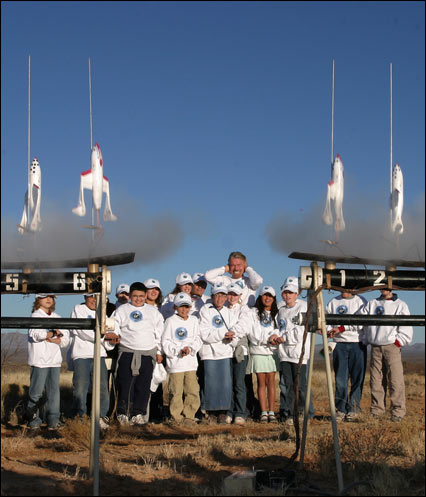
Tribune caption: Billionaire entrepreneur Richard Branson stands with elementary students from Las Cruces as they launch model rockets near the site of a proposed spaceport in Upham. Branson, owner of the British company Virgin Galactic, said Wednesday he hopes to start launching tourists, satellites and scientific experiments from the site within four years. (Associated Press)


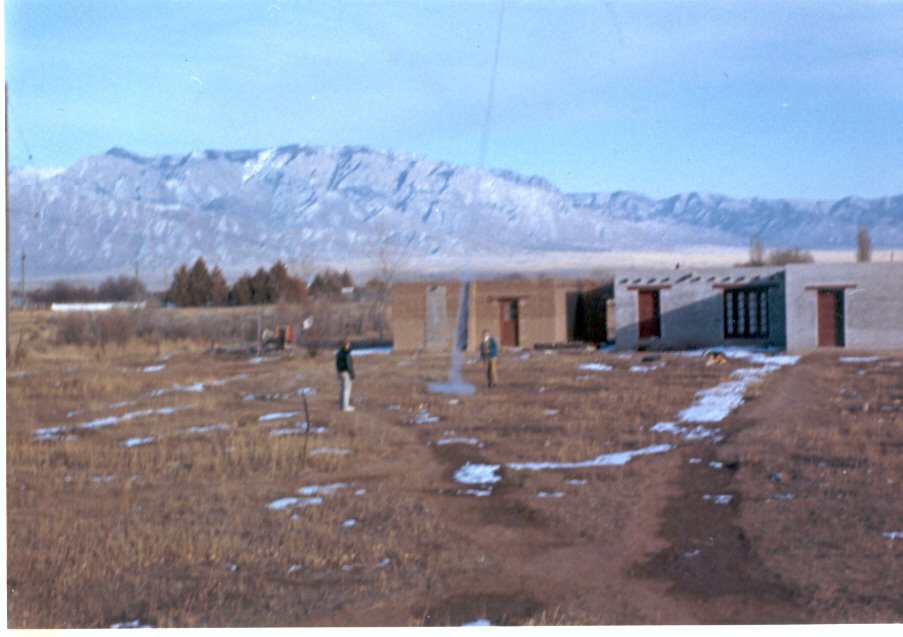
Fourteen-year-olds Marc Valdez (right) and Jonathan Amsbary launch a model rocket from behind Marc's childhood home in Corrales, NM, with the Sandia Mountains in the background. The model rocket smoke trail splits the photo in half. Photo by Jonathan’s father, and provided courtesy of Jonathan Amsbary.

There is actually a lot of information in this (fuzzy) photograph. The view is from a slight elevation, indicating Mr. Amsbary was standing on the deck of the swimming pool the Lewis family (the previous owners) had built. The footpaths, which had once run straight along the divisions of the irrigated alfalfa fields that had predated construction of the house (one runs from the red door on right to the camera) were now running at diverse angles: we kids, having grown older, were no longer running along them quite so much as we had in childhood, and the dogs that now ran the paths preferred shortcuts (my dog “Prince” is visible near the snow patch). The date of the photo is probably about February 1971 (although it might be late 1970).

We, The Animals

So this is where the threat to our way of life comes from? Pardon me, it's time to prey:
Evolutionists claim that their battle against creation-science is primarily a "scientific" issue, not a constitutional question. But our treasured U. S. Constitution is written by persons and for persons. If man is an animal, the Constitution was written by animals and for animals. This preposterous conclusion destroys the Constitution. The Aguillard Humanists leave us with no Constitution and no constitutional rights of any kind if they allow us to teach only that man is an animal.
Oy Vey! Broadway!

Lenore Sebastian just stopped by to chat! As an aside, she says that both her and Gil will be reviving a favorite show of theirs over at Chautauqua Playhouse, running from mid-May to the end of June, 2006, called "Oy Vey! Broadway!" The show is apparently a revue of Broadway musical tunes created by Jewish composers. (Isn't that just about everyone, maybe excluding Cole Porter???) In any event, this sounds like something nice to look forward to in the coming year!
Skyrocket In Flight, Afternoon Delight!

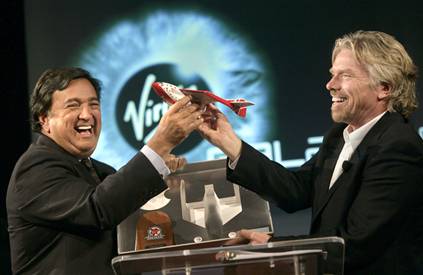
MSNBC caption: New Mexico Gov. Bill Richardson, left, receives a model of the Virgin Galactic spacecraft as a gift from Virgin Group Chairman Richard Branson during Wednesday's news conference in Santa Fe.

Gene passed along this Bill Richardson razzle-dazzle from New Mexico:
"What we are calling the second space age will open up a wide range of commercial opportunities, including point-to-point cargo delivery, with personal and business travel," Richardson said, during a Santa Fe news briefing that provided New Mexico's perspective on the ambitious spaceport plan.

...The "anchor tenant" of the 27-square-mile facility is to be Virgin Galactic, which intends to offer suborbital spaceflights starting in late 2008 or early 2009. The very first flights will take off from Mojave Airport in the California desert, but Virgin will move its base of operations to New Mexico after the new Southwest Regional Spaceport is finished, in late 2009 or early 2010.
If Virgin can't even sell compact disks at a profit, what makes them think they can run a spaceport? And they are trying to rope in the chic Hollywood/Santa Fe crowd too? (gag!) The Roswell/Flying Saucer crowd won't be far behind either.... Science guys probably won't even be able to stick a thermometer outside either - insurance regulations, you know.....

I'd very much would like to be on one of these flights, but it would be much more fun if I could leave the crystals-and-pyramids and UFO crowds behind. And the crazed millionaires. I'd also like to pay for it with other people's money (which is an advantage of the U.S. Space Program for the few, lucky astronauts). Everyone is going to have their hands out to get paid here. And the ultimate goal of people like Richardson is to make sure the sidewalks in Alamogordo and Tularosa get paved and everyone has a good time.

Well, what are you going to do? The Space Shuttle is becoming more and more of a White Elephant as the years go by, and there's a lot of Federal investment in the Space Program (all that *stuff*) rusting away under-used out there at White Sands. I figure Richardson is thinking that someone has to be pro-active, or the place will become some kind of eccentric Space Slum. And if you could make it cheap enough, maybe some sub-millionaires would like to join in on the action. But the personal travel portion just killed me: "Quick! I've got to travel from Tehachapi, CA to Carrizozo, NM, today, and I can spare no more than an hour to do it!"

Bread and circuses; circuses and bread.

Hmmm......

Wednesday, December 14, 2005

Dude, Where's My Car?

Oh, here it is!
Idle Speculation About Acid Deposition & Mercury

Walt, who lives in South Carolina, asked some air chemistry questions about California, and got me going....
I note from acid rain data that California doesn't seem to have any acid rain. Why is that? Aren't there any power plants in CA?

Also: Why is mercury deposition by rainfall concentrated in south Florida and the gulf coast? Is it from TX/LA oil refineries, or does it come from tropical ocean air?
These are really-interesting, thought-provoking, isopleth maps that Walt pointed out! I answered:
These inorganic ions do not correlate precisely with acid rain: rain acidity depends on anions like carbonate as well. In general, the West doesn't get much acid rain because of the buffering presence of alkaine dust in the rain. There is much less of that dust in the Northeast, and so acid rain is more of a problem there.

The sulfur comes mostly from coal combustion (which has a lot of sulfur - much more than most petroleum), and so sulfate deposition closely-tracks the power-plant region of the Ohio Valley (particularly around Wheeling, WV), but also noticeable around Price, Utah, a coal-mining area in the Green River Valley. The mystery, in my mind, is why there isn't more deposition in the Tennessee River Valley, where there are also large power plants. Is the coal cleaner there? Or does the sulfur come down far enough downwind to obscure the source location? But then why does Price, Utah stand out (unless the source is actually from farther south, like the Navajo Power Plant?)

Nitrate deposition is more erratic, and depends, in part, on whether an area is ammonia-rich, or not. Ammonia emissions closely track soil fecundity and seasonality. There are two, common, depositable forms of nitrate: nitric acid and ammonium nitrate. Nitric acid can deposit directly to surfaces as a gas, or dissolve directly into rain, and deposit that way. Ammonium nitrate is very volatile, and small changes in temperature and humidity can strongly affect how much of it is present. Deposition of ammonium nitrate occurs as particles.

Ammonia-rich means nothing more than total ammonia (TA) molar concentration is more than twice the total sulfur (TS) molar concentration: [TA] > 2*[TS] (ref.: Seinfeld & Pandis, p.538). Under ammonia-rich conditions, rather large amounts of nitrates are sometimes formed, particularly if its humid and sunny. A runaway heterogeneous reaction occurs whereby ammonia dissolves into aerosol water, more than neutralizing the sulfate present, raising the pH and drawing nitric acid in. At times, you see huge spikes in ammonium nitrate concentrations, expressed as Extremely Hazy Days and Nights (the kind of nights that disoriented novice pilot JFK, Jr. and caused him to crash near Martha's Vineyard), but it's a finicky process, and easily derailed. The process is also affected by the presence of sea-salt aerosol. Ammonium nitrate (particulate) concentrations are low to non-existent under ammonia-poor conditions.

So, nitrate and ammonium deposition tends to track:
  • humid areas
  • fertile areas
  • urban areas, where there are more nitrogen emissions
The West sees less deposition of nitrates as a whole than the East, but there are exceptions, like the Central Valley, where there's lots of ammonia, lots of nitrogen emissions, and where it's humid and fecund enough in the winter.

I haven't followed mercury issues. My understanding is that there is a significant marine source of that volatile metal, but I also understand that people are puzzled why Florida and the Gulf Coast get so much deposition. The area is not downwind of a lot of the coal combustion, and so it's a mystery. But there's a reason, I'm sure.
    Walt then asked:
    OK. Referring to the sulfate isopleths, I notice that California has very little. Being a populous state, I would expect coal plants there to put sulfate into the air; but I don't see that. Whats up?

    Nitrate: Is this mostly from combustion or from agriculture?

    Ammonium: Is this released by plants, or is it particulate fertilizer?

    Haze: Is ammonium nitrate a major cause of haze?
    I answered:
    Actually, there is very little coal combustion in California (very little coal in California at all). The comparatively small, but numerous power plants here are powered mostly by natural gas, most of which is derived from either Alberta, or Texas (with some exceptions, like dual gas/oil in at least one of San Diego's power plants). In a broad sense, no coal combustion means little sulfur in the air (with the notable exception of petroleum extraction and refining in the SF Bay, LA area, Kern Co., and Santa Barbara Co.)

    It's not an iron-clad rule, though. There are some exceptions, of course: they burn nasty sulfur-rich petroleum-based fuels from Indonesia and elsewhere in Hawaii and the Pacific Islands (mostly out of necessity, given the remote locations). The air isn't that bad, though, because the islands are compact.

    The nitrate derives principally from transportation emissions, but with an agricultural component. Oxidized nitrogen can deposit anytime as nitric acid, but it can sometimes, erratically, deposit as ammonium nitrate. Ammonia can deposit anytime as ammonia (but only sometimes as ammonium nitrate).

    The ammonia can come from either plants, or from fertilizer, or both. It would be interesting to have a tracer study and see which dominates in a place like the Central Valley (my guess would be fertilizer, but I could be wrong).

    Haze is hydrated aerosol deriving from numerous sources: elemental carbon, organic carbon, sea-salt aerosol, sulfates and nitrates. Sometimes you see huge spikes in particulate concentrations, however. In California, these spikes occur in the winter, when it's humid, and can prevent you from seeing even short distances. These haze spikes are principally, sometimes almost exclusively, ammonium nitrate.

    Two more points occur to me....

    Deposition is dependent on available surface area, particularly inviting leaf surface area, with its numerous, intricate stomata. Because the East is lusher and has a lot more leaf surface area than the West, all else being equal, it will receive higher deposition.

    Also, these wintertime haze spikes of which I speak are different than California's famous summertime smog. Smog aerosol is generally ammonia-poor and tends to be more acidic than ammonium-nitrate aerosol. Smog aerosol contains a lot of nasty oxidants that accumulate due to rapid, solar-powered reactions of nitrogen oxide and hydrocarbon precursors.

    Plus, there's plain, old wildfire smoke.

    So, no matter what the season, California can generate a visibility-robbing aerosol to soot (sorry, suit).
    Then, I started looking harder at the mercury question. It's actually pretty interesting, and has contradictory aspects that make me think the chemists don't have a strong handle on it yet.

    The deposition map for mercury tends to mirror the U.S. annual rainfall map. That's interesting: unlike mercury, inorganic ions get rained out, so the deposition isn't proportional. Tripling rainfall will increase inorganic ion wet deposition by a lesser factor, say 1.5, because the cleansing effect of the rain strips out the available ions. In a single rainstorm, the last bit of rainfall is much cleaner than the first bit of rainfall.

    With mercury, that seems to be less true - perhaps not true at all. Perhaps there is a larger reservoir of mercury in the air, so that no matter how much it rains, there is still much more mercury around. Now, I wonder about the chemistry of mercury! Are there multiple species??

    Checking further, the reservoir species is probably elemental mercury (~ 0.5 ppb), and the removable species is either mercuric oxide or mercuric chloride, or both. Oxidation seems to be rapid when water is around (like in a rainstorm - otherwise the depositable mercury would rain out), but the apparent long residence time of mercury in the atmosphere (several months) suggests either the natural or anthropogenic source emissions for mercury have been underestimated (meaning the residence time is actually shorter), or oxidation just about ceases in the absence of water. In any event, the information looks kind of contradictory to me. Strange stuff!

    Anyway, like Mark Twain says, this is the value of science: investing a little knowledge yields a huge dividend of idle speculation!
    False Comfort

    Another sham success in the U.S. Missile Defense system. This time, the attacking warhead didn't even exist: it was computer-generated:
    A ground-based interceptor missile was launched from Kwajalein Atoll in the Marshall Islands against a simulated target, the Pentagon's Missile Defense Agency said late on Tuesday night.

    The simulation was based on a hypothetical missile launch from Kodiak, Alaska, using data from previous launches, said the agency, known as MDA.

    In full-fledged interceptor tests of the so-called Ground-Based Midcourse Defense System, the system has successfully shot down five live targets in 10 tries.

    The last successful intercept took place in October 2002. The interceptor failed to launch in the two tests that preceded the latest one, in February 2005 and December 2004.

    The latest test was designed chiefly to evaluate the performance of the interceptor missile's rocket motor system and Raytheon Co.-built "exoatmospheric kill vehicle," the bit designed to smash into the target warhead and pulverize it in space, MDA said.

    It also successfully tested, among other things, silo support equipment, the agency said.

    Last February, a ground support arm in the silo malfunctioned because of hinge corrosion caused by what MDA later said had been "salt air fog" that entered the underground silo.
    Twenty-five years ago, physicists like Freeman Dyson showed how easy it is to overwhelm a missile defense system. Attacking missiles are cheap, compared to defensive missiles. So, instead of attacking a target with one missile, attack it with two. Or ten. Or twenty. Eventually, one makes it through, and the target is wiped out. Imagine playing sudden-death defensive basketball, against a team where everyone has a basketball!

    To test an effective missile defense, divide the Air Force team into two: a Red Team in Alaska and a Blue Team at Kwajalein Atoll. Red Team gets to attack whenever and however they feel like (just like in reality!) Then, let's see how well the Blue Team does!
    Down With The Uncle Toms!

    Four church burnings in the Sydney suburbs, apparently as the result of intra-Arab violence, in order to force people to choose sides, in anticipation of more extensive rioting this coming weekend.
    Audience Reaction

    Jon Carroll, over at the San Francisco Chronicle, went to go see "Ballet Russes", and he liked what he saw:
    So, now, is there anyone more fabulous than a Russian ballerina, particularly a Russian ballerina willing to tell stories? As it happens: no. That's why the film spends so much time in the room of fabulous people. There are many, many "moments" in the film, partly because these folks are no dummies and know how to create crowd-pleasing moments, even though (or especially because) they're mostly in their 80s.

    But wait, there's more: Amazing archival footage, most of it shot by amateurs using wind-up 16mm cameras. The quality of the film is not wonderful, but the quality of the dance is astonishing. Even the bad dances -- and there's some pretty over-the-top stuff, and not in a good way -- are exhilarating in their ambition. If some of the numbers seemed to be based on the "throw it against the wall and see what sticks" school of aesthetics, that is always to be preferred to the "let's not throw anything against the wall and hope no one notices" school of polite, cautious performance.
    The Purchase Is Off

    The Louisiana Purchase, that is. A disgruntled New Orleans evacuee wants to sell the place back to France.
    Programs Progress

    Progress continues on updating the computerized Master Cast List for DMTC. This cast list, currently in Excel, will be converted in a couple of months into a database that can be accessed via the Web on DMTC's Web Site. It will have the name and function of every participant in a DMTC show (with the exception of Summer Workshops and occasional fundraisers). Currently, the list has about 14,000 entries, representing the activities of roughly 2,700 people over a 21-year time span.

    There are a few holes in the Master Cast List, particularly in the YPT in the early 90's. Here is the current list of YPT programs needed to complete the DMTC Master Cast List:

    NARNIA.................. JUN 92-JUL 92
    SLEEPING BEAUTY......... SEP 93-OCT 93
    MUSIC MAN............... MAR 94 (Missing program altogether)
    WIZARD OF OZ............ SEP 94
    PETER PAN............... MAR 96 (Missing program altogether)

    In addition, the Main Stage program for 1997 Secret Garden (Director, Valerie Cogdill) lists no orchestra (likely an oversight), and so we need to remember who those folks were, if possible.

    Tuesday, December 13, 2005

    Ghost Story

    There is a fascinating story in today's Wall Street Journal regarding the dreadful practice of medical research ghostwriting (the article is available on-line only for subscribers, but there is a helpful, free pop-up feature illustrating the problem). This story reveals what happens when you define deviancy downwards: what once were vices, or even crimes, become common habits.

    Scientific ethics have traditionally insisted that the writers of an article be intimately associated with the research for that article: otherwise, slipshod work can go undetected. Scientific ethics have also traditionally insisted that possible conflicts-of-interest be fully revealed, at the very least, and certainly avoided if possible, to preserve one's all-important reputation for good work. Traditionally, scientific ghostwriting has been absolutely, unequivocally unethical.

    Nevertheless, there is a temptation to engage ghostwriters, because writing is so time-consuming. Squeaky wheels get the grease, as they say! Pressed for time? Poor researcher! Let *us* at Smith/Merck/Glaxo/Kline do the work!

    The practice of medical research ghostwriting is going to allow a series of avoidable disasters to happen. Ghostwriters, in the pay of drug companies, can write up medical research on behalf of harried medical researchers, who then check off on the work, in order to catapult (what can amount to inflated) drug company propaganda into the top-tier medical journals. The researcher gets another paper to pad their curriculum vitae, and the drug companies move the onerous drug approval process that much further along, for an eventual payoff when the drug enters the market.

    I always wondered how the top medical researchers got so many papers published: their output is much higher than most scientific research fields. I thought it was because they had labs full of post-docs and graduate students hard at work, but apparently it isn't even that anymore. There is an entire group of poorly-acknowledged ghostwriters hard at work as well.

    Merck's trouble with Vioxx is a perfect illustration. Someone at Merck withheld late-arriving information from the rent-a-doc at the University of Arizona whose name they were using to help promote Vioxx in the medical literature. The researcher may not have even known his reputation was in the process of being tarnished, but he should have been more wary! (The researcher says he actually had very little to do with the article - AT ALL!!!)

    The Merck folks did not misconstrue data so much as they omitted data. That should still count as unethical. After all, if you were hastily trying to cross the street, and I *forgot* to tell you about the approaching traffic you failed to see (but that I did), I should share blame for the ensuing accident.

    The entire enterprise of medical research has become a house of cards!
    Those Who Live In Glass Houses...

    Interesting point on Daily Kos regarding silly 'War On Christmas' stuff, that even though O'Reilley on Fox News has been at war with use of the term 'Happy Holidays' instead of 'Merry Christmas', one of Fox's own Web Pages had eleven uses of the term 'Holidays' and none of the term 'Christmas', until the lapse was pointed out and hastily changed.
    The Thunder Down Under

    A few related, violent incidents reported in Perth, Adelaide, and the Gold Coast. Sydney and Cronulla Beach quiets down, but uneasily.

    It's interesting that the Lebanese immigrants are taking the brunt of the reaction. I had thought that Indonesians might be targeted instead, what, with all the recent tension regarding Schapelle Corby and terrorism, but maybe there aren't enough of them around for a mob to zero in on.

    Monday, December 12, 2005

    Oklahoma Weirdness

    Hmmm...
    An outbreak of geysers spewing mud and gas into the air in rural Kingfisher County is puzzling state and local officials.

    ...The geysers have appeared throughout the countryside of rural Kingfisher, with stretches of up to 12 miles between spots, and some as short as a quarter of a mile.

    Crawford says the threat of the gas igniting is unlikely, but he says there is a concern the gas could begin coming up through water-well lines.

    He says sheriff's deputies were dispatched to inform residents of the possibility of gas coming through wells and water systems.
    Who Is A Boomer? Not I!

    Gabe and I have had a friendly, long-running debate about whether I (born 1956) belong to the Baby Boom, or not. Gabe follows the conventional time-line that anyone born in the 19-year span of time (1946 - 1964), when birth rates were statistically-higher than usual, belongs to the Baby Boom. By that logic, of course, I belong to the Baby Boom.

    Since Gabe was born in 1968 (a Gen X-er), he has an (unstated, of course) moral superiority that goes with not belonging to a supposedly morally-compromised generation (Acid, Amnesty, and Abortion). Indeed, Gabe tends to attribute the end of the Baby Boom with the widespread introduction of birth control, so even in birth, Boomers are somehow compromised.

    Age notwithstanding, however, I don't feel I belong to the Baby Boom. I suppose one could say I also want to have the moral superiority that goes with not belonging to a supposedly morally-compromised generation, but actually it's because I more-narrowly define the Boomer generation birth years to be from 1946, to about 1954 (nine years, rather than an unwieldy 19).

    I attribute the start of the Baby Boom to a generation of hyper-normal people, people who were eager to start families seeing how the disruptions of the Great Depression and World War II had ravaged the prospects of their parents and older brothers and sisters. Also, I think birth control had nothing to do with the Boom's end: it was simply the end of the child-bearing years of this particular generation.

    So what do I think defines Boomers? I think it's the common experiences people have. Two touchstones define the Boomers: the last generation of Americans not to have television strongly-affecting their earliest childhood years, and the generation most affected by the Vietnam War military draft. I can remember television right back into nursery school days. Older Boomers can remember a time when many people didn't have television at all. There's a difference there.

    More important is the military draft, however. I remember burning my draft card in 1975, when such an exercise, fraught with the threat of prison in prior years, had become totally meaningless. I posted the fragments of the burnt card (with portions still legible) on a bulletin board at the New Mexico Tech canteen. A janitor removed the fragments within half-an-hour. Big deal! Not so to Boomers!

    Even at Baby Boomer HeadQuarters, there is the recognition that not everyone is on the same page:
    The 1960s is the decade that defined the boomers. The music, events, and the social changes made a permanent impression on us. Those of us born during the "peak" boomer years, '52-'57, were in our formative years during the sixties. There were so many changes in the sixties that how old you were during the decade greatly affected how you turned out. 1961 was a whole lot different from 1969!

    Those born at the early end of the spectrum were in our early 20s by 1970. The deaths of President Kennedy, Bobby Kennedy, and Dr. Martin Luther King; the Vietnam war and related protests; and the Watergate scandal... all made deep impressions on us.

    At the other end, those born after 1959 have no direct recollection of the assassination of President Kennedy; they were not yet listening to rock music by the time the Beatles broke up. They were much more likely to use illegal drugs.... often to a great and disturbing excess. And they were never subjected to the military draft. So any attempt to lump us all together probably won't work. We can tell, by the e-mail we receive here at BBHQ, that there is much that ties us together, but also much that separates us.
    So, what generation do I belong to? Who's to say, but I like to think I'm at the leading edge of the Disco Generation. Get down, get down, tonight!
    CYA Over At NEJM Regarding Vioxx

    The weekend Wall Street Journal reports (sorry, no link; I just have the hard copy) that editor Gregory Curfman is strongly defending the New England Journal of Medicine (NEJM) for its handling of the revelation that Merck & Co. omitted data regarding three heart attacks from its article submitted to NEJM regarding the drug Vioxx. Apparently Dr. Curfman was *surprised* at his deposition last month:
    The discovery of the deleted heart attacks was prompted by information contained in internal Merck documents and provided to Dr. Curfman during the deposition last month. The documents indicated to Dr. Curfman that Merck researchers on the study knew of the three heart attacks in July 2000, more than four months before the journal published the Vigor paper - plenty of time to have included them in the report.
    Yet, how is this possible? Hasn't NEJM been paying attention? Earth to NEJM! I mean, it's been clear that Merck & Co. completely corrupted the scientific review process of Vioxx: I blogged myself about it in May and August of this year, after reading open-press articles in The New York Times and the Wall Street Journal. If the problem was obvious then, why isn't Dr. Curfman, who has a stake in the process, better informed? Or is it precisely because he has a stake in the process that he can't handle dissonant information? This a CYA process gone awry!

    Apparently the third Vioxx trial ended in a mistrial today: it'll be fun to read the details!
    Cool Recent Satellite Pictures

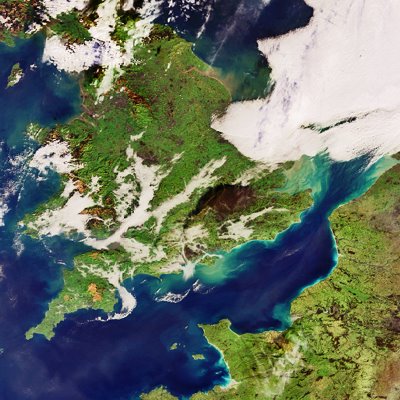
    Caption: London is completely blanketed by the black plume of smoke from Europe's worst peacetime fire in this Envisat image, taken within five hours of the blaze beginning.

    This image was acquired at 10:45 GMT on Sunday morning by the Medium Resolution Imaging Spectrometer (MERIS), one of ten instruments aboard Envisat, Europe's largest satellite for environmental monitoring. This Reduced Resolution mode image has a spatial resolution of 1200 metres, and shows the cloud spread across a span of around 140 km.

    The pall of smoke comes from a fire at Buncefield oil depot on the outskirts of Hemel Hempstead. Buncefield is the fifth largest fuel storage depot in the UK, distributing millions of tonnes of petrol and other oil products per year, including aviation fuel to nearby Luton and Heathrow Airports.


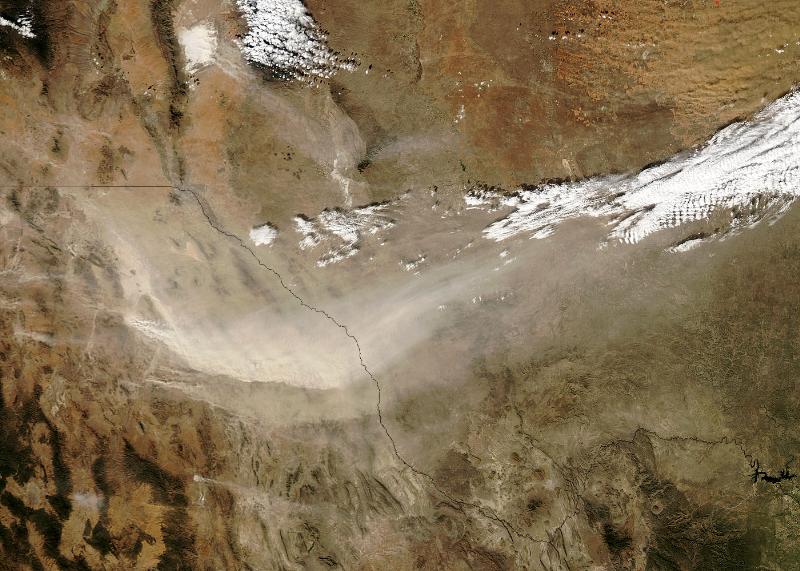
    Dust storms along the Mexico-Texas border
    Date: Sunday, November 27, 2005.

    Nothing like a massive dust storm in the desert! The stuff gets everywhere. The barren Northern Mexico desert playas are unusually vulnerable to high winds, as is evident in the picture.
    American Conservatives

    Getting excited by the Sydney riots.

    Sunday, December 11, 2005

    Sydney Violence

    The U.S. and Australia share a lot of common characteristics, including an insular mindset that can lead to violence towards foreigners. Lots of trouble today in Sydney:
    CRONULLA'S day of shame began like any normal Sunday.Families enjoyed a morning swim and early cloud gave way to brilliant December sunshine.

    ...By midday the beachfront concourse at North Cronulla resembled a summer cricket match with thousands of bare-chested locals chanting and drinking.

    A group of mates ran a sausage sizzle from the back of their ute, blasting out favourites by AC/DC and Cold Chisel.

    But as the beer flowed the day began to turn ugly. Cries of "f... off Leb" goaded the crowd.

    Surfers young and old, bikies, white supremacists, and even families with young children joined in the chants.

    Just after 1pm (AEDT) the throng descended on Northies Hotel where a Middle Eastern man was rumoured to be hiding.

    The mob screamed for him to show himself, chanting "string him up".

    ...Two girls of Middle Eastern descent were the next victims. As they walked along the street another group of teenage girls pushed them to the ground and assaulted them.

    The baying crowd erupted again, this time with calls of "cat fight" and "kill the Leb b......".

    ...With the PolAir helicopter overhead, the crowd swarmed towards Cronulla station with talk of catching a train to Bankstown to "bash Lebs".

    ..."This has been coming. It's not about race, it's about respect and pride," said local volunteer lifesaver Luke O'Brien.

    The mob nearby sang "I am, you are, we are Australian".
    Did You See That VW Pass By?

    They're nuts over there at VW:
    A superlative on four wheels, the Bugatti Veyron 16.4 is not only the world's fastest production car but also the most expensive: $1.25 million before taxes and richly deserved gas-guzzler penalties. Also, the most powerful: Its 8.0-liter 16-cylinder quad-turbo engine produces about 1,000 horsepower and churns it through a high-tech all-wheel-drive system and gob-smacking foot-wide tires. Also, the quickest: The Veyron accelerates to 60 mph in 2.1 seconds, faster than a Formula 1 car, but then it's just getting started. In 20 seconds — about the time it takes a fast reader to get through this paragraph — it reaches 200 mph. In 53 mind-blowing seconds, the Veyron reaches its marquee speed: 253 mph.At that speed, the tires would begin to soften in about half an hour.

    Fortunately, at top speed, it runs out of gas in 12 minutes. "It's a safety feature," Wolfgang Schreiber, the Veyron's chief engineer, says with a smile.

    Friday, December 09, 2005

    No Dragons Were Harmed In The Making Of This Film

    Friday evening, I went with the DMTC crew to the Natomas Regal Cinema multiplex to see "Harry Potter And The Goblet of Fire." My mistake was drinking three glasses of Gewurtztraminer at the annual company Christmas party, just prior to sitting in a warm, dark room in a comfy chair. I dozed a bit, and lost some of the busy plot.

    Plot loss wasn't as bad as when I saw Austin Powers III, however, and actually fainted, because I started laughing uncontrollably at the shadow play featured in every Austin Powers movie (the Mini-Me getting 'born' bit just slays me) , and I couldn't get my breath for more than 30 seconds, since I was folded up in a seat with a belly full of popcorn and diet soda, and my wheezing and snorting laugh cramped up my diaphragm's style, and Michael Myers just wouldn't stop being funny, and the inevitable result was a few moments of unconsciousness. But, that was then. This is now. Where was I?

    Oh yes, plot loss. Anyway, the Harry Potter movie was interesting visually, but a bit hard for me to follow, since I haven't read the books, and couldn't properly place the wizards, and the dragons, and the potions, and the special effects. Steve apparently had similar difficulties, even though he was wide awake. But I think we all enjoyed the film nonetheless. Just don't spring Harry Potter charades on either of us, though.

    Outside, KCRA Channel 3 was preparing to go live to catch the 11 p.m. premiere crowd for "Narnia." I leaned into the TV van and said "It's bad to watch so much TV!" The fellow in a suit sitting inside the van smiled and said, "Yeah, unless you are paid to do it!"
    Cool Album Cover Ideas From The Mid-70's...

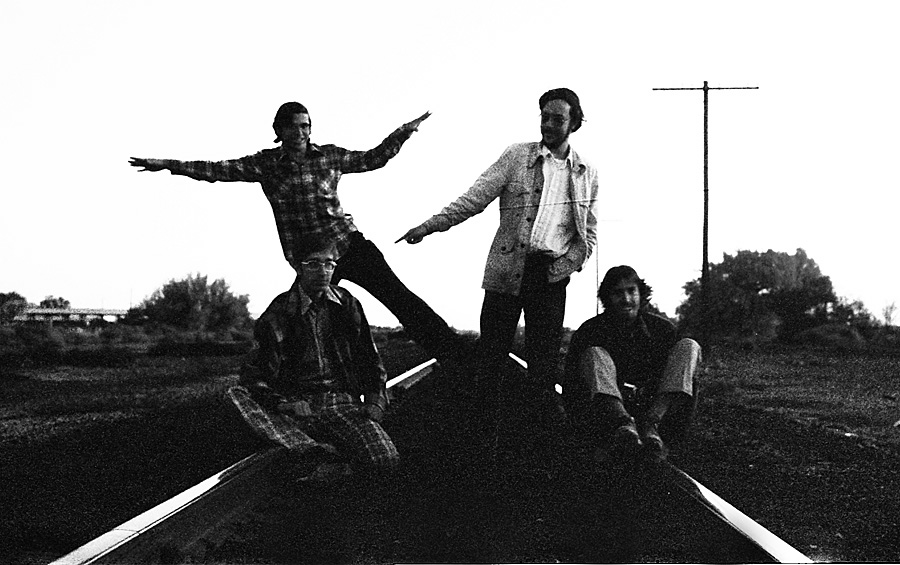
    That somehow didn't go anywhere. Maybe if we had taken the photo BEFORE sunset, and worn swim suits, and maybe played in a band, it would have helped! (Courtesy of Dyer Lytle: seated, left, Walt Kubilius; right, John Shortess. Skidding, left, Marc Valdez; center, Joel Weinfeld.)
    Many Happy Tidings!

    To Lauren and Mike Mac, on the occasion of their wedding - tomorrow!
    A View From A Bridge

    There is an unusually-detailed review by Corky Templeman in the December 1st East Sacramento News (unfortunately no link yet available) regarding Natomas' Charter School's "A View From A Bridge." Wish I had seen the production, but the review is written in a breathless 'you are there' perspective that is very helpful in - putting you there!

    I thought it was interesting how rapidly Chloe Condon's characters are evolving - from an orphan in Annie, to Zaneeta in Music Man, to a maiden in Pirates, to a politically-embroiled lover (Catherine) in Bridge:
    The energy of Catherine and Rodolpho's ebullient liaison spilled into the audience just as Eddie's dark and insane rage would inevitably submerge it. The audience held its breath as they began to witness the peeling back of the outer layer of this family.
    Ouch! At this blistering pace, by next year, Chloe will burn through adulthood, and start playing retirees!

    Over at B3ta, drama student 'La Rousse' discusses her five-year journey in search of a drama degree:

    • played a prostitute;
    • played an old lady (same production);
    • been beaten up twice;
    • learned to waltz;
    • fallen on my arse more than once;
    • played a body piercer;
    • played a chav;
    • rapped parts of midsummernights dream;
    • been blindfolded and poked;
    • run around the woods in the dark with a firey torch;
    • played a STD , and;
    • played Mary Tudor and a horse;
    Women tend to have more complicated dramatic journeys than men do. No matter what happens, I'm the cop, or the drunk (except in "Victor/Victoria", when I was the bartender).

    I also thought it interesting in "A View from A Bridge" how Colin Sphar apparently composed the jazz accompaniment. Cool! Times change. It was only as far back as 2001, in DMTC's "Oliver!", that Steve would mutter during intermissions, in a jaundiced 'I Hate Kids' mind set, that young Colin should go play on the Interstate (Steve was just teasing, but he's such a good actor, sometimes it's hard to tell). If Colin did venture onto the busy asphalt, it apparently only helped with the music!

    It will be interesting to see what these talented folks do next!

    Thursday, December 08, 2005

    Makeshift Swing

    I've known people who would have done exactly this. I got out of rock-climbing when I realized my double-jointedness was a recipe for disaster:
    An experienced rock climber died early Tuesday after he climbed to the tip of a 10-story crane on the University of Colorado campus and then used rock climbing gear to create what amounted to a giant swing.

    Ryan Young, 22, may have been blown off course by a gust of wind, sending him crashing into a building across the street, CU police Lt. Tim McGraw said.

    "As we all know, the winds were blowing last night, and as we also know, crane arms aren't tied down," McGraw said. "They're somewhat akin to a large weather vane. A little movement on the end of the crane could have a huge impact."
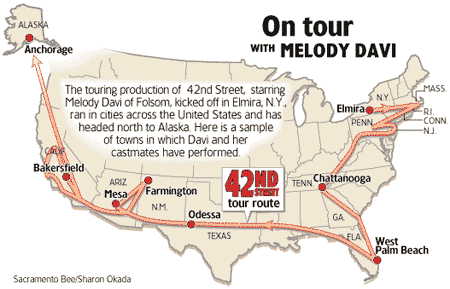
    Melody on Tour


    Nice story regarding Melody Davi in the Sacramento Bee today. Sounds like she's becoming a good judge of audiences too:
    Davi said she discovered that the most appreciative audiences are in out-of-the-way places.

    "The crazy thing is that when we get to smaller venues, we have the best reaction," she said.

    She described the sold-out Stockton audience, for instance, as "a great house."

    Following the brief break, "42nd Street" left this week for a six-day trip to Anchorage, Alaska.

    Wednesday, December 07, 2005

    A Breed Apart

    One nice thing about attending New Mexico Tech, in Socorro, for two years in the mid-70's, was being a Techie: a breed apart among college students.

    The hallmark of being a Techie was an independence of thought and manner. All college students are susceptible to herd-think, but the awkward placement of NM Tech far from major cities removed the herd, and served to provoke original thinking and adventurousness, whether that meant plunging into caves and abandoned mines on weekends, or scouting for Indian ruins, or hiking through the mountains and badlands of central NM (there were plenty of 'chemical' adventures as well, but I steered away from most of that).

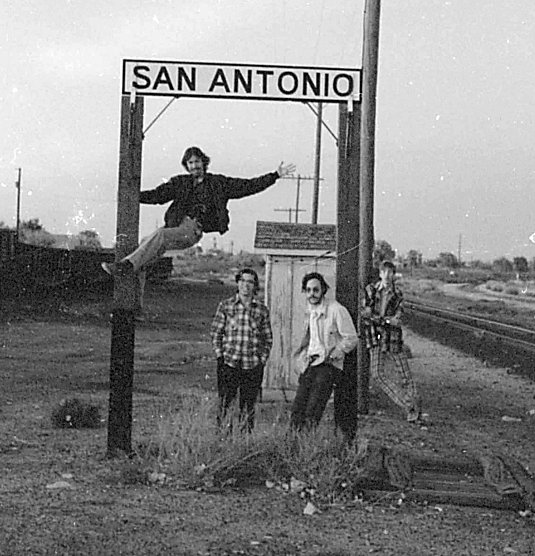
    Dyer just sent this scanned photo from one of several trips we took to the vicinity of San Antonio/San Marcial, NM, around 1975. Hanging from the sign is John Shortess: I'm there in the checked shirt, with Joel Weinfeld (with his beta version of photogray glasses) and Walt Kubilius (leaning on the pole). I'm not sure if this is the trip where we found the dessicated cow or not. It looks pretty chilly in this photo.

    As I recall, the grand challenge of the location was trying to screw up the courage to cross the Santa Fe railway trestle on foot from San Marcial, over the Rio Grande river, to the remote, desolate east side. The trestle crossed the Rio Grande at an shallow angle, and thus was a couple of miles long. Had a train come down the tracks there would have been no alternative but to jump 30 feet into the shallow Rio Grande, or into the neighboring brush, miles from help. It would have been difficult, at best, to try to outrun the train over such a long distance on foot. Alternatively, we could have hung off the end of railroad ties as the train passed by a few feet away. Very scary. I don't think any of us ever attempted the grand challenge. A pity, really. Maybe we were more susceptible to herd-think than I thought! Maybe I can still do it! ("Confused Man, No Doubt On A Chemical Adventure, Swan-Dives Into Muddy Oblivion" will read the headline).

    The world is a small place. The only time I've ever seen a Broadway play ('Dracula' in 1978), Walt and I bumped into John Shortess in the lobby of the Broadway theater, quite by accident, 2000 miles from Socorro. How strange!
    Mel Gibson, Republican For Governor?

    Ha ha! California voters would never vote for an actor for Governor, would they?

    (Oh yeah, I guess there's a track record there, isn't there?)
    Happy, er... Holidays

    It's just plain amusing that the Bush White House is in so much trouble with the xenophobic right wing for its "Happy Holidays" cards. Like The Carpetbagger notes:
    Laura Bush's press secretary defended the holiday card saying the First Family "included best wishes for a holiday season, rather than Christmas wishes, because they are sent to people of all faiths." But that's only likely to make things worse — conservative whiners don't care about non-Christian faiths and they don't want the White House to care either.
    Brr...

    It's pretty cold along the Front Range of the Rockies right now - temperatures in and around zero degrees Fahrenheit. Lows dipped to 45 below at West Yellowstone. Deborah in Ahwatukee (just outside Phoenix), reported 34 degrees yesterday (Sky Harbor airport reported 37 degrees), which is pretty darn cold for that place. Doug went camping at the Grand Canyon, and it was three degrees Fahrenheit there (thank goodness for down).

    FNMOC forecasts suggest this weather pattern will continue for awhile, with an extreme ridge in the west and an extreme trough in the east, and given the long Rossby wavelength, it won't be moving very far, very fast. Continued arctic intrusions into the Plains....brr!
    It's Official...

    The best Woodland tradition is/was:
    Chili Cook-off (5) 24%
    Yolo County Fair (2) 10%
    Stroll Through History (7) 33%
    Hot August Cruise Night (3) 14%
    Christmas Parade (4) 19%
    I like the Hot August Night myself. Low-riders with bouncy hydraulics and sharp bicycles with great paint jobs shimmering in mirror shards on black velvet.

    Tradition!
    Laurie T, And The Trick


    A fine band - lots of 70's covers: 'Hotel California' by the Eagles, KC & The Sunshine Band, some newer stuff that sounded like Shania Twain. I didn't hear them play Sheryl Crow, but she would have fit right in.

    At one point, a delicate diplomatic moment arose. An enthusiastic patron called out for a DJ. For most bands, that might be quite insulting. Seeing the patron's enthusiasm, though, and the possibility that her English skills were quite limited, the appropriate interpretation of the remark was that she wanted more dance tunes. So everyone clap your hands!

    At one point, the band offered to play Lynyrd Skynyrd's 'Free Bird' but then changed their minds. I took this to be a good omen. 'Free Bird' has been overworked all these years.

    When I graduated from West Mesa High School in 1974, a student committee chose two songs to best represent our class: one by Cat Stevens (was it 'Oh Very Young'?), and another by Seals and Crofts. These were excellent, youthful, optimistic songs from our golden year of 1974.

    When the Cibola High School class of 1980 (my youngest sister's class) chose their class song, they chose 'Free Bird,' even though it actually came from 1974. In the intervening six years, the song had become something of an anthem of southern rock-and-roll, and had achieved an enduring second popularity that escapes most pop songs. I took the mismatch of year to be a bad omen, however, indicating a nostalgic, conservative bent-of-mind of the graduating class. Then that fall, Reagan was elected, and it's been downhill ever since.

    When most of the band members of Lynyrd Skynyrd were wiped out in a plane crash, I heard about it on the CBS Evening News with Walter Cronkite. Cronkite pronounced the band's name with a jolly Swedish lilt that knocked me on the floor with laughter. It was clear that Cronkite had never seen or heard the name until it popped up on his teleprompter, and he gave it a good, robust sight-read attempt. I suppose if you tried to plot out social circles with a Venn Diagram, and put Charlie Daniels and the Allman Brothers Band in one bubble, and the '60 Minutes' crew in another bubble, you'd end up with two separate, isolated bubbles. It was the funniest plane crash I ever heard about, which reminds me of Don Henley's song, 'Dirty Laundry' (which Laurie T and the Trick also covered), which was inspired by the 1977 movie "Network," and cynically discusses a TV anchor:
    We got the bubbleheaded bleach-blonde, comes on at 5
    She can tell you about the plane crash with a gleam in her eye
    It's interesting when people die, give us dirty laundry
    We need new anthems to replace the old ones like 'Free Bird'. How about 'Beat It' by Michael Jackson? (Bad idea - forget I ever mentioned it) How about that incredibly windy Celine Dion Titanic hit 'I Will Always Remember You?' (Too cold!) How about the 'Macarena'? (I can hear the call for a DJ now).

    We'll think of something, I'm sure.

    Tuesday, December 06, 2005

    All That Glitters Is Not Gold....

    But better to have loved glitter and lost glitter than not to have loved glitter at all.
    Orchestral Din

    And "Sleeping Beauty" no less. Who'd have thought it would be so - noisy?:
    To stick within the law, some musicians will have to wear ear plugs and some will have to be replaced at the interval, costing Australian Ballet up to $100,000 extra for the production. WorkCover told the orchestra's managers, Opera Australia, the musicians could not be subjected to noise greater than 85 decibels averaged over a working day, which it believes Sleeping Beauty will exceed.

    Opera Australia has agreed to shorten the length of time some musicians spend in the pit and hire casuals - at an average cost of $140 a shift - to fill the 750 extra spots it now needs to cover.

    Australian Ballet has to foot the bill, but the upheaval has also given Opera Australia a headache. Finding replacement musicians two weeks before Sleeping Beauty opens on December 2 is proving difficult. Vernon Winley, Opera Australia's human resources director and executive in charge of the AOBO, said Opera Australia would have to look at bringing musicians in from other states. "We're having to look very hard," he said.

    ... Musicians complain of damage to their hearing, and at least three have refused to play in Sleeping Beauty.

    Those that remain are worried the quality of the music will suffer and are considering writing a disclaimer for the audience.

    "It's going to be really awful," said Will Farmer, a trombonist. "Nobody knows, for example, how it's going to sound when the whole brass section have got their ear plugs [in].
    Telling Remark

    By Digby, regarding Christopher Hitchens:
    For a guy who models himself on George Orwell he sure is a naive little thing, isn't he? Where has he been?

    Monday, December 05, 2005

    Rio Rancho Estates - The Nightmare Unleashed


    Tribune caption: Earthmovers are the only occupants of what will one day be Rio Rancho's new Downtown six miles west of the city's current center. In this aerial photo, Unser Boulevard runs along the bottom of the photo, crossed by the under-construction extension of King Boulevard. (Craig Fritz/Tribune)

    Nothing in my life has been so bothersome to watch as the relentless, sprawling growth of Rio Rancho Estates, west of my hometown of Corrales (which, in turn, is NW of Albuquerque, NM). Nothing can stop the cancerous spread of Rio Rancho, with its utter contempt for the land and the living creatures on it. [Note: I've had many good friends from Rio Rancho over the years - my complaint is with the form of development, not the people].

    The most ominous part of the growth is that there seems to be no natural limit for it. Rio Rancho, and the WESCORP development planned further to the west could eventually dwarf Albuquerque, and become even larger than, say, Phoenix. But even then, there would be no natural stopping point. It could outstrip LA even, and envelope any and every possible barrier, spilling past Mt. Taylor, chewing north and south, and west, west, west. Only the spread of a contagious, fatal human virus could stop it.

    The Albuquerque Tribune has recently run a special series, looking at the feeding, breeding, building, despoiling horde out there.
    Today, this suburban Shangri-La is just a few subdivisions away from becoming the third-largest city in New Mexico, behind Albuquerque and Las Cruces. In a few years, its borders are expected to span a massive 300 to 400 square miles - nearly twice the geographic size of Albuquerque and Las Cruces combined.
    In the last Ice Age, Rio Rancho used to be a vast 400 square mile Serengeti Plain, with mammoths, camels, and other large grazing animals roaming around. There are plenty of red, clayish, river-mud-like rocks, for example, in the hill north of the Country Club, that indicate the Rio Grande once wandered across that vast area. The Rio Grande eventually settled into its current valley near the Sandia Mountains, and the vast plain dried out a vast steppe, with its own, unique charm.

    Now, the place is being carved up, and what little life left is being systematically erased.

    It’s a strange social environment too. Development always takes surprising turns out in Rio Rancho. The place has developed a strange, schizophrenic dichotomy between those homeowners who built their own homes in detached independence, and those who have their homes built for them, as part of clashing subdivisions. A drive up Highway 528 just highlights the strange weirdness of the place – the clones and the cowboys. Are they in harmony? Or are they at war? Or are they all – just plain weird? What must it be like to be a kid there, growing up?
    "It was a mesa with millions of tumbleweeds," longtime resident Arturo Boniello says of the nowhere he bought into in the 1970s. "It was a bunch of nothing."
    People misremember their own history. No, the tumbleweeds sprouted up in your wake! Tumbleweed is an opportunistic plant – it grows in disturbed soils. If the place had been left in a more-natural state, there wouldn’t have been nearly so many tumbleweeds!

    When I was 15, I used to walk from Corrales to Rio Rancho, where I’d either go visit friends (particularly Jeff Anderson) or go to work at a tree nursery where I had a summer job (Jeff helped get me that job). I remember the two of us once approached a lonely, unfenced, modern-looking suburban house that had sprung up suddenly along my usual path. Dust blew everywhere from the disturbed soil. I heard a lonely, frightened man with a Brooklyn accent warily shout hello. We said hello back – we meant no harm, and we were just passing by – but I always wondered what he was thinking, lost and adrift in this strange, new, sunny, barren world, where unknown teenagers can just walk right up to your door, or buzz past on dirt bikes.

    I could see the rapid transformation of the place, how grading the hills above Corrales stripped the sugar sand of any coherence whatsoever, allowing instant arroyos to be made when the summer thunderstorms came along. One 30-foot deep arroyo appeared overnight in 1974, north of Ella Drive, where Corrales and Rio Rancho shared a boundary, and where the Rio Rancho folks had unwisely decided to dump water from the gutters of Corrales Heights. Lots of money was spent corralling that damage in. A dam was built, but there was enough water fetch on the face of the dam itself to allow continued arroyo development downstream, dam or not: the 30-foot deep arroyo became 50-feet deep below the dam. I can only imagine what a wretched mess that particular place must be, 30 years later.


    This picture epitomizes everything that angers me about Rio Rancho: the dunes, like all major soil disturbances out there, are pretty-much man-made. Tribune caption: Vincenzo La Mendola, 10, rides down a sand dune north of Northern Boulevard on Unser Boulevard. Vincenzo's grandfather moved to Albuquerque in 1974 from New York after seeing real estate advertisements; he later moved to Rio Rancho. The dunes are typical of what all of Rio Rancho once looked like, but they are destined to become the city's new Downtown. (Craig Fritz/Tribune)

    In the beginning of Rio Rancho Estates was the Word, and the Word was Greed:
    The campaign was concocted by a fledgling New York conglomerate called American Reality and Petroleum Co. - AMREP for short - whose main stock in trade before Rio Rancho had been mail-order roses.

    "I got those advertisements showing rivers and green grass, green, beautiful," Boniello says. "I hesitated when they started coming, but those mailed things kept coming."

    …Rio Rancho, they said, was a lucrative investment, costing as little as $10 down for half-acre lots, which started in the 1960s at $795, but reaping as much or more than 150 percent in resale values as the shining metropolis of Albuquerque spilled westward.

    Rio Rancho, they said, offered fishing, camping, swimming and golfing in a place where the sun shone 360 days a year. It sloped along "one of the greenest most fertile valleys in the world," the brochures bragged. It was "a resort region featuring giant lakes," another said.

    …By 1969, some 1,500 people lived in Rio Rancho. The community had one police officer and a volunteer sheriff's posse. …New Yorkers then made up a large percentage of the population, earning Rio Rancho the nickname "Little New York" and making memberships to the New York Club the hottest social ticket in town.

    …"There is no question that Intel made this place," Forbes says. "It exploded afterward. Before, we were like one big, happy family here, even though we were all different religions and backgrounds. Unfortunately, it's changing."
    The place is straining to stay ahead of the boom:
    This school year, more than 13,621 students are enrolled in the district's 16 schools, up from about 5,905 in seven schools in 1994, when the district began.

    …To help pay for the buildings to house such successes, Rio Rancho voters in 2003 approved the maximum sale of general obligation bonds, taxing themselves to the limit and maxing the district's bonding capacity.

    …Hveem has seen the high school's population skyrocket from about 2,000 in 1997 to 3,481 students in the 2004-05 school year, 693 more than the second-largest school in the state, Cibola, at 2,788. Hveem says this year's population could reach about 3,700.
    And the boosters:
    Not surprisingly, Mayor Jim Owen, a hopelessly optimistic man who can make a weed seem like a rose, sees it differently.

    Rio Rancho, he says, is a clean slate, free of the usual mistakes older cities have made. Its personality is broad, fresh, American.

    "We're a good blend, a new breed," he says. "We're the maverick people who can get things done."
    No, you are a parasitic clone.

    "In 1995, there was not one stick of wood out here," he says. "Now it's rooftops as far as the eye can see."

    A newcomer might see ugly, uncontrolled sprawl. Owen sees a beautiful future.

    "We'll be that big because we can be that big," he says. "Albuquerque is hemmed in, but Rio Rancho has room to grow."

    …Finishing up his first term as mayor, Owen has turned into the city's primary salesman, a veritable P.T. Barnum.

    His stories of the old days act as the prologue to a tale of unparalleled growth, of a city with so much potential he terms it "the Dallas to Albuquerque's Fort Worth."

    "I'm the one that coined the phrase," he says of his Dallas reference. "Everybody thought I was insane.

    "But everybody's saying it now."

    By Owen's estimate, Rio Rancho could someday grow to almost 400 square miles once it envelops all the land he hopes to annex.

    If that comes to fruition, Rio Rancho would more than double the land of present-day Albuquerque.

    "We can be that big. Albuquerque can't be that big," Owen says. "The only way they can move is west, and they have no heart to move west.

    "We will go west all the way to Laguna (Pueblo)."

    ... Nearly 90 subdivisions are under construction.

    "You can't fight growth," he says. "We exist as a result of being able to have affordable housing. We're trying to build this community in such a way that you don't have to go to Albuquerque and Santa Fe."

    One good feature of the Tribune series is to focus on the role of “redevelopment” in trying to establish some coherence to development in Rio Rancho. Redevelopment in such a place is like trying to repair the damage caused by a suicide bomber: civic planning would have been a better thing to do, but who has the time to plan during an explosion:
    "Redevelopment is the acquisition of property for the public good," Tollefson says.

    Using powers granted by the state, a municipality like Rio Rancho can buy individually owned lots in tracts of land that have not been developed or are developing too slowly.

    ...The city of Rio Rancho, incorporated in 1981 and now with a population of about 70,000, uses redevelopment as a tool for what it calls orderly growth.

    …Matt DeAveiro of Coldwell Banker, who has been selling real estate in Rio Rancho for 18 years, says the redevelopment process has two sides. Owners fret the process will cheat them out of a fair price, he says, but the money might be the only chance they have to get anything out of their unimproved land.

    "The only way you are going to improve those properties is by bringing utilities in, and (individual owners) are not going to do that because they can't afford to," he says.

    "And redevelopment is the only way the city can go forward and help citizens throughout the community."

    According to Tollefson, roughly 25 percent of Rio Rancho's 103 square miles is developed or under development.

    ...Tollefson says tracts selected for redevelopment are those adjacent to or surrounded by developed tracts and so are those that have immediate access to infrastructure.

    "Rio Rancho wants to retain a rural character and large lots in some areas," Tollefson says. "We want a diverse mix of residential development.
    Rio Rancho has never had a rural character, and never will. It is hostile to rural values, like living off the land, rather than grading it into oblivion.
    Their population estimates four years ago showed Rio Rancho would be home to 100,000 people by 2020. Now officials peg the total at 125,000 by 2010.

    At that rate, the city will add about 11,000 people a year, Tollefson says.

    To pay the tab for so much development, Rio Rancho in 1995 started an impact fee system, charging developers for improvements like roads and parks.

    "In terms of financial improvements, we're able to keep up because of impact fees," Tollefson says. To hold that trend, city councilors have proposed raising the fees by 51.4 percent. As it is, an average house price includes $6,094 in impact fees. That would rise to $9,229 by January 2007.

    In Albuquerque, impact fees - increased in July of this year - vary depending on the location of the house. A 2,000-square-foot house on the West Side, for example, includes $8,000 in impact fees; something similar in Nob Hill includes $1,332 in fees.
    The place eats resources too:
    In securing a future with water, Rio Rancho must play catch-up to Albuquerque, where Duke City officials in the early 1960s set up the San Juan-Chama project, giving it the right to sip water from the Rio Grande.

    Rio Rancho, by contrast, must keep buying water rights under a permit granted by the state Engineer's Office. So far, says state Engineer John D’Antonio, the city is on the right path.

    "There is enough, but it gets increasingly harder to find water and land to take out of (agricultural) production," he says. "It's going to be expensive. Water rights are available, but it's difficult to find willing sellers."

    Costs vary, but water rights have sold for several thousand dollars an acre-foot in the Middle Rio Grande Valley. Under a 1979 permit with the state Engineer's Office, Rio Rancho is entitled to 12,000 acre-feet of water a year but must offset the effect of its pumping on the Rio Grande.
    What can stop the sprawl? The counter-culture can’t do it…
    There it lies, at the end of Rainbow Boulevard, a secret treasure.

    Where the rough dirt road stops, an ancient escarpment drops into the scrubby vastness of the Sandoval County desert. Silently, it marks the northeast border of Rio Rancho with a stunning, postcard-worthy view.

    Gilbert and Virginia Otterstetter, living in a solar-powered trailer just three uninhabited miles from the site, have it mostly to themselves. For now. But in about five years, Rainbow Boulevard will be paved and lined by houses, and the secret treasure won't be much of a secret anymore.

    Gilbert, 62, and Virginia, 60, moved there for the solitude, for the big sky, for the independence. The sun powers their hot water heater, oven and electricity. A friends hauls 1,500 gallons of water to them for $50.

    "We are totally off the grid. We don't owe anyone anything," Virginia says.

    …"Eventually they are going to be out here," Virginia says. "But are they going to want to build around my ugly trailer?"

    She doesn't think so. She worries that a developer, as has happened in the city's past, will persuade the city to use eminent domain to claim her plot so it can be absorbed into a tidier development parcel.
    I liked the words of V.B. Price:
    I've never been a fan of the concept of Rio Rancho - a supersprawl, developer city built around the Eisenhower-era fiction of limitless water and limitless petroleum, a generic American place plopped on a distinctive New Mexican landscape, with no ecological or cultural sensitivity and no conservation strategy, selling people "affordable housing" miles away from most of their jobs.

    …Granted, Rio Rancho is an economic competitor. But even with Intel's semiconductor plant there, the city's self-promotion as a "tech-savvy community," with broadband for all, and its expanding call center industry, Rio Rancho is still an economic parasite on Albuquerque, where most of its jobs and cultural attractions reside.

    From an airplane, before Rio Rancho became a city, the area's endless miles of bulldozed roads seemed to many New Mexicans like airstrips for an invasion from Long Island, N.Y. And as Rio Rancho has grown, it has, indeed, invaded some of the most beautiful country in our area, sprawling right up to U.S. 550, without any buffer zone. The mountain-blocking walls on N.M. 528 along River's Edge make driving in Rio Rancho like driving in occupied territory.

    It's for reasons like this that many New Mexicans see Rio Rancho more as a land-gobbling amoeba than a City of Vision.

    It's worrisome Rio Rancho is a city that's growing beyond its water supply and that's clogging the interstates into Albuquerque with lung-wrecking traffic congestion.

    Rio Rancho's water problems could get serious, especially if it tries to grow to 100,000 residents by 2020. Right now, it's in a struggle with the state Engineer's Office over transferring water rights from Sierra County. Rio Rancho's growth means taking water from rural places that might like to do a little of their own growing one day.

    If Rio Rancho does continue to grow, I wonder if it will feel some of the animosity from rural New Mexico legislators that's always directed a Albuquerque. At least that would be sharing a burden.
    Remember, Sierra County is more than 150 miles away. Rio Rancho, the behemoth child, is hungry, and getting hungrier....
    Three Pieces, or Two?

    There is some question regarding how the HMS Titanic sunk in 1912:
    Undersea explorers said Monday that the discovery of more wreckage from the Titanic suggests that the luxury liner broke into three sections -- not two, as commonly thought -- and thus sank faster than previously believed.
    So, how can DMTC simulate what really happened to the Titanic? Special effects:
    The wind began to switch - the house to pitch and suddenly
    the hinges started to unhitch....

    The house began to pitch. The kitchen took a slitch.
    It landed on the Wicked Witch (of the North ... Atlantic)
    in the middle of a ditch,
    This is what will happen to the "house" that Mike Mac will build!
    The Wasted Teachings of Marcus Aurelius, Emperor of Rome

    Gabe quotes, from Meditations, Book V, No. 28:
    Art thou angry with him whose arm-pits stink? Art thou angry with him whose mouth smells foul? What good will this anger do thee? He has such a mouth, he has such arm-pits: it is necessary that such an emanation must come from such things—but the man has reason, it will be said, and he is able, if he takes pains, to discover wherein he offends—I wish thee well of thy discovery. Well then, and thou hast reason: by thy rational faculty stir up his rational faculty; show him his error, admonish him. For if he listens, thou wilt cure him, and there is no need of passion; leave that to actors and whores.
    I respond:
    Hmmm..... It's good not to get too excited by such things, I suppose. But those actors, and those whores: who can blame them?
    Gabe replies with a pithy saying:
    All roads lead to Rome.
    I respond:
    Including the road with the smelly armpit/bad breath guy, but I'm not going to get all passionate about it, like the hos and the actors do.
    Gabe replies:
    You cannot step into the same river twice.
    I respond:
    Smelly armpit/bad breath guy never stepped in a river at all: otherwise, the discussion would be moot.
    Gabe puzzles at the word "hos". I elaborate:
    There he is! He's foul, but he's coming to Rome, and he's got bling-bling!
    To emphasize, Marcus Aurelius is well-known as the last, and the philosophic best, of the Five Good Emperors of Rome.

    Sunday, December 04, 2005

    "Into The Woods" Closes

    Nice show, but more fatalities (15) than any show since "Sweeney Todd," and with a cast of only 17, or so, it's just too many casualties: City of Davis health and safety code demands no more than ten (10) fatalities per production. But I guess that won't work, with "Titanic" coming up, with its 1,000+ casualties. Weren't all those folks in steerage anyway? In any event, "Joseph and the Amazing Technicolor Dreamcoat" is casualty-lite, with only a missing goat or two, so maybe it all averages out.
    Can't Shake Epsilon

    Persistent hurricane!:
    The storm was about 1,000 miles west of Portugal's Azores islands and moving to the east at 12 mph (19 kph).

    "Epsilon is a tenacious tropical cyclone which has maintained hurricane intensity over cool waters and apparent unfavorable atmospheric conditions," the Miami-based hurricane center said. But it reiterated its expectation that the storm would steadily weaken over the next few days.
    Dreamcoat Productions

    Jocelyn Price says that Julia Spangler and herself, under the sponsorship of Julia's mother, Helen, are going to put together a theater company of their own, aimed at teens, called Dreamcoat Productions. They have several projects under consideration for the coming year, with performances planned for DMTC's Hoblit Performing Arts Center.

    It seems that if the number of available facilities expands, the number of theater companies will expand as well, to fill the available space. The proliferation of theaters in the Sacramento area over the last decade might be partly responsible for the proliferation of theater companies in the same time period. Makes the Elly Awards process more complicated than ever, these days.

    I had thought that DMTC should cast about looking for dance companies to fill DMTC's dark nights at the New Theater, or other perhaps other embryonic theater companies, like Flying Monkey or Big Barn, would make approaches to us. There's no reason, of course, why we can't give birth to our own companies, like Dreamcoat Productions.

    And we might still hear from other folks. Jennifer Lin says that Sacramento Opera is beginning to look for a smaller facility than the Sacramento Community Center, or the Mondavi, for smaller productions. Perhaps we'll hear from a number of people over the next year. We'll need to come up with rules and procedures. Right now, all I can think of is some basic rules: no spitting on stage, no fireworks or large predatory animals. Mimes would be OK, though. We need mimes - theater companies talk too much, in general.

    Friday, December 02, 2005

    Ask The Professor

    A friend and climate-change skeptic, W., quizzes J., a professor of climatology, about the state of climatology. As I understand it, in the last 25 years, there has been a shift away from chemical explanations for climate change (carbon sequestration in the oceans, as affected by carbonate/bicarbonate sensitivity to temperature), and a shift towards thermohaline circulation sensitivity towards salinity. Presumably the fairly-rapid temperature changes of the Pleistocene can't be explained by deep oceanic processes, which don't change that rapidly. For other, probably more authoritative answers, J. suggests Realclimate.org.

    W. writes:

    Hey Marc: Got some questions about climate change / global warming. Back in 1990 I taught a night school course for teachers on Climate Change (textbook was Schneider & Londer). I've lost track with the thinking, but now I want to catch up somewhat. So here are the questions:

    1.) As of 1990, climatic variation on a scale of 1-10 years was becoming understood in terms of ENSO. Variation on a scale of 10,000-100,000 years was well understood as Milankovitch cycles. But variation on time scales of 10-10,000 years was not understood much at all. There was speculation of CO2 sequestration and release in vertical ocean convections. What is the present interpretation of this time scale? Something in one of your recent emails made me think the vertical ocean circulation has been successful.

    J. answers:
    It depends on which period you're interested in. In the late Pleistocene, the large temperature fluctuations that occurred were probably caused because of an instability in the Laurentide Ice Sheet (the big one that covered most of Canada). Basically the idea here is that influxes of freshwater into the North Atlantic and the subsequent reduction in the salinity of the surface waters caused a weakening in the North Atlantic thermohaline circulation, thus reducing heat transport into the high latitudes of the Northern Hemisphere. (One example: the Younger Dryas Event, which may have been caused by a sudden re-direction of water from glacial Lake Agassiz.

    In the Holocene, the amplitude of temperature changes has been much smaller; various possible mechanisms have been proposed as causes: changes in solar energy flux, increased albedo due to volcanic eruptions, and "internal variability" of the climate system, e.g., things like ENSO, PDO, etc. Nothing definitive, though, as far as I can tell. (Reconstructions of solar-energy flux are very dubious; they are essentially extrapolations based on a rather meager dataset -- 25 years of satellite measurements.)
    2.) In 1990, the big unknown in climatic modelling was albedo change due to cloud cover -- will warming result in positive or negative feedback? You seemed to say that this was still an unknown. Is this correct? If so, how much confidence do you have in all the models which predict significant warming over the next century?

    J. answers:
    There are two main sources of uncertainty: (1) future anthropogenic emissions of greenhouse gases and (2) the effect of cloud feedbacks. For a given emissions scenario, it is still true that the biggest source of uncertainty is the cloud feedback. The latest model intercomparison study that I have seen still shows that the feedback is positive in some and negative in others.

    "Confidence"? Hard to say. There is such a range in model sensitivities and of emissions scenarios that it seems likely that the future warming is encompassed by the projections that have been made. The lowest projected temperature rise, made using the least sensitive model (one in which the cloud feedback is strongly negative) and the lowest credible emissions scenario (in which emissions in 2100 are actually lower than 1980 values) is 1.5 degrees C.
    3.) In 1990, when talking with believers in anthropogenic warming who pointed to demonstrated warming since 1850 (correlating with the Industrial Revolution), I would counter by saying one could interpret the present warming regime as beginning around 1700, when the Little Ice Age began to let up. In that case, the warming would predate the Industrial Revolution, and would therefore require a different (or at least an additional) cause. Nobody ever satisfactorily rebutted my argument at that time. How would you answer that today?

    J. answers:
    What you're really talking about here is how the warming of the past century or so compares with natural variability. Climate models that are given constant forcing (e.g., constant solar flux) exhibit a century-scale variability of only a few tenths of a degree C, considerably less than the 0.6 deg. warming that has been observed. In addtion, temperature reconstructions using proxy climate data (e.g., Mann, Bradley, and Hughes) indicate that temperature increase of the 20th century is much greater than the variability over the period 1000-1900. (This study has stood up well to recent attacks, e.g., by McIntyre and McKitrick; I recommend the the discussion at Realclimate.org for more details.)
    4.) In 1990 I was not aware of any good theories for the Little Ice Age and the Medieval Maximum. Are there explanations now?

    J. answers:
    I go back to the reconstructions mentioned in #3, which indicate that the amplitude of global mean temperatures on time scales of centuries was probably only a few tenths of a degree prior to 1900; this is considerably less than some early estimates that were based on much sparser data. So, statements that indicate that the global mean temperature in the middle ages was a degree or more than today's temperature would appear to be unfounded. It seems to me that the "Little Ice Age" is essentially a period in which the Earth was somewhat colder than today. It may be that part of the warming since then (e.g., in the early 20th century) was due to natural causes, but when all of the data and model results are taken together, the preponderance of evidence supports the thesis that most of the warming has been caused by the observed increase in anthropogenic greenhouse gases. This is especially true of the last several decades; there has been a 45 ppm increase in CO2 concentrations since 1975 and an increase in global surface temperature of nearly half a degree Celsius during that time. (These are essentially the only climate-related variables that have shown a large increase over that time.)
    Dreams, and The Laboon

    How one of the Moken (the Sea Gypsies of Thailand) survived a year ago:
    John then asks Salama of his own experiences nearly a year ago. Salama pauses, then describes a series of dreams he had before the Laboon, as the Moken call the tsunami. Three nights before he had his first dream, in which he saw the sea turn blood red and watched a western woman struggle in the waves. When he woke, he turned and prayed to the sea that it not be too harsh.

    The second night the dream repeated, and when he told his wife she dismissed his premonition, saying he had too much to eat and drink.

    The third night the dream happened again, and Salama was convinced nature was angry. The Moken legends tell that the sea sends in a Laboon every once in a great while to clean up what has become dirty, and Salama knew his village was not clean. He lamented that the young people had been leaving the island for the mainland allures, and returned with trash, which was littering the once pristine beach. He said he knew that morning that the sea was coming to wash his village.

    He first noticed the fish in his bay were unusually roused, frisking out of the water as though in alarm. Then the sea took its big breath, and sucked the water away, and Salama knew the Laboon was coming.

    He had 20 minutes to alert his people, and such was his respect and power that everyone listened. All raced to the highlands, and all but one Moken on the Andaman island of Surin survived.
    Must....Blog.....

    I gave up denial a long time ago, and I'm now in acceptance:
    These specialists estimate that 6 percent to 10 percent of the approximately 189 million Internet users in this country have a dependency that can be as destructive as alcoholism and drug addiction, and they are rushing to treat it. Yet some in the field remain skeptical that heavy use of the Internet qualifies as a legitimate addiction, and one academic expert called it a fad
    illness.

    ...But other users have a broader dependency and spend hours online each day, surfing the Web, trading stocks, instant messaging or blogging, and a fast-rising number are becoming addicted to Internet video games.

    ...On a list of 15 symptoms of Internet addiction used for diagnosis by Internet/Computer Addiction Services, Mike, who is unemployed and living with his mother, checked off 13, including intense cravings for the computer, lying about how much time he spends online, withdrawing from hobbies and social interactions, back pain and weight gain.

    ...And the prevalence of other technologies - like BlackBerry wireless e-mail devices, sometimes called CrackBerries because they are considered so addictive; the Treo cellphone-organizer ; and text messaging - has created a more generalized technology addiction, said Rick Zehr, the vice president of addiction and behavioral services at Proctor Hospital.

    The hospital's treatment program places all its clients together for group therapy and other recovery work, whether the addiction is to cocaine or the computer, Mr. Zehr said.

    "I can't imagine it's going to go away," he said of technology and Internet addiction. "I can only imagine it's going to continue to become more and more prevalent."

    ...Dr. Orzack said she got the idea after she discovered she had become addicted to computer solitaire, procrastinating and losing sleep and time with her family. When she started the clinic, she saw two patients a week at most. Now she sees dozens and receives five or six calls daily from those seeking treatment elsewhere in the country. More and more of those calls, she said, are coming from people concerned about family members addicted to Internet video games like EverQuest, Doom 3 and World of Warcraft.

    Still, there is little hard science available on Internet addiction. "I think using the Internet in certain ways can be quite absorbing, but I don't know that it's any different from an addiction to playing the violin and bowling," said Sara Kiesler, professor of computer science and human-computer interaction at Carnegie Mellon University. ...In her view, she said, television addiction is worse.
    Energizer Bunny of a Season

    HURRICANE Epsilon! A rare December hurricane!
    Epsilon strengthened into a record 14th hurricane in the Atlantic Ocean on Friday -- two days after the 2005 season officially ended. Forecasters said it posed no threat to land. Epsilon had maximum sustained winds of 75 mph at 10 a.m. EST, according to the National Hurricane Center in Miami. Its top sustained winds had been near 65 mph earlier in the day.

    ...Epsilon was only the fifth December hurricane recorded in more than 120 years, National Weather Service Hurricane Specialist Stacy Stewart said.

    By December, upper-atmosphere winds are normally strong enough to keep storms in check, Stewart said, "but about every 20 years or so, the atmosphere allows it to happen."

    The latest that a hurricane formed in the Caribbean was Dec. 30, which happened in 1954, he said.

    ...Forecasters say 2006 could be another brutal hurricane year because the Atlantic is in a period of frenzied activity that began in 1995 and could last at least another decade.